US Rejects China's Scarborough Shoal 'Nature Reserve' Claim
State Department spokesman Tommy Pigott called China's new Scarborough Reef rules a coercive land grab dressed up as environmental policy.

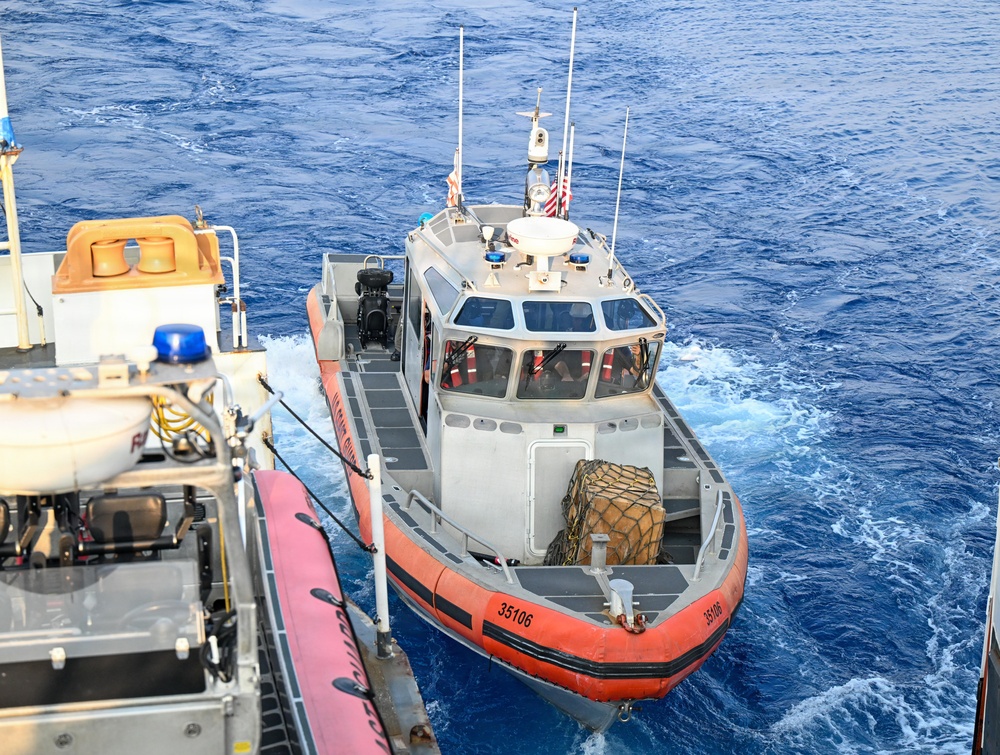
Photo by Petty Officer 3rd Class Austin Wiley, U.S. Coast Guard, via DVIDS, public domain
The State Department on Aug. 8 formally rejected China’s newly published rules for a “nature reserve” it unilaterally declared around Scarborough Shoal, calling the environmental designation a cover for what amounts to physically blocking Filipino fishermen from waters an international tribunal has already ruled China has no legal claim to. The objection matters less as a one-off statement and more as a marker of a new tactic: Beijing shifting from coast-guard patrols and water cannons toward a formal legal and administrative designation to lock in physical control of the shoal.
From water cannons to administrative rules
State Department spokesman Tommy Pigott’s statement was direct about what the US believes is really happening:
“The United States rejects China’s ongoing attempts to enforce its destabilizing ‘national nature reserve’ at Scarborough Reef and deny Filipino fishermen access to their traditional fishing ground,” Pigott said. “This is yet another unilateral attempt by China to use dubious environmental and legal pretexts, backed by coercion, to advance its sweeping territorial and maritime claims in the South China Sea at the expense of its neighbors” (The Manila Times, citing AFP, Aug. 9, 2026).
China unilaterally declared the nature reserve around Scarborough Shoal in 2025 and this week published new administrative and management rules for it, a claim of environmental stewardship that China has stated as its own official rationale. That rationale is a state claim, not independently verified, and the US statement treats it as a legal pretext rather than a genuine conservation measure. What makes the designation notable is the mechanism, not the sentiment: a “nature reserve” is a domestic legal instrument, something China can cite in future disputes to justify restricting access, inspecting vessels, or enforcing rules without invoking a maritime claim directly. It is the same physical outcome, Filipino boats kept away from the shoal, wrapped in the vocabulary of environmental regulation instead of the vocabulary of sovereignty.
A reef with a settled legal question and an unsettled reality
Scarborough Shoal sits roughly 240 kilometers, about 124 miles, from the Philippine island of Luzon, and hundreds of kilometers from the Chinese mainland, a geography that by itself makes China’s claim geographically strained. Both countries claim the reef, but the legal question was already answered a decade ago: a 2016 ruling by the Permanent Court of Arbitration in The Hague rejected China’s expansive claim to the shoal and the broader South China Sea, a ruling Beijing has never recognized and has treated as functionally void ever since. China has physically controlled Scarborough Shoal since a tense 2012 standoff with the Philippines, meaning the legal and physical situations have been at odds for close to 14 years. A “nature reserve” designation does not reopen that legal question, but it gives China a new administrative tool to entrench the physical control it already has, which is precisely the pattern the US statement is pushing back against.
The pattern behind this week’s statement
This week’s rules did not appear in a vacuum. On June 21, 2026, four Chinese warships, including a vessel identified as Warship 554, confronted the Philippine Navy frigate BRP Diego Silang near the shoal, the kind of direct naval encounter that has become a recurring feature of the dispute. Roughly a month earlier, from May 26 to 30, the Philippines and the United States ran a “Maritime Cooperative Activity” in the area that marked the first time the US Coast Guard participated in this specific joint exercise, pairing the cutter USCGC Midgett with the Philippine Navy frigate BRP Antonio Luna and the Philippine Coast Guard vessel BRP Melchora Aquino.
That exercise, WeaponSpecs covered in detail in its prior reporting on the drills, reflected a deliberate US effort to put the Coast Guard, not just the Navy, into the Philippines’ corner in these encounters, since it is Chinese coast guard and maritime militia vessels, not warships, that do most of the actual harassment of Filipino fishing boats and resupply missions. This week’s “nature reserve” rules are best read against that backdrop: a US-Philippine relationship that has moved from occasional naval patrols toward a standing coast-guard presence, met by a Chinese strategy that is itself evolving, from physical harassment toward a legal architecture designed to make that harassment look like routine environmental enforcement. WeaponSpecs’ earlier coverage of China’s Scarborough Shoal drills traced the earlier stages of that same shift.
Why the legal framing is the actual news
The sensemaking point here is not that China restricted access to a reef it already controls, it has done that for years. It is that China is now doing so through a formal domestic legal instrument rather than through ad hoc coast guard action, a change that gives Beijing a durable administrative basis to cite the next time it wants to justify boarding a fishing boat or turning back a resupply mission. That is a harder thing to walk back than a patrol pattern, and it is why the State Department chose to respond to a paperwork announcement with the same language it uses for a confrontation at sea.
Sources
- US slams Chinese actions in South China Sea — The Manila Times (AFP), Aug 9, 2026
- US slams Chinese 'nature reserve' as effort to claim South China Sea — Al Jazeera, Aug 8, 2026
Frequently asked questions
What is Scarborough Shoal and who controls it? +
A fish-rich reef about 240 kilometers off the Philippine island of Luzon and hundreds of kilometers from mainland China. Both countries claim it, but China has physically controlled it since a 2012 standoff despite a 2016 international tribunal ruling against its claim.
What did the US object to this week? +
China's newly published administrative rules for a 'nature reserve' it unilaterally declared around the shoal in 2025, which the US says are being used to block Filipino fishermen from their traditional fishing grounds.
Has this led to a military confrontation? +
Not this specific week. The most recent documented standoff was a June 21, 2026 confrontation between four Chinese warships and a Philippine Navy frigate near the shoal.
More news


