China's PLA Drills at Scarborough Shoal With Bombers, Warships
China combined PLA drills, coast guard patrols and new reserve rules at Scarborough Shoal in early August, answering Manila's UN baseline filing.

Photo by Andrei Shmatko, Wikimedia Commons, CC BY-SA 4.0
China’s PLA Southern Theater Command staged a joint naval-air exercise around Scarborough Shoal on Aug. 1, 2026, deploying H-6K bombers each carrying four YJ-12 supersonic anti-ship missiles alongside a Type 071 amphibious dock and Type 054A and Type 056A surface combatants. The drill did not arrive alone. Within the same 48 hours, China Coast Guard vessels ran a separate set of boarding-and-seizure exercises nearby, and four Chinese government agencies jointly published 16 articles of management rules for a brand-new “Huangyan Dao National Nature Reserve.” Stacked together, the three moves read less like a single show-of-force drill than an attempt to lock in Chinese control of the shoal on three tracks simultaneously: military, law enforcement and now administrative law.
What China staged on Aug. 1
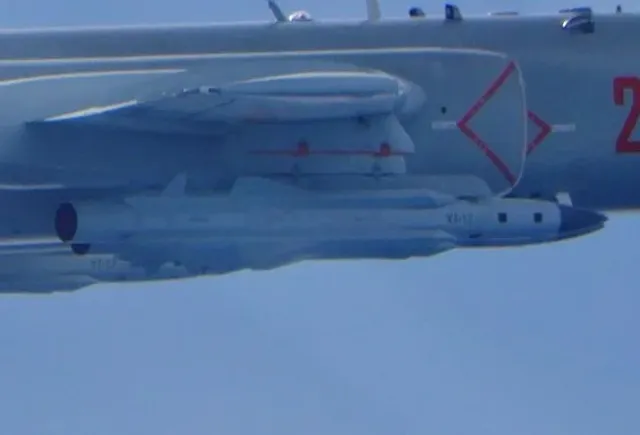
State media footage cited by Global Times, reprinted via GlobalSecurity.org, showed Xian H-6K bombers, the PLA Air Force’s primary standoff strike aircraft, flying with four YJ-12 anti-ship missiles apiece. WeaponSpecs’ own database entry for the H-6K bomber lists six hardpoints and payload capacity up to 12,000 kilograms, room to spare for that loadout. The YJ-12 missile is credited in open-source Chinese and third-party reporting with roughly 400 kilometers of range at speeds near Mach 3, figures that are unverified claims but which, if accurate, would let the bombers threaten ships well outside visual range of the shoal.
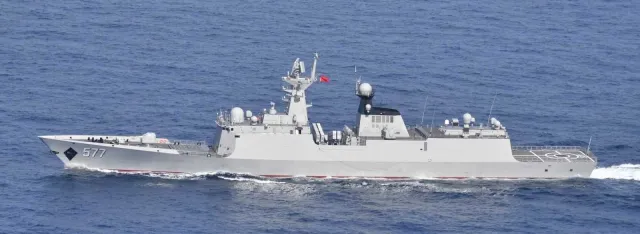
Alongside the bombers, the drill area held a Type 071 amphibious transport dock, plus Type 054A and Type 056A surface combatants providing escort and patrol coverage. WeaponSpecs tracks the Type 054A frigate as one of the PLA Navy’s most numerous general-purpose surface combatants, a workhorse that typically screens larger task groups rather than leading them, consistent with an escort role here.
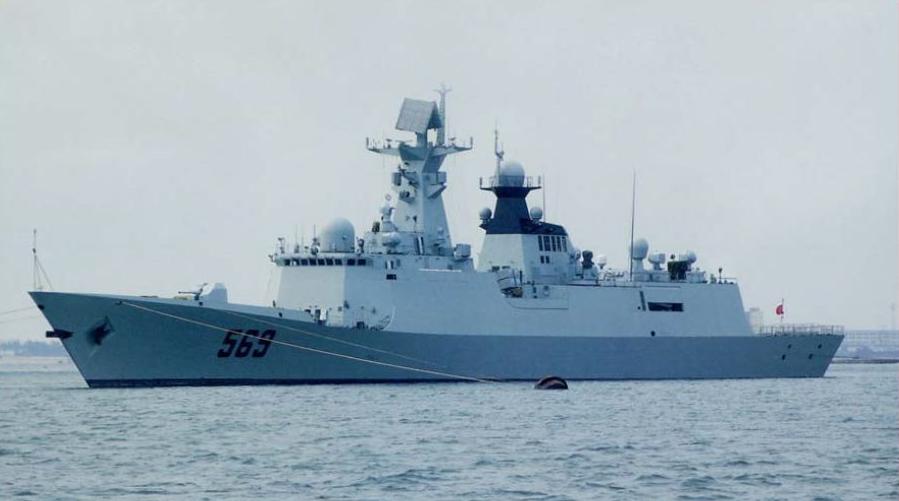
PLA Southern Theater Command’s official WeChat account called the exercise “necessary,” the Chinese military’s own characterization, not an independently verified assessment. China Coast Guard spokesperson Jiang Lue similarly described the concurrent “visit, board, search, seizure, forced-towing” drills in official terms, again China’s own account, not a neutral description.
The trigger: Manila’s UN baseline filing
The drill did not happen in a vacuum. In late July, the Philippines deposited an official nautical chart with the United Nations Secretariat establishing territorial-sea baselines around Scarborough Shoal, known to China as Huangyan Dao and to the Philippines as Bajo de Masinloc or Panatag Shoal. China’s Foreign Ministry responded that the filing was “a grave infringement” on Chinese sovereignty and “illegal, null and void,” China’s official position, not a neutral legal finding. Rather than a routine annual exercise, the Aug. 1 drill landed within days of that specific legal move, and the new nature-reserve rules followed on the very same day as the drill itself, an unusually tight administrative-military coupling.
This is also not the first friction at the shoal this summer. WeaponSpecs previously reported on the 17th US-Japan-Philippines trilateral exercise and a separate water-cannon incident that unfolded July 21-25, when Chinese vessels fired water cannons at Philippine coast guard and fisheries ships on back-to-back days. That episode was a single tactical confrontation. This one differs in kind: a distinct trigger (the UN filing, not the water cannons), different assets (bombers and an amphibious dock, not coast guard cutters), and a legal-administrative layer the July episode did not have.
Who actually controls Scarborough Shoal
Scarborough Shoal sits roughly 220 kilometers from the Philippine coast, within its exclusive economic zone under the UN Convention on the Law of the Sea. A 2016 ruling by the Permanent Court of Arbitration rejected China’s historical claim to the area. China does not recognize that ruling and has controlled the surrounding waters since a 2012 standoff, a state claim about its own rights there, not an independently settled legal fact.
A layered playbook, not an isolated drill
Chinese commentators quoted exclusively through Global Times framed the drill as part of something more durable than a single exercise. Song Zhongping, described as a “Chinese military affairs expert,” said the drills demonstrate the PLA’s ability to respond quickly to perceived provocations, a comment relayed through state media, not independent analysis. Ding Duo, of the state-affiliated National Institute for South China Sea Studies, and Yang Xiao, of the Chinese Academy of Social Sciences, both described the combination of military, coast guard and administrative measures as evidence of “a more regular and coordinated framework.” Both were quoted exclusively via Global Times and both work at state-affiliated institutions, so their comments read as state-media-relayed commentary, not independent assessment.
That framing matches what happened on the ground: a military drill, a coast guard boarding exercise, and a new 16-article nature-reserve regulation, issued by four government agencies the same day, each reinforcing a different form of control over the same water. Any one alone might pass as routine. Together, in a 48-hour window timed days after Manila’s UN filing, they read as coordinated escalation rather than coincidence.
The risk is not that either side wants a shooting war over a shoal, but that repeated layering of pressure narrows the room for de-escalation the next time an incident turns physical, as July’s water-cannon confrontations already showed it can. Secretary of State Marco Rubio addressed the broader stakes of US-China friction in a late-July interview, before this episode but describing exactly the risk a steadily escalating pattern around a contested shoal keeps testing.
“Any conflict between the U.S. and China, be it economic or be it military, God forbid, would be catastrophic for both countries and for the world,” said Secretary of State Marco Rubio, in an interview aired on Fox News’ “My View with Lara Trump” (U.S. Department of State, July 28, 2026).
Sources
- Exclusive: H-6K bomber carrying YJ-12 supersonic anti-ship missiles involved in PLA drills around Huangyan Dao — Global Times (via GlobalSecurity.org), Aug 1, 2026
- China strengthens Huangyan Dao control through PLA, CCG drills, reserve rules — Global Times (via GlobalSecurity.org), Aug 2, 2026
- PLA and coastguards stage South China Sea drills days after Philippine territorial bid — South China Morning Post, Aug 2, 2026
- Chinese PLA conducts exercise focusing on realistic training subjects at Huangyan Dao — GlobalSecurity.org, Aug 2, 2026
- Secretary of State Marco Rubio On Fox News Channel's 'My View with Lara Trump' — U.S. Department of State, Jul 28, 2026
Systems mentioned
Every system named in this story, with its photo and, where available, a video. Tap a card to open the full spec sheet.
Compare these side by side →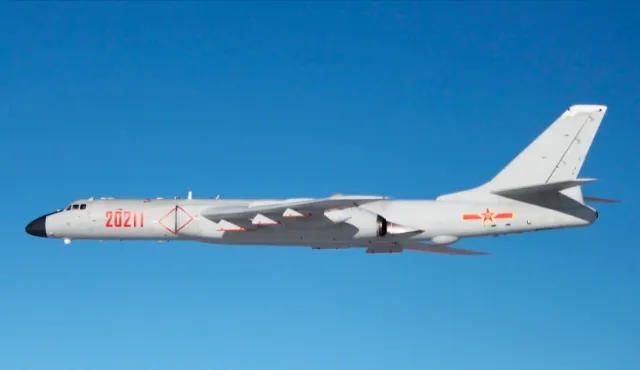
Frequently asked questions
What triggered China's Aug. 1 drills at Scarborough Shoal? +
The Philippines deposited an official nautical chart establishing territorial-sea baselines around Huangyan Dao/Scarborough Shoal with the UN Secretariat in late July. China's Foreign Ministry called it a grave infringement on its sovereignty, and the PLA responded with the exercise days later.
What forces did China deploy? +
State media footage showed H-6K bombers each armed with four YJ-12 anti-ship missiles, plus a Type 071 amphibious transport dock and Type 054A and Type 056A surface combatants, according to PLA statements relayed by Global Times.
Who actually controls Scarborough Shoal? +
A 2016 international tribunal ruling rejected China's historical claim, and the shoal sits within the Philippines' UNCLOS-defined exclusive economic zone. China has controlled the surrounding waters since a 2012 standoff and does not recognize the ruling, a position that is China's own state claim, not an independently settled legal fact.
Is this an isolated incident? +
No. Experts cited in Chinese state media describe it as part of a more regular and coordinated framework combining military drills, coast guard law enforcement and new administrative rules, following a July 21-25 US-Japan-Philippines exercise and a separate water-cannon incident WeaponSpecs already covered on July 26, 2026.
More news


