Rifle Range Has Almost Nothing to Do With Bullet Speed
Across 76 database rifles, velocity and range correlate at just r=0.375. The fastest rifle in the sample, the Mini-14, has one of the shortest ranges.

U.S. Army photo by Davide Dalla Massara, Public domain
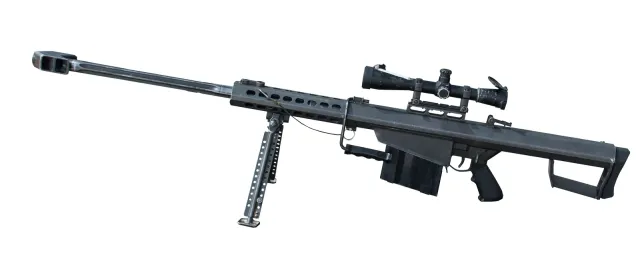
The 990 m/s Ruger Mini-14 has the highest muzzle velocity of any rifle in the WeaponSpecs database, faster than every service rifle, every machine gun, and every anti-materiel rifle we track. Its published effective range is 183 m, one of the shortest in the entire 76-rifle sample, ahead of only two 12-gauge shotguns at 40 m. The Barrett M82, by contrast, fires its .50 BMG round 137 m/s slower, at 853 m/s, yet reaches 1,800 m, nearly ten times farther. Across the whole sample, muzzle velocity and effective range correlate at just r=0.375, a weak relationship for a figure most buyers assume is the whole story.
Does a Faster Bullet Really Reach Farther?
Not in this dataset. We pulled every rifle-type system in the WeaponSpecs database that publishes both performance.muzzleVelocityMs and performance.effectiveRangeM, 76 systems in total, and ran the correlation. One system, the South Korean K11, an unusual 20mm airburst-grenade launcher paired with a 5.56mm rifle barrel, was excluded from that calculation and from the caliber-class breakdown below as a flagged non-comparable outlier: it isn’t a conventional rifle caliber, and folding its 20mm grenade performance into a rifle-bullet analysis would distort both numbers. Across the remaining 75, the correlation between muzzle velocity and effective range is r=0.375. That is a positive relationship, faster does trend toward farther, but it is a weak one. Roughly 86% of the variation in effective range across these rifles has nothing to do with how fast the bullet leaves the barrel.
The scatter below plots a representative slice of that sample. The orange cluster of intermediate-caliber service rifles sits at some of the highest velocities in the entire database, yet lands low on range. The gold magnum and anti-materiel points, slower or similar in velocity, sit far higher.
Muzzle velocity and effective range correlate at only r=0.375 across the 75 rifles plotted here (one further system, the K11 airburst hybrid, is excluded as a non-comparable outlier). The orange cluster of intermediate 5.45-6.8mm service rifles sits at some of the highest velocities in the database, 900-990 m/s, yet lands in the lower third of the chart on range. The gold magnum and anti-materiel points span a similar or lower velocity band but reach two to four times farther. Velocity explains almost none of that gap; bullet mass and cartridge design explain most of it.
The two systems that anchor this chart, the Ruger Mini-14 and the Barrett M82, sit at opposite corners for a reason worth stating plainly: the Mini-14 is a light, semi-automatic 5.56mm-class carbine built for civilian and light-infantry use at modest distances, while the M82 is a 12.7mm anti-materiel rifle built specifically to put a heavy, aerodynamically efficient bullet on target at ranges where the Mini-14’s round has long since run out of energy. Comparing their muzzle velocities alone answers a question nobody who buys either rifle is actually asking.
Why the Fastest Rifle in the Database Has One of the Shortest Ranges
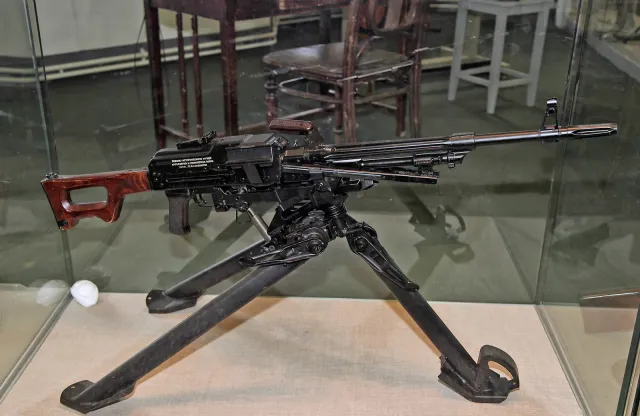
A cleaner, more apples-to-apples pair makes the same point without crossing into anti-materiel territory. The PKM, a Soviet-designed 7.62x54mm general-purpose machine gun, fires at 825 m/s and reaches a published effective range of 1,000 m. The M4A1 carbine, the standard US service rifle for a generation, fires faster, at 884 m/s, and yet its published effective range is 500 m, half the PKM’s figure. The PKM’s round leaves the barrel more slowly and still travels twice as far before it stops being considered effective. Velocity moved in the wrong direction for the “faster is farther” intuition to hold.
Grouping the whole dataset by caliber class sharpens the pattern further. These are medians computed directly from the database, n=75 rifles (K11 excluded):
| Caliber class | n | Median effective range (m) | Median muzzle velocity (m/s) |
|---|---|---|---|
| Magnum .338 (8.6mm) | 3 | 1,200 | 905 |
| Full-power 7.62mm | 21 | 600 | 800 |
| Intermediate 5.45-5.8mm | 39 | 500 | 920 |
| 6.8mm NGSW (XM7, SIG M250) | 2 | 700 | 929.5 |
| PDW/SMG (9/4.6/5.7mm) | 6 | 200 | 415 |
The intermediate 5.45-5.8mm class is the largest bucket by far, 39 of the 75 rifles, and it posts one of the highest median velocities in the whole table, 920 m/s, while landing at one of the lowest median ranges, 500 m. If velocity drove range, this would be the longest-reaching class in the dataset. Instead it is near the bottom, beaten even by the smaller 6.8mm NGSW group and comfortably beaten by every 7.62mm and magnum class above it. At the extremes, the anti-materiel and shotgun-bore systems bracket the entire chart: the M200 Intervention (10.4mm) posts 2,000 m at 975 m/s, and 12-gauge shotguns post 40 m at 400 m/s, a thousand-fold difference in stated range between two calibers whose muzzle velocities differ by less than 60%.
What Actually Drives Effective Range, If Not Speed
The answer sitting underneath all of this is bullet mass, caliber, and aerodynamic design, in short, how well a bullet retains its velocity and energy as it travels, rather than how fast it started. A heavier, higher-sectional-density bullet, the kind fired by anti-materiel .50 BMG rifles or magnum .338 Lapua sniper rifles, sheds velocity and energy far more slowly downrange than a light, fast intermediate-caliber round, even when the intermediate round leaves the muzzle faster. The intermediate round was never designed to solve that problem. It was designed for close-quarters and maneuver-warfare use: light enough to carry hundreds of rounds, controllable enough to fire on automatic, optimized for a fight that happens well inside its effective range.
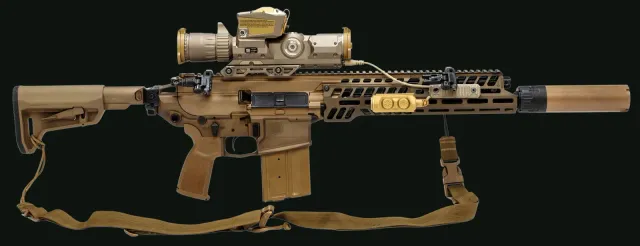
This is exactly the tradeoff that pushed the US Army to develop the 6.8mm Common Cartridge and field it in the XM7 rifle and SIG Sauer M250 automatic rifle under the Next Generation Squad Weapon program. The Army’s own reasoning was that 5.56mm had reached a performance ceiling, not enough mass behind the bullet to do what a modern rifle round needs to do at range and against body armor.
“The challenge of the 5.56mm is that it doesn’t have enough mass… The right solution is somewhere between the two, where you have enough mass to penetrate but you’re still moving fast enough,” said Col. Geoffrey A. Norman, Force Development Division Chief at Army Headquarters (Task & Purpose).
That is the thesis of this entire dataset compressed into one sentence from the people who buy rifles for a living: mass and design, not raw speed, are what buy range and terminal performance. Other Army leaders, including Brig. Gen. William Boruff and then-Chief of Staff Gen. Mark Milley, separately described the 5.56mm cartridge as having hit a penetration and range ceiling against modern body armor, which is part of what drove the search for a 6.8mm replacement in the first place. In the database, that logic shows up numerically: the two NGSW-class rifles post a 700 m median effective range against a 929.5 m/s median velocity, both figures higher than the legacy 5.56mm intermediate class, evidence of a cartridge built to add mass without giving up much speed at all.
Note also that most Russian- and Chinese-origin figures in the ranked list below, the AK-series and QBZ-series rifles in particular, are manufacturer or state-published catalog specifications rather than independently, third-party flight-tested results. That is a standard caveat for unclassified small-arms specs, not an assertion that these numbers are exaggerated, but it is worth remembering that a 400 m AK-74 figure and a 400 m FAMAS figure were not necessarily arrived at the same way.
The Full Ranked List
All 76 rifle-type systems in the WeaponSpecs database that publish both fields, sorted by effective range, descending.
| Rifle | Country | Caliber class | Muzzle velocity (m/s) | Effective range (m) |
|---|---|---|---|---|
| M200 Intervention | United States | Anti-materiel 10.4mm | 975 | 2000 |
| M82 | United States | Anti-materiel .50cal (12.7mm) | 853 | 1800 |
| ORSIS T-5000 | Russia | Magnum .338 (8.6mm) | 830 | 1500 |
| TRG-42 | Finland | Magnum .338 (8.6mm) | 905 | 1200 |
| MG3 | Germany | Full-power 7.62mm | 820 | 1200 |
| Arctic Warfare Magnum (AWM) | United Kingdom | Magnum .338 (8.6mm) | 936 | 1100 |
| M240 | Belgium | Full-power 7.62mm | 853 | 1100 |
| PKM | Soviet Union | Full-power 7.62mm | 825 | 1000 |
| M249 SAW | Belgium | Intermediate 5.45-5.8mm | 915 | 800 |
| Negev | Israel | Intermediate 5.45-5.8mm | 915 | 800 |
| SIG Sauer M250 | United States | 6.8mm NGSW | 914 | 800 |
| RPK-16 | Russia | Intermediate 5.45-5.8mm | 900 | 800 |
| SVD | Russia | Full-power 7.62mm | 830 | 800 |
| SR-25 | United States | Full-power 7.62mm | 823 | 800 |
| HK417 | Germany | Full-power 7.62mm | 800 | 800 |
| M110 SASS | United States | Full-power 7.62mm | 792 | 800 |
| AN-94 Abakan | Russia | Intermediate 5.45-5.8mm | 900 | 700 |
| XM7 | United States | 6.8mm NGSW | 945 | 600 |
| M16A4 | United States | Intermediate 5.45-5.8mm | 930 | 600 |
| AEK-971 | Russia | Intermediate 5.45-5.8mm | 890 | 600 |
| M27 IAR | Germany | Intermediate 5.45-5.8mm | 880 | 600 |
| ARX-200 | Italy | Full-power 7.62mm | 850 | 600 |
| Tavor 7 | Israel | Full-power 7.62mm | 850 | 600 |
| FAL | Belgium | Full-power 7.62mm | 840 | 600 |
| FN SCAR-H | Belgium | Full-power 7.62mm | 840 | 600 |
| MPT-76 | Turkey | Full-power 7.62mm | 810 | 600 |
| G28 | Germany | Full-power 7.62mm | 800 | 600 |
| AUG A3 | Austria | Intermediate 5.45-5.8mm | 970 | 500 |
| CZ 805 BREN | Czech Republic | Intermediate 5.45-5.8mm | 920 | 500 |
| CZ BREN 2 | Czech Republic | Intermediate 5.45-5.8mm | 920 | 500 |
| G36 | Germany | Intermediate 5.45-5.8mm | 920 | 500 |
| Galil ACE | Israel | Intermediate 5.45-5.8mm | 920 | 500 |
| HK433 | Germany | Intermediate 5.45-5.8mm | 920 | 500 |
| K11 | South Korea | Airburst/rifle hybrid (20mm+5.56mm, flagged outlier) | 920 | 500 |
| F2000 | Belgium | Intermediate 5.45-5.8mm | 915 | 500 |
| Tavor TAR-21 | Israel | Intermediate 5.45-5.8mm | 910 | 500 |
| AK-12 | Russia | Intermediate 5.45-5.8mm | 900 | 500 |
| MCX Spear LT | United States | Intermediate 5.45-5.8mm | 900 | 500 |
| MPT-55 | Turkey | Intermediate 5.45-5.8mm | 900 | 500 |
| ARX-160 | Italy | Intermediate 5.45-5.8mm | 895 | 500 |
| M4A1 | United States | Intermediate 5.45-5.8mm | 884 | 500 |
| SCAR-L | Belgium | Intermediate 5.45-5.8mm | 880 | 500 |
| SIG516 | United States | Intermediate 5.45-5.8mm | 880 | 500 |
| HK416 A5 | Germany | Intermediate 5.45-5.8mm | 850 | 500 |
| G3 | Germany | Full-power 7.62mm | 800 | 500 |
| AR70/90 | Italy | Intermediate 5.45-5.8mm | 950 | 460 |
| K2 | South Korea | Intermediate 5.45-5.8mm | 920 | 460 |
| FNC | Belgium | Intermediate 5.45-5.8mm | 965 | 400 |
| FAMAS | France | Intermediate 5.45-5.8mm | 960 | 400 |
| L85A3 | United Kingdom | Intermediate 5.45-5.8mm | 940 | 400 |
| L85A3 (SA80A3) | United Kingdom | Intermediate 5.45-5.8mm | 940 | 400 |
| QBZ-03 | China | Intermediate 5.45-5.8mm | 930 | 400 |
| QBZ-191 | China | Intermediate 5.45-5.8mm | 930 | 400 |
| QBZ-95 | China | Intermediate 5.45-5.8mm | 930 | 400 |
| Type 89 | Japan | Intermediate 5.45-5.8mm | 920 | 400 |
| StGw 90 | Switzerland | Intermediate 5.45-5.8mm | 920 | 400 |
| Tavor X95 | Israel | Intermediate 5.45-5.8mm | 920 | 400 |
| AK-19 | Russia | Intermediate 5.45-5.8mm | 900 | 400 |
| AK-74 | Russia | Intermediate 5.45-5.8mm | 900 | 400 |
| AK-74M | Russia | Intermediate 5.45-5.8mm | 900 | 400 |
| M70 | Yugoslavia | Full-power 7.62mm | 720 | 400 |
| AK-103 | Russia | Full-power 7.62mm | 715 | 400 |
| AK-15 | Russia | Full-power 7.62mm | 715 | 400 |
| vz. 58 | Czechoslovakia | Full-power 7.62mm | 710 | 400 |
| AK-47 | Russia | Full-power 7.62mm | 715 | 350 |
| AKM | Russia | Full-power 7.62mm | 715 | 350 |
| Type 56 | China | Full-power 7.62mm | 710 | 350 |
| MP7 | Germany | PDW/SMG (9/4.6/5.7mm) | 725 | 200 |
| P90 | Belgium | PDW/SMG (9/4.6/5.7mm) | 715 | 200 |
| MP5 | Germany | PDW/SMG (9/4.6/5.7mm) | 400 | 200 |
| Uzi | Israel | PDW/SMG (9/4.6/5.7mm) | 400 | 200 |
| Mini-14 | United States | Intermediate 5.45-5.8mm | 990 | 183 |
| Scorpion EVO 3 | Czech Republic | PDW/SMG (9/4.6/5.7mm) | 430 | 150 |
| APC9 | Switzerland | PDW/SMG (9/4.6/5.7mm) | 400 | 150 |
| M4 | Italy | Shotgun-bore (18.5mm) | 400 | 40 |
| 870 | United States | Shotgun-bore (18.5mm) | 400 | 40 |
What This Means If You’re Reading a Rifle Spec Sheet
Muzzle velocity is easy to compare across a brochure page and it feels like it should matter, so it gets top billing in a lot of marketing copy. This dataset says treat it as a secondary figure. If effective range is what you actually care about, look at caliber class and bullet mass first, the intermediate 5.45-5.8mm rifles that dominate modern infantry inventories cluster at 400-500 m almost regardless of which country built them, and no amount of extra velocity within that class buys meaningfully more range. If a rifle needs to reach beyond that, the database says the answer is a heavier bullet and a different caliber entirely, not a faster version of the same one.
You can pull this comparison yourself, side by side, for any two rifles in the database using WeaponSpecs’ compare tool, or browse the full rifle type page to see where a specific system lands against the rest of the field.
Sources
Systems in this comparison
Every system covered above, with its photo and, where available, a video. Tap a card to open the full spec sheet.
Compare these side by side →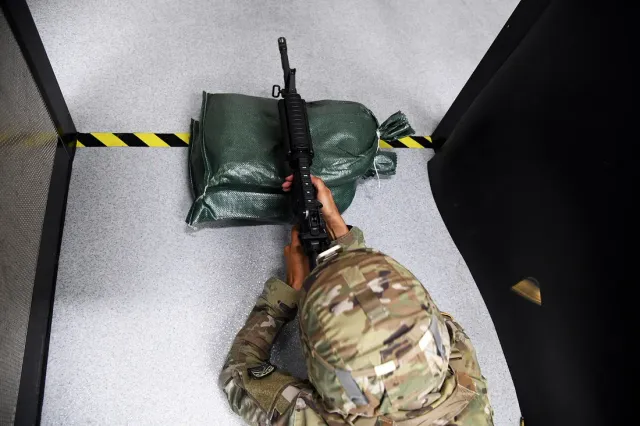


Frequently asked questions
Does a higher muzzle velocity mean a rifle can hit targets farther away? +
Not reliably. Across the 76 rifles in the WeaponSpecs database that publish both figures, muzzle velocity and effective range correlate at only r=0.375. The Ruger Mini-14 has the highest muzzle velocity in the sample, 990 m/s, and one of the shortest effective ranges, 183 meters, while the slower 853 m/s Barrett M82 reaches 1,800 meters, nearly ten times farther.
Why does the Barrett M82 outrange the Ruger Mini-14 despite firing slower? +
The M82 fires a far heavier, higher-sectional-density .50 BMG (12.7mm) bullet built to retain velocity and energy over long distances, while the Mini-14's 5.56mm-class round is light and fast by design, optimized for close-range maneuverability and low recoil rather than downrange reach. Effective range is set mainly by bullet mass, caliber, and aerodynamic design, not by how fast the round leaves the barrel.
What is the US Army's XM7 (NGSW) 6.8mm cartridge trying to fix? +
The Next Generation Squad Weapon program replaced part of the 5.56mm M4/M249 family with a 6.8mm Common Cartridge because the Army concluded 5.56mm had reached a performance ceiling against body armor and at extended range. Army officials, including Col. Geoffrey A. Norman, have framed the fix as adding bullet mass without losing velocity, splitting the difference between a light, fast round and a heavy, slow one.
Why do so many 5.56mm rifles publish the exact same 400m or 500m effective range? +
These figures are typically doctrinal, cartridge-class numbers rather than individually flight-tested results for each rifle. In the database, 39 intermediate-caliber (5.45-5.8mm) rifles cluster tightly around a 500m median effective range regardless of which country or manufacturer built them, because the number describes what the 5.56mm-class cartridge can do, not a property unique to any one weapon.
Is 7.62mm always a longer-range round than 5.56mm? +
Only modestly, and role matters more than caliber class. Full-power 7.62mm rifles in the database post a 600m median effective range versus 500m for intermediate 5.45-5.8mm rifles, a real but not enormous gap. Magnum .338 and anti-materiel .50-caliber rifles far exceed both, showing that caliber family alone is a weaker predictor of range than the specific cartridge and role a rifle was built for.
Related reading


