Same 5.56mm NATO Round, Wildly Different Range Claims
26 rifles firing the same 5.56x45mm NATO round publish effective ranges from 400 to 600 meters, and the fastest ones don't claim the longest reach.

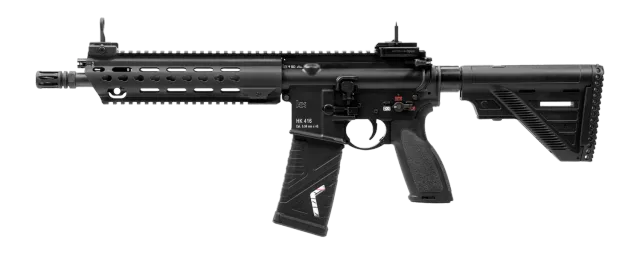
Heckler & Koch, official product render
Twenty-six rifle designs in WeaponSpecs’ database fire the identical, standardized 5.56x45mm NATO round. Their published effective ranges span 400m to 600m, a 200-meter, 50 percent spread, for one cartridge. It is not the ammunition. It is the definition of “effective range” itself, and that definition is doctrine, not physics.
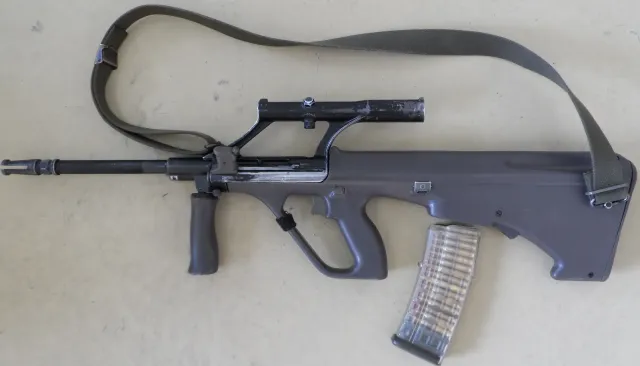
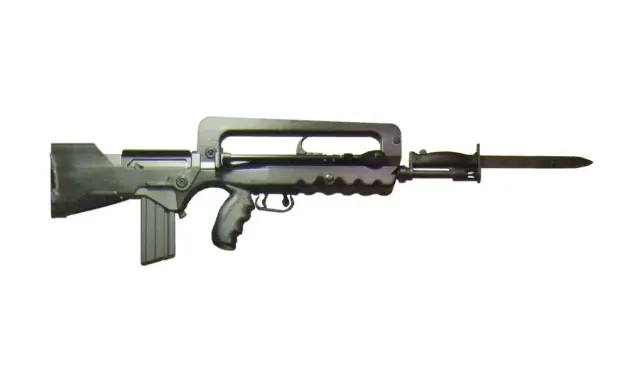
That’s the finding worth sitting with before the numbers below. Muzzle velocities across these 26 rifles cluster tightly, 850 to 970 m/s, a variance of barely 14 percent. Claimed effective range does not track that variance at all. If anything it moves the other way: velocity and claimed range correlate weakly negative across the set, r is about -0.39. The fastest rifle in the database, Austria’s AUG A3 at 970 m/s, claims the same 500m as Germany’s HK416 A5 at 850 m/s, the slowest gun on the list. The two fastest rifles of all, Belgium’s FNC at 965 m/s and France’s FAMAS at 960 m/s, both cap out at 400m, the shortest range band in the entire dataset. A buyer reading spec sheets alone would guess the opposite.
Which 5.56mm NATO rifles publish the longest and shortest effective range?
Sorted by claimed effective range, then muzzle velocity, all 26 rifles chambered in 5.56x45mm NATO that publish both figures in our database:
| Rifle | Country | Muzzle Velocity (m/s) | Effective Range (m) | Barrel (mm) | Year |
|---|---|---|---|---|---|
| M16A4 | United States | 930 | 600 | 508 | 1998 |
| M27 IAR | Germany | 880 | 600 | 419 | 2010 |
| AUG A3 | Austria | 970 | 500 | 508 | 1997 |
| CZ 805 BREN | Czech Republic | 920 | 500 | 360 | 2010 |
| CZ BREN 2 | Czech Republic | 920 | 500 | 360 | 2016 |
| G36 | Germany | 920 | 500 | 480 | 1997 |
| Galil ACE | Israel | 920 | 500 | 460 | 2008 |
| HK433 | Germany | 920 | 500 | 368 | 2017 |
| F2000 | Belgium | 915 | 500 | 400 | 2001 |
| Tavor TAR-21 | Israel | 910 | 500 | 460 | 2001 |
| MCX Spear LT | United States | 900 | 500 | 355 | 2022 |
| MPT-55 | Turkey | 900 | 500 | 405 | 2020 |
| ARX-160 | Italy | 895 | 500 | 445 | 2008 |
| M4A1 | United States | 884 | 500 | 370 | 1994 |
| SCAR-L | Belgium | 880 | 500 | 355 | 2009 |
| SIG516 | United States | 880 | 500 | 406 | 2010 |
| HK416 A5 | Germany | 850 | 500 | 368 | 2013 |
| AR70/90 | Italy | 950 | 460 | 450 | 1990 |
| K2 | South Korea | 920 | 460 | 465 | 1984 |
| FNC | Belgium | 965 | 400 | 449 | 1979 |
| FAMAS | France | 960 | 400 | not disclosed | 1978 |
| L85A3 | United Kingdom | 940 | 400 | 518 | 2018 |
| Type 89 | Japan | 920 | 400 | 420 | 1989 |
| StGw 90 | Switzerland | 920 | 400 | 528 | 1990 |
| Tavor X95 | Israel | 920 | 400 | 355 | 2009 |
| AK-19 | Russia | 900 | 400 | 415 | 2019 |
The M16A4 and M27 IAR tie for the top claim at 600m. Neither is the fastest rifle on the list, and the M27’s 880 m/s is squarely mid-pack. Eleven rifles cluster at exactly 500m, spanning a 120 m/s velocity range among themselves. Six sit at the 400m floor, and that group includes the two highest muzzle velocities in the entire table.
Does a faster round mean it reaches farther?
Not in this dataset, and the scatter below is the whole argument in one picture.
Every dot on this chart fires the same 5.56x45mm NATO round. If velocity drove range, the chart would trend up and to the right. It does not: the fastest design (AUG A3, top right of the middle row) sits level with the slowest (HK416 A5, far left of the same row), and the two fastest rifles overall, FNC and FAMAS, land in the bottom row with the shortest claimed range.
If the round’s ballistics set the number, the dots would climb left to right. They don’t climb at all, and the weak downward tilt (r is about -0.39) says the opposite trend is closer to true than a flat line would be. That is not a physics result. A cartridge does not get worse at 970 m/s than it is at 850 m/s. What changes between these 26 rifles is not the bullet, it is the standard each country’s small arms program used to define “effective,” and how much of that standard rests on the sighting system bolted to the receiver rather than the receiver itself.
What about barrel length?
Barely a factor either. Across the 25 rifles in the database that disclose both figures, barrel length and claimed effective range correlate at r of about -0.11, close enough to zero that it rules out barrel length as the hidden variable. A shorter barrel does cost some velocity at the muzzle, but the effect is small across the narrow 355mm to 528mm range these rifles actually span, and it plainly is not driving who claims 400m and who claims 600m. The M16A4’s 508mm barrel and the M27 IAR’s shorter 419mm barrel both land at the same 600m top claim. The correlation data closes off the two most obvious physical explanations, velocity and barrel length, in the same dataset.
So what is “effective range” actually measuring?
It’s measuring a doctrine, not a distance. Effective range is not a fixed physical limit where a bullet suddenly stops being lethal, it is a hit-probability threshold set by whoever wrote the testing standard. U.S. military doctrine, for instance, defines it around a stated probability of hitting a given target type at a given distance, and that probability assumption, not the cartridge, is what a manufacturer or defense ministry is actually publishing when it prints a range figure on a spec sheet. Change the assumed shooter skill, the assumed optic, or the assumed target size, and the published number moves with it, even though the barrel and the round in the chamber haven’t changed at all.
“A Soldier must be able to engage the threat he’s faced with, whether it’s at eight meters or 800,” said Lt. Col. Henthorn, small arms division chief at the Maneuver Center of Excellence, Fort Benning, Georgia. “Squads need a diverse capability that allows them to maximize their effectiveness in any operating environment.”
That framing, an engagement-capability question rather than a fixed-distance one, is exactly why a published “effective range” number on a spec sheet can vary by 200 meters for the identical round: it is describing a doctrine’s answer to “how far should this squad be able to reach,” not a physical limit of the cartridge.
That the round itself is not the variable is the other half of the story. The 5.56x45mm NATO cartridge is standardized under STANAG 4172 across NATO and NATO-interoperable forces specifically so that ammunition and, in principle, terminal performance are interchangeable between allied rifles. All 26 of these designs draw from that same standardized case, propellant charge, and projectile family. If the cartridge is standardized and the muzzle velocities barely vary, the only place left for a 200-meter, 50 percent range spread to come from is the definition applied on top of the hardware, national testing doctrine, assumed optics, assumed shooter proficiency, not the ammunition anyone is actually firing.
The takeaway for a spec sheet reader
A published “effective range” figure tells you what standard a country’s small arms program used when it wrote the number down. It does not tell you, on its own, how one rifle’s reach compares to another’s when the round is held constant, because in this dataset it demonstrably does not track the one variable that is pure physics. Treat the figure as a doctrine label, verify what hit-probability and target-size assumptions sit behind it before using it to rank rifles, and don’t assume a higher number means a faster or better gun. Browse the full rifle category to see how these 26 fit alongside the rest of the field, or build your own side-by-side in the comparison tool before drawing a procurement conclusion from a single spec cell.
Sources
Systems in this comparison
Every system covered above, with its photo and, where available, a video. Tap a card to open the full spec sheet.
Compare these side by side →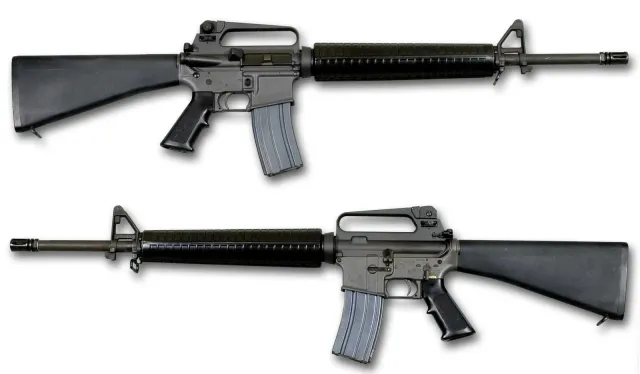
Frequently asked questions
What does "effective range" actually mean for a rifle? +
It is a doctrine-defined, hit-probability standard, not a fixed physical distance. U.S. military doctrine defines it around a stated probability of hitting a given target type at a given distance, and that assumption, plus sights, optics, and shooter skill, does more to set the published number than the cartridge's raw ballistics.
Why do rifles firing the identical 5.56x45mm NATO round publish different effective ranges? +
Per WeaponSpecs' database, 26 rifle designs chambered in the standardized 5.56x45mm NATO round (STANAG 4172) publish effective ranges from 400m to 600m, a 200-meter spread for an identical cartridge. The variance tracks national testing doctrine and assumed sighting systems, not the round itself.
Does a faster muzzle velocity mean a rifle can hit farther? +
Not in this dataset. Across the 26 5.56mm designs, muzzle velocity and claimed effective range correlate weakly negative (r is about -0.39). The fastest rifle in the database, the AUG A3 at 970 m/s, claims the same 500m range as the HK416 A5 at 850 m/s, and the two fastest rifles overall, FNC and FAMAS, both cap out at 400m, the shortest band in the dataset.
Which 5.56mm NATO rifle in the database claims the longest effective range? +
The M16A4 and the M27 IAR both top the list at 600m, tied for the longest published range among the 26 5.56mm designs tracked in the WeaponSpecs database.
Does barrel length explain the range difference instead? +
Barely. Barrel length and claimed effective range correlate at r of about -0.11 across the 25 rifles with both figures disclosed, close to no relationship at all, which rules out barrel length as the driver too.
Related reading


