NATO's Baltic Trust 26 Drills Fuse Radar, Jammers Against Drones
650 troops from NATO, Ukraine, Australia and Japan test layered counter-drone defenses in Latvia through Aug 14, under NATO's counter-UAS drive.

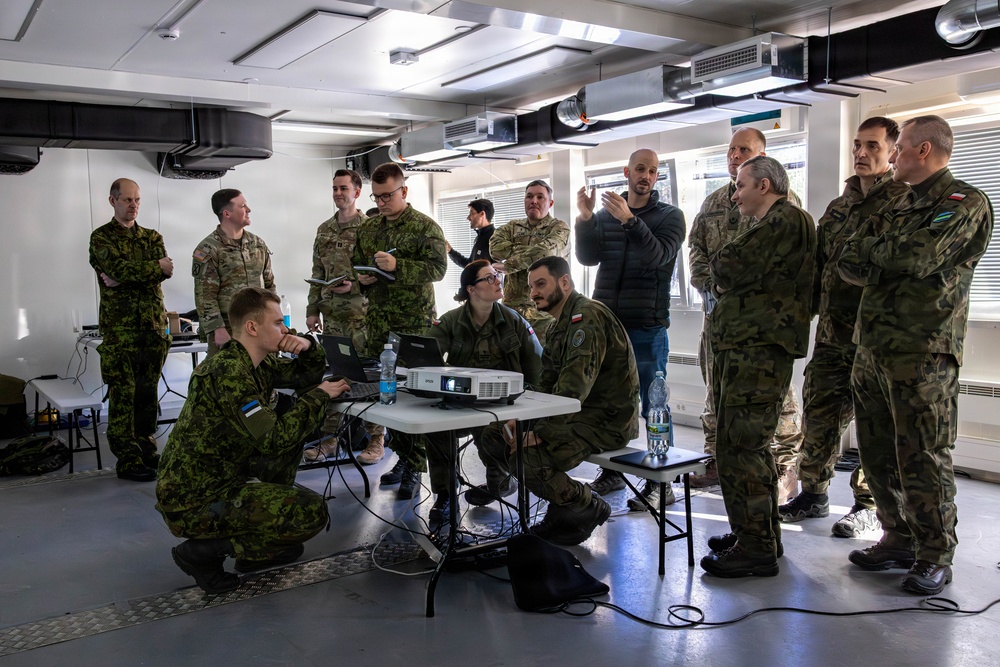
U.S. Army photo by Spc. Gabriel Martinez, DVIDS, Public Domain
Roughly 650 troops, technical specialists and industry representatives from NATO members plus Ukraine, Australia and Japan are running a two-week counter-drone exercise at the Sēlija military training range in southern Latvia, testing whether radar, jammers and kinetic defenses from different nations and vendors can work together against a single drone threat rather than each covering it alone. Baltic Trust 26 runs August 3 through 14, jointly organized by the Latvian National Armed Forces and NATO’s Communications and Information Agency.
What the exercise is actually testing
Baltic Trust 26 brings together military personnel, technical specialists and industry representatives from Latvia, other NATO member states, and partner countries Ukraine, Australia and Japan, alongside industry representatives from several EU countries, according to LSM’s reporting on the drill. The core exercise design integrates detection systems, radar, radio-frequency sensors and cameras, with defeat systems, electronic jammers and kinetic suppression, treating the two halves of the counter-drone problem as one fused system rather than testing any single piece of equipment in isolation. That interoperability focus is the point: a nation’s radar picking up a drone is only useful if it can hand that track to another nation’s jammer or interceptor in time to act on it, and past exercises in this series have specifically probed where that handoff breaks down between different vendors’ equipment. The exercise is also explicitly designed to address massed or swarm drone attacks, not just single intruders, per Unmanned Airspace’s coverage of preparatory testing ahead of the August drill.
Baltic Trust runs under NATO Allied Command Transformation’s Layered Counter-UAS Initiative, known as LCI-X, a standing program of linked exercises meant to accelerate fielding counter-drone technology across the alliance. Earlier 2026 iterations under the same initiative, branded “Crucible,” were held in Romania and Finland, per NATO’s own event listing for BATT26. Baltic Trust itself is an annual fixture rather than a one-off response, with a 2025 edition having run the year before.
The regional pressure behind it
This exercise sits on top of a live security problem the Baltic states have already been managing on their own. Drone incursions from Russian-adjacent airspace into Estonia, Latvia and Lithuania have recurred through 2025 and 2026, with at least 24 tracked incidents according to Novaya Gazeta Europe reporting cited in preparatory coverage of the exercise. That pattern had already pushed Latvia to deploy mobile drone-interceptor units to its eastern border in May 2026, a unilateral national response that predates this alliance-level drill. Baltic Trust 26 is best read as NATO’s collective answer to a threat its eastern member states have largely been handling separately until now, an attempt to turn several countries’ individual counter-drone purchases into one coordinated layered defense rather than a patchwork of systems that may not interoperate under real conditions.
The inclusion of Ukraine, Australia and Japan, none of them NATO members, signals this is meant as a coalition-wide interoperability effort rather than a purely European drill. Ukraine’s presence in particular is meant to feed three years of drone-war lessons directly into NATO doctrine and vendor testing, since few militaries anywhere have more sustained real-world experience defending against mass drone attacks than Ukraine’s own air-defense units have accumulated since 2022.
Sources
- International drone defence exercise to take place in Latvia — LSM (Latvian Public Broadcasting), Jul 31, 2026
- NATO tests C-UAS tech and concepts ahead of Baltic Trust exercise in August — Unmanned Airspace
- Baltic Trust (BATT26) event listing — NATO
Frequently asked questions
Is Baltic Trust 26 a response to a specific drone attack? +
Not one specific incident. It is the alliance-level answer to a pattern of dozens of drone incursions into Baltic airspace since early 2025, a pattern that had already pushed Latvia to deploy its own mobile interceptor units to its eastern border in May 2026.
Why does this exercise include Ukraine, Australia and Japan alongside NATO members? +
It pools interoperability and lessons across allies who are not NATO members but face related drone threats or bring relevant combat experience, particularly Ukraine's, into how NATO nations coordinate detection and jamming systems from different vendors.
What specifically is being tested, a new weapon? +
No single new weapon. The exercise fuses existing detection tools, radar, cameras and RF sensors, with defeat tools, jammers and kinetic intercept, from multiple vendors and nations to see whether they work together against real drone threats, including simulated mass attacks.
Is this the first time NATO has run this kind of drill in Latvia? +
No. Baltic Trust is an annual exercise, with Baltic Trust 25 held in 2025, and it sits within NATO's broader, ongoing Layered Counter-UAS Initiative, which ran related exercises in Romania and Finland earlier in 2026.
More news


