NBC Protection: Just 7 of 134 Vehicles Go Without It
Of 134 tanks and IFVs in our database, 110 confirm sealed NBC protection. The 7 that don't are almost all light, wheeled, and under 19 tonnes.

Rheinmetall MAN Military Vehicles GmbH, via Wikimedia Commons, CC BY-SA 4.0 (shown for identification)
Of the 134 tank and infantry-fighting-vehicle (IFV) systems in the WeaponSpecs database, 110 (82.1%) confirm a sealed NBC (nuclear/biological/chemical)-protected crew compartment, 7 (5.2%) explicitly state they don’t have one, and 17 (12.7%) don’t address the field at all. The 7 exceptions cluster hard around one variable: weight. Six are light wheeled vehicles averaging roughly 11 tonnes, patrol trucks and APC-class hulls where a sealed citadel isn’t worth the mass or the money. The seventh breaks the pattern entirely: a 38-tonne Japanese main battle tank that, on paper, has more in common with a Toyota-based patrol vehicle than with the other tanks in its own weight class.
What does “NBC protection” mean on an armored-vehicle spec sheet?
It is a specific, mechanical claim, not a synonym for “well armored.” A sealed NBC crew compartment uses gasketed hatches and a filtered overpressure system: air is pulled through a chemical/particulate filter and pumped in slightly faster than it can leak out, so any breach in a seal pushes clean air outward rather than pulling contaminated air in, protecting the crew from chemical agents, radiological fallout, and biological contamination while they keep fighting from inside the vehicle. It has nothing to do with how thick the armor is or what caliber the vehicle can stop. A tank can carry composite armor rated against kinetic penetrators and still have no sealed citadel, while a lightly armored reconnaissance vehicle can be built specifically around one. In WeaponSpecs’ schema, protection lives in its own field, protection.nbcProtection, separate from protection.armorType and every ballistic spec on the sheet.
How many tanks and IFVs in the database actually have it?
Of the 134 systems, 87.3% (117) address the field one way or the other, and of those, the overwhelming majority, 94.0%, say yes. Only 17 systems (12.7% of the full set) simply don’t publish a value, which we treat as undisclosed rather than absent.
Undisclosed is the swing category worth watching, it's nearly two and a half times the size of the "no" group, and a buyer should not read silence as a "yes."
The weight split behind that donut is the more useful number for procurement. Computed across the same 134-system dataset (footnote: these four figures are aggregate statistics from our own analysis, not single-system citations):
| Category | Avg combat weight | Sample size |
|---|---|---|
| NBC-protected tanks | 52.3 t | 53 |
| NBC-protected IFVs | 24.6 t | 56 |
| Undisclosed | 25.7 t | 17 |
| No NBC protection | 14.9 t (median 12.5 t) | 7 |
Protected tanks average nearly four times the weight of the unprotected group, and even the "undisclosed" middle band sits closer to the protected IFV average than to the unprotected one.
That ordering is the actual finding. NBC protection appears on 53 of the database’s heaviest land platforms and on the majority of IFVs, 56 of 77 total. The unprotected group sits well below all three other bands, and it isn’t close.
Which vehicles skip it, and what do they have in common?
Six of the seven “no” vehicles are light, wheeled, and cheap relative to a main battle tank. The seventh is not, and it’s the more interesting data point on this page.
| System | Country | Combat weight | Platform | Released | Status |
|---|---|---|---|---|---|
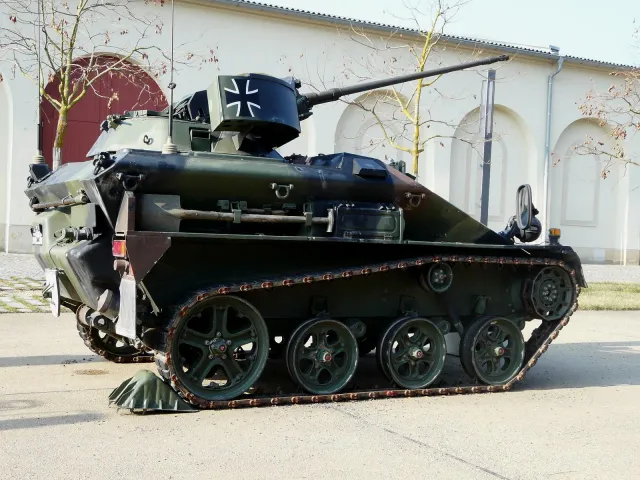
| Wiesel AWC | Germany | 2.75 t | Tracked, air-transportable light weapons carrier | 1,989 | Active |
| Sandcat (RAM 2000) | Israel | 7.25 t | 4x4 wheeled, Ford F-550 chassis, patrol/border security | 2,006 | Active |
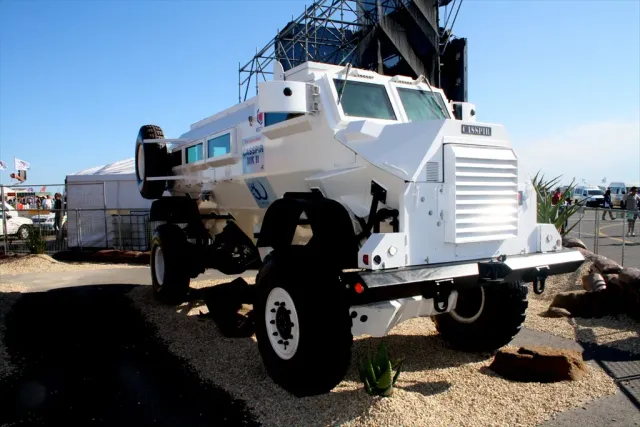
| Casspir | South Africa | 12.5 t | 4x4 wheeled, MRAP lineage | 1,980 | Legacy |
| Otokar Cobra II | Turkey | 12.5 t | 4x4 wheeled light tactical/APC | 2,018 | Active |
| PT Pindad Anoa | Indonesia | 13 t | 6x6 wheeled APC | 2,008 | Active |
| Ratel IFV | South Africa | 18.5 t | 6x6 wheeled IFV, arms-embargo-era design | 1,976 | Legacy |
| Type 74 | Japan | 38 t | Tracked main battle tank, 105mm gun | 1,975 | Legacy |
Exclude the Type 74 and the remaining six average just 11.1 tonnes, drawn from five countries and spanning four decades: West Germany’s 1989 Wiesel, South Africa’s 1976 Ratel and 1980 Casspir, Israel’s 2006 Sandcat, Indonesia’s 2008 Anoa, Turkey’s 2018 Cobra II. That spread is the point. This is not an old-design gap and it is not a poor-country gap, since Germany, Israel, and Turkey all field NBC-protected heavier platforms elsewhere in their own inventories. It is a weight-budget gap: a sealed overpressure citadel adds mass, cost, and maintenance burden that a light patrol truck or APC bought in bulk for internal-security or convoy-escort missions, where planners typically discount chemical exposure risk, doesn’t carry.
Type 74 inverts that logic completely. At 38 tonnes it is the heaviest vehicle in the “no” group by a wide margin (roughly three and a half times the six light exceptions’ combined average). It is also a tracked main battle tank with a 105mm gun: exactly the profile that gets NBC protection everywhere else in the database. Its absence here isn’t a live combat-readiness risk today: Japan’s Ground Self-Defense Force has largely retired the Type 74, with small numbers remaining in reserve and training roles rather than front-line service. Read it instead as a design-era artifact. It entered service in 1975, reflecting mid-1970s Japanese tank doctrine and budget priorities rather than the weight-class logic the rest of the database follows so consistently.
Is protection the same as detection?
No, and conflating them is a real mistake a spec sheet can invite. Protection seals a crew compartment against contamination that’s already present. Detection identifies what’s in the environment before or while it’s happening, a different sensor problem entirely. WeaponSpecs’ database tracks these as a distinct small category: 5 purpose-built cbrn-defense systems, separate from the 134 tanks and IFVs above.
Three are dedicated reconnaissance vehicles, and each one carries its own sealed NBC-protected crew compartment on top of its detection payload:
| System | Country | Platform | What it detects | In service since |
|---|---|---|---|---|
| TPz Fuchs NBC Recon (Fox) | Germany | 6x6 amphibious wheeled | Chemical, radiological/nuclear (Fuchs 2 adds biological) | 1,979 |
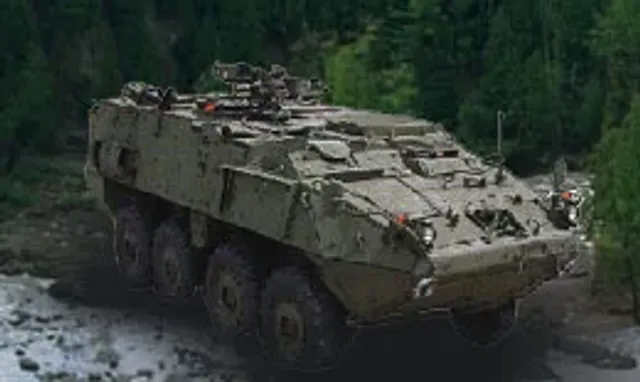
| M1135 Stryker NBCRV | United States | 8x8 wheeled (Stryker family) | Chemical (onboard mass spectrometer, standoff detector), biological (Joint Biological Point Detection System), radiological/nuclear (Radiac sets) | 2,006 |
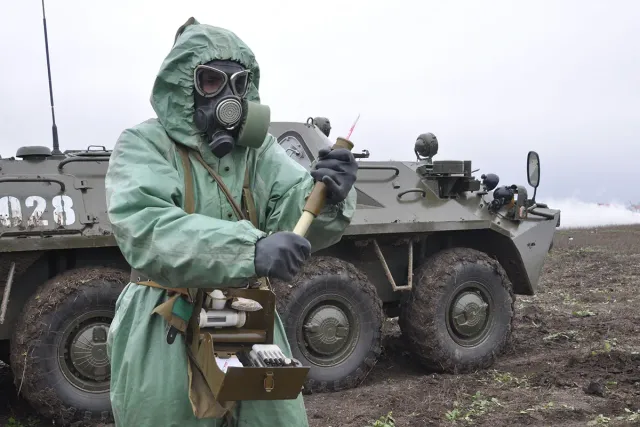
| RKhM-6 | Russia | 8x8 amphibious wheeled, BTR-80-based, onboard express lab | Chemical, biological, radiological/nuclear (state-claimed, unverified) | 2,012 |
TPz Fuchs entered service in 1979 and became the basis for the US M93 Fox, later exported to the UAE and Kuwait. The M1135 Stryker NBCRV replaced the M93 Fox in US service starting in 2006, stacking a mass spectrometer, a standoff chemical detector, the Joint Biological Point Detection System, and Radiac radiological sets onto a single 8x8 platform. RKhM-6, fielded by Russia since 2012, carries an onboard express laboratory, but per the database’s own sourcing note, its detection claims are state-claimed and independently unverified, the same caveat applied everywhere else on this page to Russian figures.
The other two cbrn-defense records aren’t vehicles at all, and that absence of an nbcProtection field on them isn’t a data gap, it’s the correct answer, because there’s no crew compartment to seal in the first place:
- JBPDS (Joint Biological Point Detection System, Chemring, US, 2009): man-portable, shelter, ship, or trailer-mounted, continuously monitors ambient air and presumptively identifies roughly 10 biological warfare agents via laser-induced fluorescence.
- M4A1 JCAD (Joint Chemical Agent Detector, BAE Systems, US, 2003): handheld or wearable, an ion-mobility spectrometer that alarms on nerve and blister agent vapors plus toxic industrial chemicals.
A vehicle can have one capability without the other. A tank with nbcProtection: true can’t smell a chemical release coming; a JCAD unit clipped to a soldier’s vest can’t seal a crew inside a citadel. They solve different halves of the same problem.
Does a “yes” mean it will actually work in combat?
Not automatically, and the same state-claim discipline that applies to a published range or armor rating applies here too. Of the 110 systems confirming NBC protection, 18 are Russian-origin, and a sealed-citadel claim from Moscow, Beijing, Tehran, or Pyongyang gets flagged as a manufacturer or state figure, not an independently verified fact, exactly like RKhM-6’s detection claims above. A sealed compartment is unverifiable from open sources the same way a claimed engagement range is: nobody outside the manufacturer’s own testing program gets to check the gaskets.
That caveat isn’t academic right now. The Organisation for the Prohibition of Chemical Weapons has, in two separate investigations in November 2024 and February 2025, confirmed the use of toxic chemical substances by Russian forces against Ukraine, the first confirmed state-on-state chemical weapons use in a European war in decades. Dutch and German intelligence services (MIVD, AIVD, BND) assessed in mid-2025 that Russia is intensifying and systematizing this use, centered on chloropicrin, a banned riot-control-derived agent that is lethal in enclosed spaces, delivered via improvised munitions dropped from drones. Ukrainian authorities have separately reported roughly 9,000 incidents and more than 2,500 troops showing exposure symptoms, with at least 3 confirmed deaths, figures that come from a combatant government and should be read as Ukrainian-reported claims rather than independently verified the way the OPCW findings are.
“Russia is going ever further in deploying chemical weapons. It is happening systematically,” said Ruben Brekelmans, Dutch Minister of Defense (Newsweek, July 4, 2025).
Against that backdrop, a spec sheet’s nbcProtection: true field is doing real work, and a buyer relying on it for a Russian-origin platform should treat it the way this page treats every other Russian performance claim: plausible, unverified, and worth a second source before it drives a decision.
What this means for the next procurement decision
The practical takeaway sits at the intersection of the two findings above. NBC protection is standard on 82.1% of the tank and IFV fleet in this database, but it clusters almost entirely on the heavier end: main battle tanks and the bulk of IFVs. A buyer evaluating a light wheeled IFV or APC-class vehicle for a mission with any chemical-exposure risk (border security in a contested region, peacekeeping near an active front, convoy escort through contaminated terrain) should not assume protection is standard just because it’s common across the database as a whole. Check the field on the specific system, not the category average, before it’s assumed away.
Cross-check any two systems’ full protection profiles side by side with the compare tool, browse the full tank category to see where NBC protection concentrates by platform weight, or run a mission-specific threat profile, chemical exposure included, through the Advisor before a light-vehicle order goes out.
Sources
- NATO Allies Sound Alarm on Russia Chemical Weapons
- Russia Accused of Escalating Chemical Weapons Attacks Against Ukraine
- Use of chemical weapons during Russia's invasion of Ukraine (Wikipedia)
- Type 74 tank (Wikipedia)
- Fuchs 2 NBC-RS Vehicle (Army Technology)
- M1135 Stryker NBC Reconnaissance Vehicle (Wikipedia)
- RKhM-6 CBRN Reconnaissance Vehicle (Army Technology)
- JBPDS (Federation of American Scientists)
Systems in this comparison
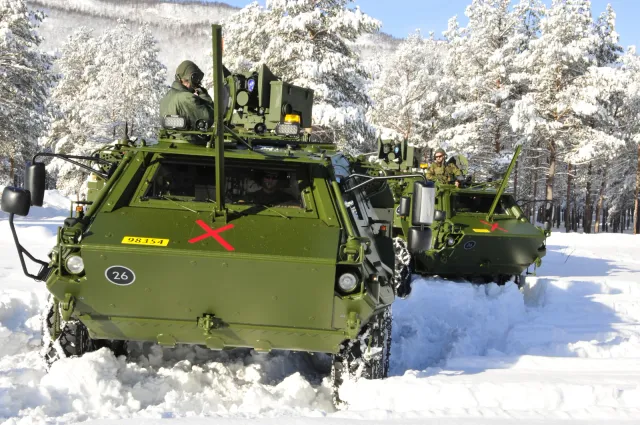
Every system covered above, with its photo and, where available, a video. Tap a card to open the full spec sheet.
Compare these side by side →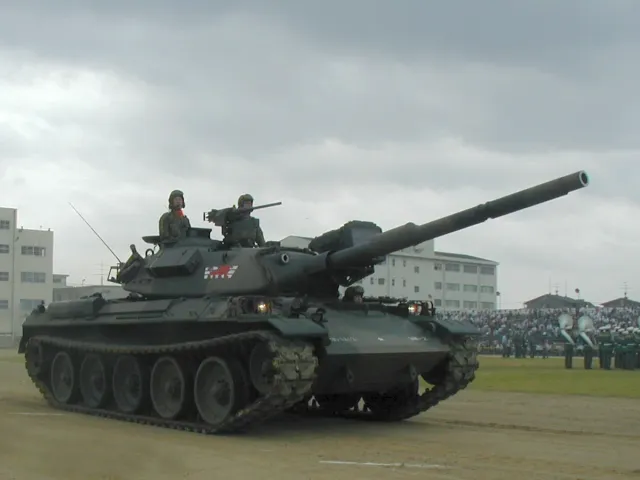
Frequently asked questions
What does NBC protection actually mean on an armored-vehicle spec sheet? +
It means the crew compartment is sealed against nuclear, biological, and chemical contamination: an overpressure system keeps filtered air pushing outward through gaskets and hatch seals so contaminated outside air can't leak in. It is a separate system from armor plating or ballistic protection, and a vehicle can have heavy armor with no sealed citadel at all, or the reverse.
How many tanks and IFVs in the WeaponSpecs database have NBC protection? +
Of 134 tank and IFV systems in the database, 110 (82.1%) confirm a sealed, NBC-protected crew compartment. Another 17 (12.7%) don't address the field at all, and 7 (5.2%) explicitly state they lack it.
Which vehicles explicitly lack NBC protection, and why? +
Wiesel AWC, Sandcat, Casspir, Otokar Cobra II, PT Pindad Anoa, and Ratel IFV, six light wheeled vehicles averaging about 11 tonnes, plus one outlier: the 38-tonne Type 74, a Japanese tracked main battle tank. The pattern is a weight and cost budget, not a nationality or era: a sealed citadel adds mass and cost that light patrol- and APC-class vehicles bought in bulk don't carry.
Does a 'yes' on NBC protection mean it's independently verified? +
Not automatically. Of the 110 systems confirming protection, 18 are Russian-origin, and WeaponSpecs flags Russian, Chinese, Iranian, and North Korean protection claims as manufacturer or state figures rather than independently verified facts, the same treatment applied to a claimed range or armor rating from those states.
Is NBC protection the same as CBRN detection? +
No. Protection seals a crew compartment against contamination; detection identifies what's in the environment. WeaponSpecs' database separately tracks 5 purpose-built CBRN-defense systems, 3 reconnaissance vehicles with their own sealed compartments (TPz Fuchs, M1135 Stryker NBCRV, RKhM-6) and 2 standalone sensor instruments (JBPDS, M4A1 JCAD) with no crew compartment to seal at all.
Related reading


