The T-14 Armata Is Still 'Announced,' 11 Years On
42 of 1,106 WeaponSpecs-tracked systems are marked announced, not fielded; Russia's T-14 Armata tank has carried that status for 11 straight years.

Via Wikipedia, T-14 Armata (shown for identification)
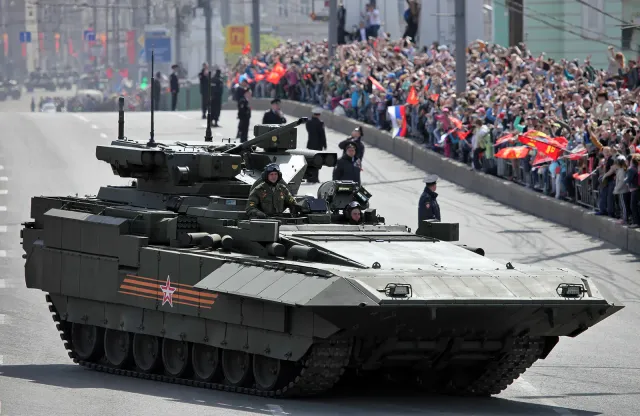
WeaponSpecs tracks 1,106 defense systems, and 42 of them, 3.8 percent, carry the status “announced”: unveiled or ordered, but not yet fielded in active service. Check those 42 against the release year each program itself set, and 12 are already overdue, but only 8 of the 12 are a real signal, more than 2 years past their own release year. Russia’s T-14 Armata tank tops that list at 11 years overdue since its 2015 unveiling, tied with its sibling T-15 Armata heavy IFV, unveiled the same year at the same parade. The other 4 overdue systems in the raw count are barely a year old and prove nothing broken; a program is supposed to still say “announced” a year after unveiling.
What does “announced” actually mean on a spec sheet?
WeaponSpecs tags every system with one of four status values: active (966 systems, 87.3 percent), legacy (97), announced (42), or discontinued (1). “Active” means confirmed in operational service. “Announced” sits one step earlier, a system has been publicly unveiled, put under contract, or given a target service-entry date, but has not yet been fielded at scale. The releaseYear field records the year that unveiling or target date was set.
That distinction matters because “announced” is a claim, not a delivery. A state or manufacturer chooses when to unveil a program, often driven by parade timing or export marketing rather than engineering readiness. The same skepticism WeaponSpecs applies to a manufacturer’s range figure applies here: a status label is only as good as the timeline behind it, and how long a system has sat in “announced” is itself a data point worth reading.
Which systems have already missed their own release year?
Twelve of the 42 announced systems have a releaseYear that has already passed, in 2026 terms:
| System | Country | Type | Release/Unveil Year | Years Still “Announced” |
|---|---|---|---|---|
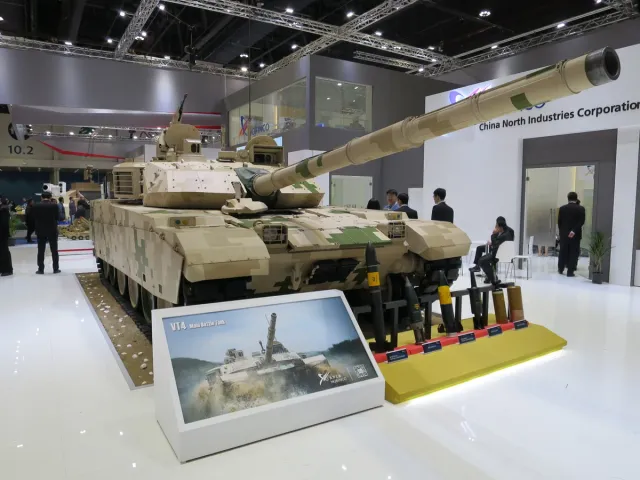
| T-14 Armata | Russia* | Tank | 2,015 | 11 |
| T-15 Armata | Russia* | IFV | 2,015 | 11 |
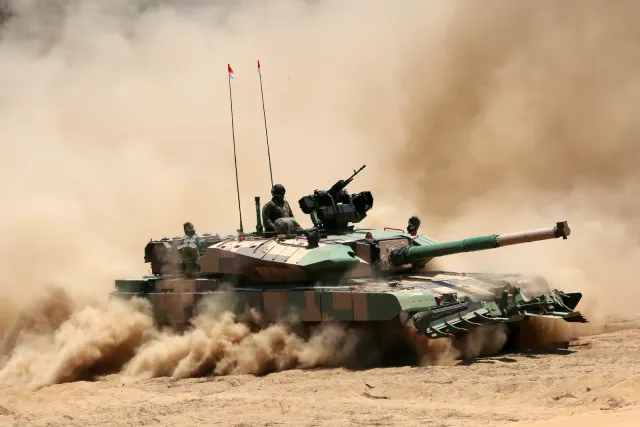
| Arjun Mk2 | India | Tank | 2,021 | 5 |
| MQ-28 Ghost Bat | Australia | UAV | 2,021 | 5 |
| Haider | Pakistan | Tank | 2,023 | 3 |
| Hwasong-18 | North Korea* | Strategic missile | 2,023 | 3 |
| T929 ATAK-2 | Turkey | Helicopter | 2,023 | 3 |
| TAI Kaan | Turkey | Fighter | 2,024 | 2 |
| EagleEye | United States | Subsystem | 2,025 | 1 |
| Seabed Sentry | United States | Subsystem | 2,025 | 1 |
| Fury (YFQ-44A) | United States | UAV | 2,025 | 1 |
| YFQ-42A (Dark Merlin) | United States | UAV | 2,025 | 1 |
*Russian and North Korean release dates rest on state media and parade disclosures rather than independent confirmation, flagged per WeaponSpecs’ standard caveat for Russia, China, Iran, and North Korea.
The anchor case is T-14 Armata, unveiled at Russia’s 2015 Victory Day parade as the flagship of a new tank generation, per Wikipedia. Eleven years later it is still tagged “announced,” not active, and its sibling heavy IFV, T-15 Armata, unveiled at the same parade per Wikipedia, carries the identical gap. The reason is not classified. It is a published cost problem.
“the T-14 tank is of a completely different generation, but it is highly expensive, so its purchase has been temporarily stopped,” said Alexander Sherin, First Deputy Chairperson of the Duma Defense Committee (19FortyFive, March 2026).
Sherin is a Russian government official, so his statement carries the same state-claim caveat WeaponSpecs applies to any RU/CN/IR/KP-sourced figure. What makes it worth quoting is the direction of the claim: he is candidly admitting a slip, not inflating a capability, the opposite of the marketing-number problem this caveat usually guards against. Per the same reporting, Russia’s Ministry of Defense has ordered only about 132 T-14 platforms at a unit cost of roughly $5.38 to $9.42 million, versus roughly half that for the older T-90, and has instead refurbished stored T-72s for its immediate wartime tank needs. Eleven years of “announced” status is not a paperwork delay, it is a program priced out of its own procurement.
Does a 1-year gap mean the same thing as an 11-year gap?
No. Treating every overdue “announced” listing as equally alarming would be its own kind of error. Look at the bottom four rows of the table above: EagleEye, Seabed Sentry, Fury (YFQ-44A), and YFQ-42A Dark Merlin, all four American, all four unveiled in 2025, all still “announced” in 2026. That single year of lag is normal acquisition cadence, not trouble; testing and low-rate production routinely run past a calendar year even for programs on schedule. A bare count of “releaseYear already passed” needs its own so-what, and for that bottom tier the honest answer is nothing to see yet.
The real signal starts at 2 or more years overdue. Eight of the 42 announced systems clear that bar, and ranking them by years-overdue is where the pattern turns diagnostic:
Only 2 of the 8 genuinely overdue systems are Russian, and the top of this ranking is not exclusively a Russia or North Korea story, five of eight sit outside the RU/CN/IR/KP caveat entirely.
Is this a Russia problem or a universal one?
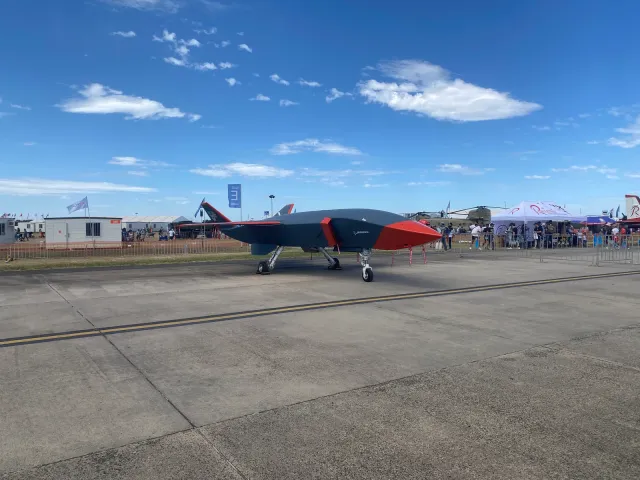
Not exclusively, and the database itself makes that case. MQ-28 Ghost Bat, Boeing’s loyal-wingman drone for Australia’s air force, was first unveiled and flown around 2021, the same year WeaponSpecs’ record dates it. Boeing has now confirmed, per Army Recognition, that the aircraft’s actual combat-service target for the Royal Australian Air Force has slipped to 2028, a 7-year gap between the original technology-demonstrator unveiling and an operational combat-ready target. Wikipedia confirms the program’s 2021 origin as a demonstrator effort, not a combat platform from day one.
That gap does not carry the same state-claim caveat as a Russian or North Korean figure, Boeing and the RAAF are transparent, allied, market-audited sources. But the underlying lesson is identical to the T-14’s: “announced” describes an intention a state or manufacturer had at one point, not a guarantee about when, or whether, it becomes a fielded capability. NATO allies miss their own dates too. The difference is not whether a slip happens, it is who tells you about it and how far it has drifted.
Which countries and system types dominate the “still coming” pipeline?
By country, the United States leads the 42-system list with 9 entries, followed by Turkey with 6, then India, the United Kingdom, Germany, and Russia with 3 each, France, China, and Australia with 2 each, and single entries from Sweden, Israel, Spain, a multi-national program, Pakistan, North Korea, a joint France/Germany effort, Poland, and Finland. By type, fighters (8) and warships (8) dominate, followed by tanks (6), UAVs (4), submarines, missiles, strategic missiles, and air-defense systems (3 each), subsystems (2), and single entries for IFVs and helicopters.
Fighters and warships topping that list is not a red flag; those are the categories with the longest built-in lead times, multi-year flight-test and sea-trial campaigns baked into the process by design. Seventeen of the 42 have a releaseYear of 2026 or later, meaning they are simply not due yet: Spain’s Bonifaz-class F110 and the US Constellation-class Frigate both target 2026, Sweden’s A26 Blekinge-class and the UK’s Challenger 3 target 2027, and GCAP Tempest stretches to 2035. A further 13, including France’s Akeron LP and China’s Chengdu J-36, carry no releaseYear at all, a database gap rather than a status finding.
What should a buyer or analyst do with an “announced” listing?
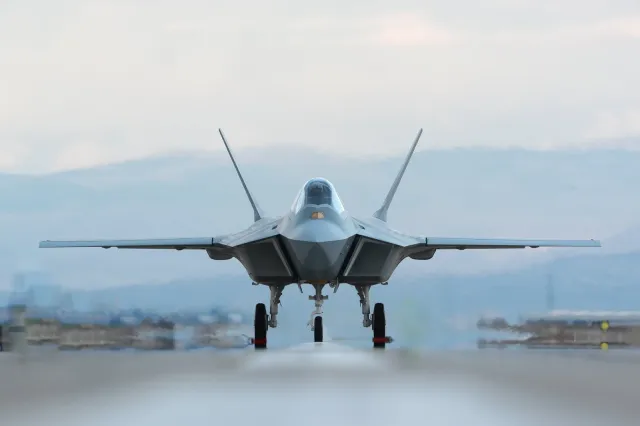
Read “announced” as a probability distribution, not a delivery date. A system unveiled within the last year and still announced today, like Anduril’s EagleEye or Fury, is on schedule, treat it as normal. A system 2 or more years past its own release year, like Arjun Mk2, Haider, or TAI Kaan, deserves a closer look at what’s actually holding it up before it enters any procurement comparison as a real option. And an 11-year gap like T-14 Armata’s, backed by an official admitting the purchase was “temporarily stopped,” is functionally closer to a discontinued or niche-production program than an active procurement path, whatever the spec sheet still calls it.
Run any of these systems, overdue or on schedule, through the Advisor to weigh them against fielded alternatives, or open the Compare tool to put an “announced” system’s published specs side by side with something already in active service.
Sources
Systems in this comparison
Every system covered above, with its photo and, where available, a video. Tap a card to open the full spec sheet.
Compare these side by side →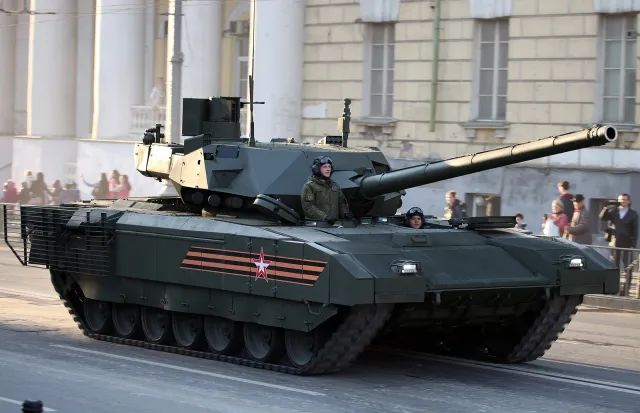
Frequently asked questions
What does 'announced' status mean in the WeaponSpecs database? +
It means a system has been publicly unveiled, ordered, or given a target service-entry date, but has not yet been fielded in active service at scale. It sits between a paper program and the 'active' tag WeaponSpecs applies once a system is confirmed in operational use. It is a status about disclosure and intent, not a claim about combat readiness.
How many of WeaponSpecs' 1,106 tracked systems are currently 'announced'? +
42, or 3.8 percent. The rest break down as 966 active, 97 legacy, and 1 discontinued. Of the 42 announced systems, 12 already have a releaseYear in the past relative to today, and 17 have a releaseYear of 2026 or later, meaning they are not yet due. 13 carry no releaseYear at all and cannot be scored either way.
Why has Russia's T-14 Armata stayed 'announced' for 11 years? +
It was unveiled at Russia's 2015 Victory Day parade and WeaponSpecs' database still tags it announced in 2026. Per 19FortyFive's reporting, Russia's Ministry of Defense has ordered only about 132 platforms at a unit cost of roughly $5.4 to $9.4 million, versus about half that for the T-90, and a senior Duma defense-committee official has publicly said purchases were 'temporarily stopped' over cost. Russia has instead refurbished stored T-72s for its immediate wartime needs.
Is releaseYear a promised service-entry date? +
Not exactly. WeaponSpecs records releaseYear as the year a system was unveiled, ordered, or given its most credible public target date, whichever the sourcing supports, not a contractual delivery guarantee. Treat it as the clock start on a program's own public claim about itself, not as a promise WeaponSpecs is making on the manufacturer's behalf.
Why isn't a 1-year-old announced listing the same signal as an 11-year-old one? +
Because acquisition programs are expected to still say announced a year after unveiling; that is normal test-and-low-rate-production cadence, not a delay. Four US systems in the database, EagleEye, Seabed Sentry, Fury (YFQ-44A), and YFQ-42A Dark Merlin, were all unveiled in 2025 and are still announced in 2026, which is on schedule. The diagnostic tier starts at 2 or more years overdue, where 8 of the 42 systems sit.
Related reading


