Gun-Based Air Defense: Rate of Fire vs. Range
Rate of fire spans a 45x range across 7 gun-based air-defense systems, but inside the CIWS tier it barely moves engagement range at all.

U.S. Navy photo, via Wikimedia Commons, Public domain, Phalanx CIWS (Mk 15)
Across the 7 gun-based air-defense and naval-gun systems in the WeaponSpecs database that publish a rate of fire, that figure spans a 45x range, from 100 to 4,500 rounds per minute. Engagement range does not track it. The correlation across all 7 systems is weak (Pearson r = -0.31), because the 7 systems actually split into two different weapons that happen to share a spec-sheet field. Five 20-40mm point-defense guns cluster tightly at 3-9 km of range no matter how fast they cycle, a 25x spread in rate of fire that barely moves the number at all. Two 76mm naval guns fire far slower, 100-120 rpm, but reach 20-40 km, a completely different mission. Rate of fire inside the point-defense tier buys saturation density against a drone swarm in a few-second window, not reach, and that distinction is exactly why six NATO members have placed gun-based counter-drone orders since late 2024.
How fast do gun-based air defenses actually fire?
The WeaponSpecs database currently carries a published rateOfFireRpm figure for exactly 7 gun-based air-defense and naval-gun systems, the first time we’ve pulled this specific field across this weapon class. Sorted by rate of fire, the split into two tiers is immediate:
| System | Country | Rate of fire (rpm) | Engagement range | Caliber (mm) |
|---|---|---|---|---|
| Raytheon Phalanx CIWS (Mk 15) | United States | 4,500 | 9 km | 20 |
| Rheinmetall Skyranger 30 | Germany | 1,200 | 3 km | 30 |
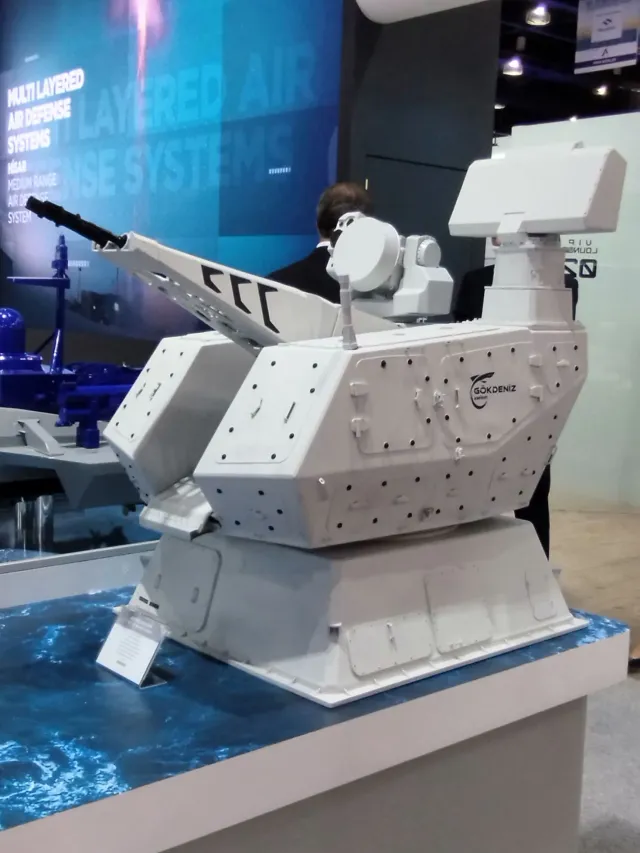
| Aselsan GOKDENIZ CIWS | Turkey | 1,100 | 4 km | 35 |
| Rheinmetall Oerlikon Millennium Gun | Switzerland | 1,000 | 5,000 m (5 km) | 35 |
| Leonardo DRACO 76mm turret | Italy | 100 | 20 km | 76 |
| Leonardo 76/62 Super Rapid Naval Gun | Italy | 120 | 40 km | 76 |
| Thales RAPIDFire | France | 180 | 4 km | 40 |
Five of the seven, Phalanx, Skyranger 30, GOKDENIZ, the Oerlikon Millennium Gun, and RAPIDFire, are 20-40mm point-defense and CIWS guns. Their rate of fire ranges from 180 to 4,500 rpm, a 25x spread, yet their engagement range sits in a tight 3-9 km band, roughly 3x. The two 76mm naval guns, DRACO and the 76/62 Super Rapid, fire at a fraction of the speed, 100-120 rpm, but reach 20-40 km, four to thirteen times farther than any gun in the first tier. Same “rate of fire” field, two different jobs.
Why doesn’t a 25x rate-of-fire spread change the range much?
Range on a gun-based system is set mostly by muzzle energy and shell ballistics, not by how fast the gun cycles. A 20mm Phalanx round and a 40mm RAPIDFire round both leave the barrel doing roughly the same job, intercepting an incoming target close to the ship or the site it’s defending, so their reach ends up clustered together almost regardless of cyclic rate. What rate of fire changes instead is how many rounds a gun can put into that fixed few-second window before the target arrives or passes.
Phalanx is the clear outlier in the tier for a mechanical reason: it’s the only true rotary Gatling gun in the set, a 6-barrel M61 Vulcan cannon. That’s why it mechanically laps every single-barrel gun in the table twice over, 4,500 rpm against a next-best of 1,200, despite firing the smallest-caliber shell, 20mm, of all seven systems. The two 76mm naval guns sit at the opposite end for a different mechanical reason: they’re single-barrel weapons trading rate of fire for shell size. A bigger, heavier round takes longer to chamber and has to survive a larger propellant charge, and that same size is what buys the 76mm guns their 4-13x range advantage over the smaller point-defense guns. Skyranger 30, GOKDENIZ, the Oerlikon Millennium Gun, and RAPIDFire are, as a class, single-barrel medium-caliber cannons, distinct from Phalanx’s confirmed Gatling action, though the specific internal mechanism of each individually isn’t something this post independently verifies.
Five point-defense guns bunch in the upper-left, high rate of fire, short range, while the two 76mm naval guns sit lower-right, slow rate of fire, long range. The Oerlikon Millennium Gun's point is plotted from its 5,000m effective range field rather than a published engagementRangeKm value.
What does firing one actually cost?
Phalanx is the only system in this dataset that publishes a system unit cost, and it’s worth separating that figure from two others that get conflated in casual coverage. The WeaponSpecs database lists 13,660,000 as the unit cost of a whole Phalanx mount, the gun, radar, and fire-control system as one platform. That number has nothing to do with what it costs to fire the gun. A single Mk 244 Mod 0 round costs $45.84, a U.S. Navy figure. And at Phalanx’s full 4,500 rpm cyclic rate, the ammunition burn rate works out to roughly $3,500 per second, per reporting from The War Zone. A 2-second defensive burst runs close to $7,000 in ammunition; emptying the full 1,550-round magazine costs just over $71,000. Three numbers, one system, three different questions: what the platform costs to buy, what one shell costs, and what a few seconds of firing costs. Conflating any two of them misreads the economics of the weapon entirely.
That cost structure is exactly why militaries have started leaning on gun-based systems rather than reflexively spending missile interceptors against cheap unmanned threats.
“We’ve learned how to use other systems and have rapidly adjusted to this concept of defense in depth,” said Navy Adm. Christopher Grady, Vice Chairman of the Joint Chiefs of Staff (The War Zone).
Even at $3,500 a second, a gun engagement against a drone or loitering munition worth a few thousand dollars is a far better trade than a missile interceptor that can run into six or seven figures per shot.
Why is NATO buying dozens of these right now?
Six countries have placed real, reported orders for gun-based air-defense systems since late 2024, explicitly because they’re cheaper to fire per engagement than missile interceptors against cheap drone and loitering-munition threats.
| Country | System | Units | Year | Context |
|---|---|---|---|---|
| Netherlands | Skyranger 30 (on ACSV Gen 5) | 22 | 2025 | Signed Dec 11, 2025; triple-digit million euro range; first deliveries end of 2028 |
| Austria | Skyranger 30 (on Pandur 6x6 Evo) | 36 | 2024 | Mid-three-digit million euro range, plus Mistral missiles; deliveries start 2026 |
| Denmark | Skyranger 30 (on Piranha V 8x8) | 16 | 2024 | Signed Sept 27, 2024; first 4 prototype turrets by end of 2026 |
| Belgium | Skyranger 30 | 20 | 2026 | Part of a €3.1 billion package; framed as closing a low-altitude counter-drone gap |
| Romania | Lynx-based Skyranger (35mm variant) | Undisclosed | 2026 | Part of a €5.7 billion Rheinmetall contract; follows a May 2026 drone strike on Galati |
| France | RAPIDFire 40mm | 7 | 2026 | Confirmed by Gen. Jerome Bellanger at a National Assembly hearing; protects air bases |
Romania’s order deserves a flag: it’s the 35mm Lynx-based Skyranger turret, not the 30mm Skyranger 30 tracked elsewhere in this dataset and ordered by the Netherlands, Austria, Denmark, and Belgium. Same product family, different caliber and turret, worth keeping separate when counting units across these announcements.
Belgium’s order came alongside its own reported justification: closing what officials called a “critical low-altitude capability gap” against persistent drone incursions over strategic domestic infrastructure. France’s RAPIDFire order followed the same logic in the opposite direction, protecting fixed sites (air bases) rather than a broader territory, and the 7 units confirmed are explicitly described as an initial phase against a requirement closer to 12. In every case, the buying pattern is the same: distributed, cheap point-defense guns at many fixed sites, not a handful of longer-range interceptors trying to cover everything at once. That’s the coverage-density logic a drone-swarm threat model rewards, and it’s the same logic this dataset’s tier split explains mechanically: a point-defense gun’s rate of fire buys density against a saturating threat in a few seconds, not reach, and reach was never the spec these buyers were shopping for.
Run your own threat profile against these systems, and the rest of the air-defense category, with the Advisor tool.
Sources
- Rheinmetall to supply Skyranger 30 for the Dutch Armed Forces
- Netherlands orders Skyranger 30 air defense systems from Rheinmetall
- Rheinmetall supplies Skyranger 30 to Austria
- Denmark to integrate Rheinmetall Skyranger 30 onto GDELS' Piranha V 8x8
- Skyranger 30 air defense system for Belgium
- Romania's Lynx-based Skyranger order builds a mobile counter-drone shield for NATO's Black Sea flank
- France orders seven RAPIDFire 40mm anti-aircraft guns to counter drone swarms at air bases
- Phalanx CIWS costs $3,500 per second in ammo to fire
Systems in this comparison
Every system covered above, with its photo and, where available, a video. Tap a card to open the full spec sheet.
Compare these side by side →
Air defense system
Phalanx CIWS (Mk 15)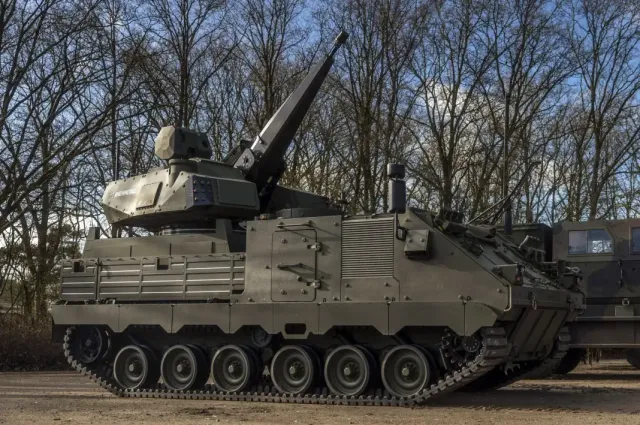
Air defense system
Skyranger 30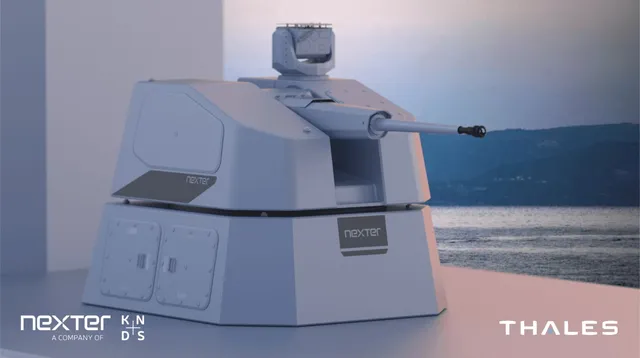
Air defense system
GOKDENIZ CIWS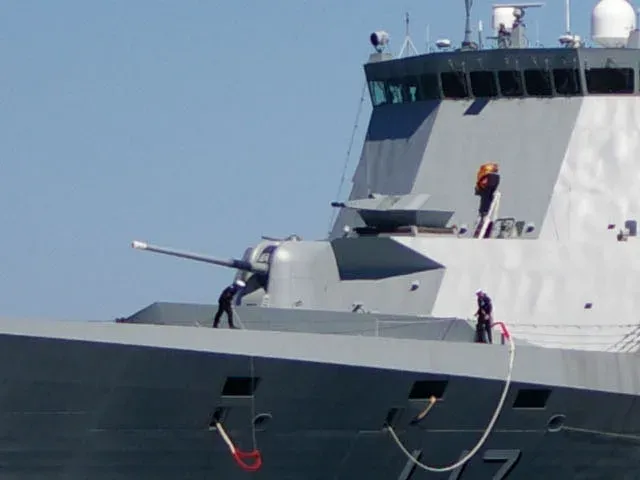
Air defense system
Oerlikon Millennium Gun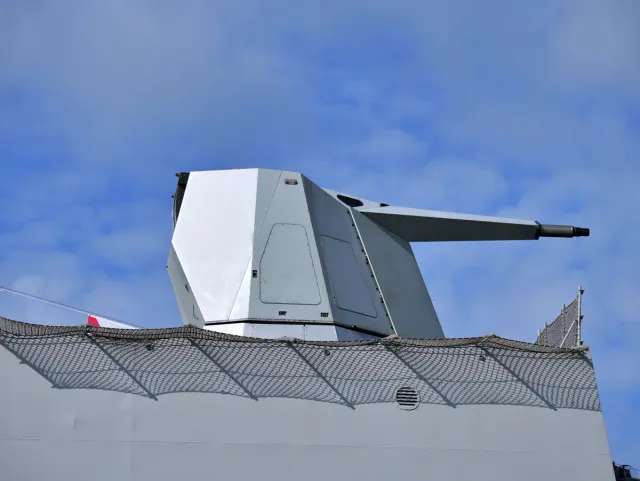
Frequently asked questions
Is a higher rate of fire always an advantage against drones? +
Not in reach. Inside the CIWS tier a 25x spread in rate of fire barely moves engagement range, which clusters at 3-9 km regardless of whether a gun fires 180 or 4,500 rounds per minute. What a higher rate of fire buys is saturation density: more rounds in the air during the few seconds a fast, small, maneuvering target is inside the engagement window. That matters enormously against a drone swarm, where several targets converge at once, and much less against a single inbound missile a slower-firing gun still has time to service.
Why does Phalanx have three completely different 'cost' numbers? +
Because they measure three different things. The WeaponSpecs database lists a $13.66 million unit cost for a whole Phalanx mount, the hardware, radar, and gun as one system. That is unrelated to the $45.84 per-round cost of a single Mk 244 Mod 0 shell, a U.S. Navy figure. And both are unrelated to the $3,500-per-second burn rate at Phalanx's full 4,500 rpm cyclic rate, reported by The War Zone. A 2-second defensive burst costs nearly $7,000 in ammunition alone; emptying the full 1,550-round magazine costs just over $71,000. Before citing a Phalanx 'cost,' check which of the three numbers is actually being used.
How is this different from WeaponSpecs' own piece on what 'range' means on an air-defense spec sheet? +
That earlier piece, [What 'Range' Means on an Air-Defense Spec Sheet](/articles/what-range-means-on-an-air-defense-spec-sheet/), sorted 68 systems into point, area, and strategic range tiers, a survey of the range axis across the whole air-defense category. This piece is narrower and different: it holds the weapon class fixed to gun-based systems and asks what rate of fire does and doesn't buy, plus the mechanical and procurement reasons a wave of 2026 orders is happening now. Different axis, not a rehash.
Is Romania's Lynx-based Skyranger order the same system as the Skyranger 30 tracked in this dataset? +
No. Romania's order is the 35mm Lynx-based Skyranger turret variant, not the 30mm Skyranger 30 tracked to a wheeled or tracked chassis that this post's dataset uses (and that the Netherlands, Austria, Denmark, and Belgium all ordered). Same Rheinmetall product family and naming convention, different caliber and turret. Treat them as related but distinct systems, not interchangeable line items in a single order count.
Why are European militaries ordering dozens of short-range units instead of fewer longer-range ones? +
Because the threat is distributed, not singular. A longer-range interceptor is built to stop one high-value inbound target, a fighter, a cruise missile, a ballistic warhead. A drone swarm or a wave of loitering munitions is a different problem: many cheap, small, simultaneous threats arriving at multiple fixed sites (air bases, armored columns, critical infrastructure) at once. Coverage density, dozens of point-defense guns spread across the sites that actually need protecting, answers that threat model better than concentrating budget in a handful of longer-range batteries that cannot be everywhere at once.
Related reading


