Documents
 United States In development
 Bell
MV-75 Cheyenne
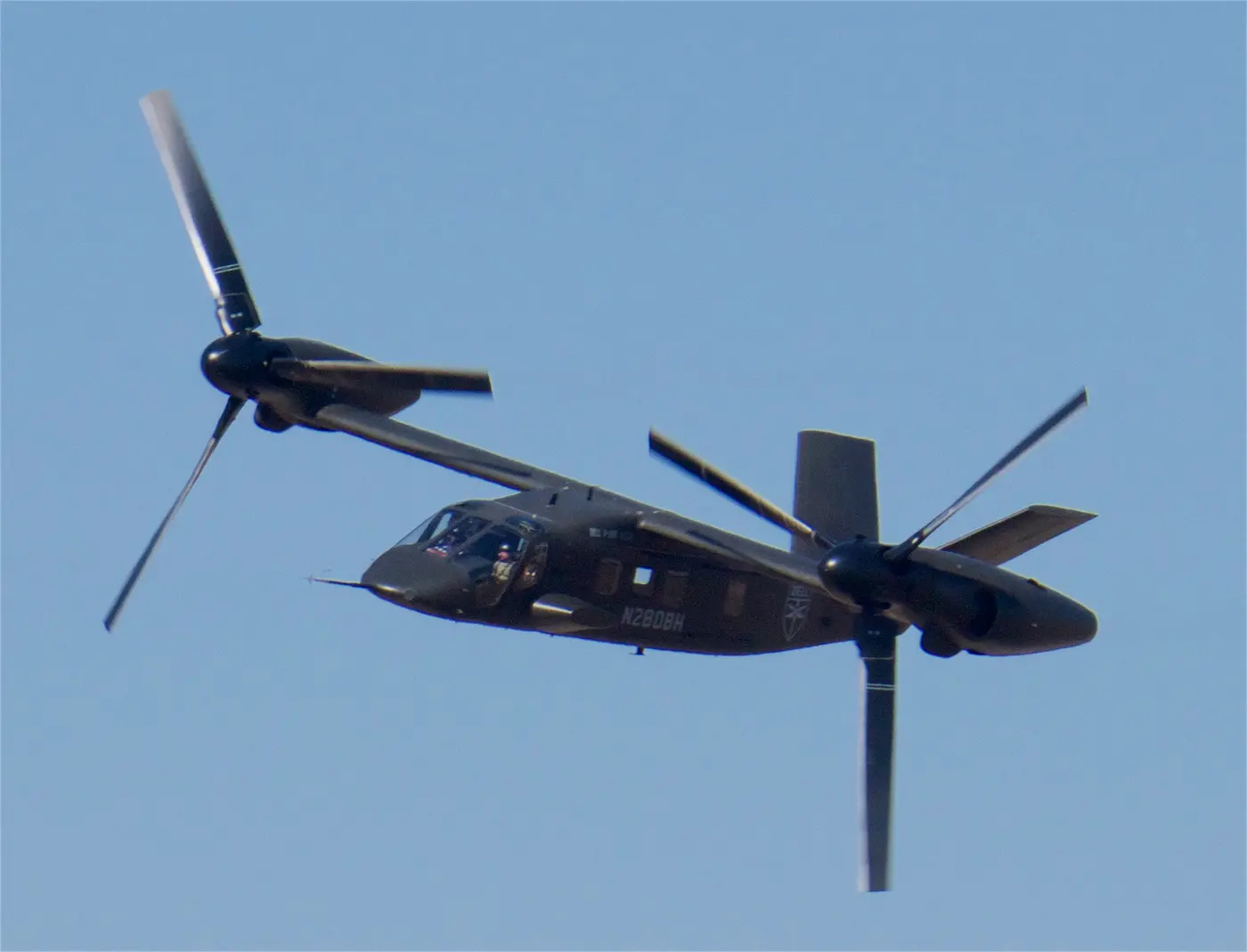
The U.S. Army's Future Long Range Assault Aircraft: Bell's V-280 Valor tiltrotor, designated MV-75 Cheyenne in 2025, intended to replace the UH-60 Black Hawk with roughly twice the speed and range of conventional rotorcraft.
Planned service entry 2031
Compiled from public sources ·primary reference ↗ ·last verified 2026-08-07
Procurement snapshot
Availability & export
US ITAR-controlled
Export needs U.S. State Dept (DDTC) approval; end-use & re-transfer restrictions apply.
Channel: Foreign Military Sales (FMS) or Direct Commercial Sale
Development status
Operator data not public
Planned service entry 2031. Status: announced.
Lifecycle cost (est.)
No public unit price to model from. Why so few systems publish one →
Interoperability
No standardised NATO calibre / datalink detected in public specs.
Derived guidance from public data, export regime by country of origin, lifecycle from the GAO ~30% acquisition rule. Verify eligibility, pricing and offsets with the manufacturer and your acquisition authority.
Overview
The MV-75 Cheyenne is the U.S. Army production designation for Bell's V-280 Valor tiltrotor, selected in December 2022 as the winner of the Future Long Range Assault Aircraft (FLRAA) competition to replace the Sikorsky UH-60 Black Hawk. The Army revealed the MV-75 designation in May 2025: 'MV' stands for Multi-Mission Vertical takeoff and the number 75 refers to the Army's founding year of 1775. The Cheyenne name honours the Northern Cheyenne Tribe and the Cheyenne and Arapaho Tribes. Unlike the V-22 Osprey, whose entire engine nacelles rotate, the V-280 keeps its engines fixed horizontally and tilts only the prop-rotor gearboxes, which keeps the exhaust away from the ground and leaves the sides of the aircraft clear for troops to enter and exit. The specifications recorded here are those published for the V-280 prototype and should be read as prototype rather than production figures: a crew of four with capacity for 14 troops, a length of 50.5 ft (15.39 m), a width across the rotors of 81.79 ft (24.93 m), a height of 7 m, an empty weight of 8,200 kg and a maximum takeoff weight of 14,000 kg, recorded here in the combat weight field. Power came from two General Electric T64-GE-419 turboshafts; the production MV-75 powerplant has not been publicly finalised. Bell's design cruise speed of 280 knots gives the aircraft its V-280 designation and is recorded here as 519 km/h; press reporting of Army briefings has cited roughly 320 mph (515 km/h) cruise and a range of up to 920 miles (1,481 km), the figure recorded here. Bell states cruise speeds around twice those of conventional rotorcraft and correspondingly greater reach, allowing assault forces to launch from safer standoff positions. The aircraft is built around a modular open systems approach and an open-architecture digital backbone intended to let mission systems be swapped without redesign. Program milestones to date: first flight of the V-280 Valor on 18 December 2017; first flight by a U.S. Army test pilot in February 2018; more than 200 flight hours across 159 flights by December 2020; FLRAA selection in December 2022; Milestone B in August 2024; the MV-75 designation in May 2025; and completion of the first two production-representative wing structures in June 2026. Limited user testing is planned for 2027 and 2028 with fielding expected around 2031, so this record is carried as announced rather than active. Only one V-280 prototype was built. Bell signed a memorandum of understanding with Korea Aerospace Industries in April 2026 covering the Republic of Korea's High Speed Medium Utility Helicopter requirement.
Full specifications
Performance
Speed, range, altitude and engagement capability.
| Cruise speed Sustained economical speed. Determines transit time to station. | 519 km/h |
|---|---|
| Range Maximum distance: ferry range for aircraft, operational range for vehicles, maximum engagement distance for missiles. Higher means more standoff or persistence. | 1,481 km |
Physical
Dimensions, weight and crew.
| Length Overall length including gun/probe where applicable. | 15.39 m |
|---|---|
| Wingspan Wingtip-to-wingtip span. | 24.93 m |
| Height Overall height. Lower profile is harder to spot and hit for ground vehicles. | 7 m |
| Empty weight Weight without fuel, ammunition or crew. | 8,200 kg |
| Combat weight Fully loaded weight. Lighter eases transport and bridging limits; heavier often means more armor. | 14,000 kg |
| Crew Personnel required to operate. Fewer reduces exposure; autoloaders trade a loader for mechanical complexity. | 4 |
| Troop capacity Number of embarked troops/passengers (IFV, APC, transport). Higher carries more. | 14 |
Propulsion
Engine, power and fuel.
| Engine Powerplant model and type. | General Electric T64-GE-419 turboshaft (V-280 prototype) |
|---|---|
| Engines Number of engines. Twin-engine gives redundancy at higher cost. | 2 |
| Propulsion type Turbofan, turboshaft, diesel, gas turbine, solid-fuel rocket, ramjet… | Turboshaft/tiltrotor |
Specifications compiled from public Bell and reference sources ↗. Published defense figures are approximations, treat comparisons as directional. Last verified 2026-08-07.
Compare with rivals
See how it stacks up
Frequently asked questions
What is the range of the Bell MV-75 Cheyenne? +
The Bell MV-75 Cheyenne has a maximum range of 1,481 km.
How much does the Bell MV-75 Cheyenne weigh? +
The Bell MV-75 Cheyenne has a combat weight of 14,000 kg.
How many crew does the Bell MV-75 Cheyenne require? +
The Bell MV-75 Cheyenne requires a crew of 4.
What engine does the Bell MV-75 Cheyenne use? +
The Bell MV-75 Cheyenne is powered by the General Electric T64-GE-419 turboshaft (V-280 prototype).
What is the Bell MV-75 Cheyenne used for? +
The Bell MV-75 Cheyenne is a helicopter typically used for assault transport, air assault, medevac, tactical resupply, humanitarian assistance.
Similar systems
Lockheed Martin
CH-53K King Stallion
Boeing
MH-139 Grey Wolf
Boeing
AH-64D Apache Longbow
Boeing
AH-64E Apache Guardian
Related coverage