Army's First Big Laser Buy: $400M for AeroVironment's LOCUST
A reported $400M order moves the Pentagon's directed-energy counter-drone weapon from prototype to large-scale production for the first time.

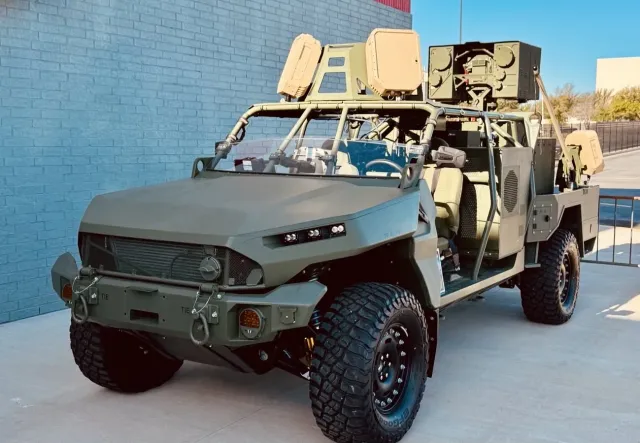
Venetia Gonzales, U.S. Army, public domain, via Wikimedia Commons. An M1301 Infantry Squad Vehicle mounted with a BlueHalo LOCUST Laser Weapon System, photographed April 7, 2025.
The US Army’s confirmed $500 million, three-year counter-drone contract with AeroVironment, awarded July 1-2, 2026, is now reported by Bloomberg to include at least $400 million earmarked specifically for the company’s LOCUST laser weapon, described as the Pentagon’s first large-scale production order for a directed-energy counter-drone system beyond the prototype phase.
The confirmed contract, and the reported figure sitting inside it
The US Army awarded AeroVironment a $500 million, three-year contract on July 1-2, 2026 for “layered” counter-drone defense systems, combining laser, radio-frequency, and kinetic effectors, issued through Army Contracting Command at Detroit Arsenal. That award is independently confirmed by both DefenseScoop and Army Recognition. On Aug. 7, 2026, Investing.com relayed Bloomberg reporting, citing people familiar with the matter, that the Army will buy at least $400 million worth of LOCUST laser systems specifically, for “dozens” of units, and that this represents the Pentagon’s first production contract for a directed-energy counter-drone system beyond the prototype stage. Yahoo Finance reported AeroVironment’s stock jumped 8% on the news.
The important caveat, and the one this story is not going to blur: the $400 million figure is sourced reporting attributed to Bloomberg, not an official Pentagon contract announcement, at the time of writing. The Defense Department has not officially clarified exactly how the $400 million LOCUST figure relates to the confirmed $500 million July award, whether it is a subset of that contract, a related but separate order, or something else. Every use of the $400 million number in this story carries that attribution because the underlying reporting does.
What LOCUST is, and how it got here
LOCUST, the Modular Laser Directed Energy Weapon System, traces back to a 2023 US Navy Naval Surface Warfare Center contract awarded to BlueHalo, since merged into AeroVironment, to build a directed-energy prototype for the Marine Corps’ Joint Light Tactical Vehicle. It is tied to the Army’s Multi-Purpose High Energy Laser effort, known as AMP-HEL. AeroVironment delivered the first two JLTV-mounted LOCUST units to the Army on Dec. 18, 2025, and the system has since been live-fire tested aboard the carrier USS George H.W. Bush (CVN 77), engaging multiple unmanned aerial vehicle targets in a maritime environment. WeaponSpecs’ own systems database confirms LOCUST’s directed-energy architecture, gimbaled tracking system, and the Dec. 2025 first delivery, but notes that the baseline system has no published laser-power rating, engagement range, weight, or crew figures, so this story does not invent any.

One spec worth flagging precisely: AeroVironment’s LOCUST X3, the third-generation variant, is published at 20 to 35-plus kilowatts of laser power against Group 1-3 drone threats. That power figure belongs to the X3 variant specifically, not the baseline LOCUST system covered by this contract reporting, and conflating the two would overstate what AeroVironment has actually confirmed about the systems the Army is now buying at scale.
The cost argument driving the purchase
The strategic logic behind moving LOCUST from prototype to production sits inside a broader post-Iran-war push, one WeaponSpecs has tracked in its own coverage of the Army’s expanded test-range access for industry and the Pentagon’s production-acceleration memo this month, to close the cost gap between cheap attack drones and expensive interceptor munitions. AeroVironment CEO Wahid Nawabi has publicly cited figures as low as $3 per LOCUST engagement, with the company more broadly citing under $5 per shot, against costs running into the millions of dollars for traditional missile-based interceptors. Those numbers are company marketing figures, not independently audited by a third party, and should be read with that caveat attached every time they appear.
If the $400 million figure holds up as an accurate read of the Army’s near-term LOCUST buy, it would represent a meaningful bet that directed-energy weapons are ready to move beyond isolated prototype demonstrations into a real operational inventory, the same transition that a Lot Acceptance Test recently marked for a very different kind of counter-drone weapon, UVision’s HERO-120 loitering munition.
Not to be confused with the Army’s missile-based counter-drone effort
LOCUST is a laser, and it should not be confused with the Army’s separate Next Generation Counter-Munition, or NGCM, program, a kinetic missile interceptor for Group 2/3 drones at 16 to 25-plus kilometers of range, targeted under $150,000 per round. The Army issued a sources-sought notice for NGCM on Aug. 4-5, 2026, with industry responses due Aug. 20, 2026, meaning that program remains in the requirements stage while LOCUST is already moving into production. The two programs address overlapping threats with fundamentally different technology and cost profiles, and reporting on one should not be read as describing progress on the other.
Sources
- AeroVironment wins $400 million US Army laser contract - Bloomberg — Investing.com (Bloomberg), Aug 7, 2026
- AVAV Stock Jumps 8% On Reported $400M Army Deal — Yahoo Finance, Aug 7, 2026
- U.S. Army Awards AeroVironment a $500M Contract for Layered Counter-Drone Defense Systems — Army Recognition
- Pentagon awards $500M contract to AeroVironment for counter-drone technology — DefenseScoop, Jul 2, 2026
Systems mentioned
Every system named in this story, with its photo and, where available, a video. Tap a card to open the full spec sheet.
Frequently asked questions
Is this a new contract or part of an older one? +
The confirmed contract is a $500 million, three-year Army award from July 1-2, 2026 covering layered counter-drone systems: laser, radio-frequency, and kinetic effectors. Bloomberg reported Aug. 7, 2026, citing people familiar with the matter, that the Army will buy at least $400 million of LOCUST laser systems specifically, described as the first large-scale production order for the weapon. The Pentagon has not officially clarified the exact relationship between the two figures.
What does LOCUST actually do? +
It is a directed-energy, laser-based counter-drone weapon using AI-assisted tracking to detect, identify, and destroy small-to-medium drones. It can be mounted on vehicles such as the Joint Light Tactical Vehicle and Infantry Squad Vehicle, or installed at fixed sites.
How is this different from the Army's NGCM counter-drone missile program? +
NGCM, which the Army put out a sources-sought notice for on Aug. 4-5, 2026, is a kinetic missile interceptor for Group 2/3 drones at 16 to 25-plus kilometers, targeted under $150,000 per round. It is a missile program still in the requirements stage, not a laser, and is a separate effort from LOCUST.
How much does a laser shot cost versus a missile? +
AeroVironment has publicly cited under $5 per LOCUST engagement, with CEO Wahid Nawabi citing figures as low as $3, versus costs running into the millions for traditional missile-based air-defense rounds. These are company marketing figures, not independently audited numbers.
More news


