Patriot Stocks Fell 65%, Rebuild Takes 42 Months
CSIS estimates Patriot interceptor stocks fell 65% during the Iran war. The Army's new $58.6B contract still takes 42 months to deliver one.

National Missile Defense image, public domain, via Wikimedia Commons
CSIS estimates U.S. Patriot interceptor stocks fell from roughly 2,330 before the Iran war to between 759 and 827 by the end of the fighting, a decline of at least 65 percent. The Army’s response, a $58.62 billion multiyear PAC-3 MSE contract with Lockheed Martin signed July 29-30, 2026, sounds like the fix, but CSIS reports current PAC-3 MSE delivery lead times of about 42 months, meaning even a fully funded factory line needs three and a half years to turn a contract into a missile in a launcher. That gap between contract date and delivery date is the story here, not the dollar figure.
How far did U.S. interceptor stocks actually fall?
Start with a caveat that matters more than any single number here: these figures come from CSIS, an independent think tank, not a Pentagon-published inventory count. The Department of War has not released its own stockpile figures, so treat CSIS’s estimate as the best open-source reconstruction available, not an official accounting.
With that flagged, the numbers are stark. Patriot interceptor stocks went from about 2,330 before the Iran war to roughly 1,030 by the April 2026 ceasefire, then down further to between 759 and 827 by the time the most recent fighting ended, a decline of at least 65 percent from the pre-war baseline. THAAD interceptors fell on a shallower curve: from about 452 to between 234 and 278, a decline of at least 38 percent.
| System | Pre-war stock (est.) | Post-war stock (est.) | Decline | Reported delivery lead time |
|---|---|---|---|---|
| Patriot (PAC-3 MSE) | ~2,330 | 759-827 | ≥65% | ~42 months |
| THAAD | ~452 | 234-278 | ≥38% | ~53 months |
Both lines "retreat" from the 100% baseline on the right. Patriot's line pulls back nearly twice as far as THAAD's, a reminder that the two interceptor families absorbed very different demand during the same conflict.
THAAD’s shallower decline is still a real capability gap once translated into hardware. WeaponSpecs’ own database entry for THAAD describes a battery’s magazine directly: “a battery’s six launchers hold 48 ready interceptors.” A shortfall of 174 to 218 missiles against the pre-war baseline of 452 works out to roughly 3.6 to 4.5 full THAAD batteries’ worth of interceptors gone missing from inventory. We don’t attempt the same battery-count framing for Patriot; the database doesn’t carry a sourced per-battery interceptor figure for that system, so extending the comparison there would be a guess dressed up as data.
What does the Army’s $58.6 billion PAC-3 contract actually buy?
On July 29-30, 2026, the Army modified a one-year undefinitized contract action into a seven-year, $58.62 billion multiyear procurement with Lockheed Martin: a $53.86 billion modification layered on a prior $4.7 billion undefinitized contract action from April 2026. Lockheed’s press release frames the deal as helping “triple capacity” by the end of 2030, but that production-rate framing comes from Lockheed’s marketing copy, not the contract text; Army Recognition’s reporting confirms the official DoD announcement specifies no quantities or delivery rates.
That silence is worth filling in with WeaponSpecs’ own numbers, carefully caveated. The Army’s FY2026 budget request lists a PAC-3 MSE flyaway unit cost of $3.87 million per missile, per militarymachine.com. Divide the full $58.62 billion contract value by that price and you get an illustrative ceiling of roughly 15,100 missiles, a number that would only hold if every dollar went to missiles alone, with nothing spent on facilities, tooling, or program overhead. It won’t: the deal explicitly funds capacity expansion, and multiyear prices typically climb over a seven-year contract rather than holding flat. Treat 15,100 as a ceiling nobody expects to hit, and a useful scale check on its own: it’s roughly ten times the entire pre-war Patriot stockpile of 2,330. That gap between the illustrative ceiling and what will actually get delivered is the clearest evidence that this contract’s real function is buying manufacturing capacity, not just rounds off an existing line.
That $3.87 million flyaway figure isn’t a universal price, either. Germany’s August 2024 Foreign Military Sales case for up to 600 PAC-3 MSE rounds was notified at $5.0 billion, more than $8 million per missile once training, spares, and support services get bundled into the FMS case price. Flyaway and FMS-bundled prices answer different questions, and comparing them directly is the same mistake this column flags whenever a field name gets treated as an interchangeable metric.
There’s a second, independent way to sanity-check the money, and it’s a genuine cross-validation this database earned before this story broke. WeaponSpecs’ own record for Patriot lists commercial.unitCostUSD at $1,100,000,000, entered July 1-2, 2026, weeks before this news, with a price note explicit that this is “approximate cost per full battery including launchers and radar,” not a per-missile figure. CSIS’s own battery-cost breakdown, published separately, lands on roughly $400 million in hardware plus roughly $690 million in missiles, a sum of $1.1 billion that matches WeaponSpecs’ figure to the dollar.
THAAD’s battery-level figure sits in the same database at $1,000,000,000, also entered July 1-2, 2026, with a price note reading “approximate cost per battery including radar and interceptors.” Neither figure should be divided by a missile count to produce a per-round price; they’re capital-program totals, the same tier-mismatch trap this column has flagged before when comparing Iron Dome’s per-round cost to Patriot’s per-battery cost.
Why does $745 million buy fewer than 30 SM-3 interceptors?
Separately, on August 10, 2026, RTX’s Raytheon division was awarded a $745.39 million contract for SM-3 Block IIA interceptors, split $275.61 million in U.S. FY2026 procurement funds and $277.69 million in Japanese FMS funds, work running through February 2031 in Tucson, Arizona, and Huntsville, Alabama. No missile quantity was disclosed.
WeaponSpecs’ own record for SM-3 Block IIA lists commercial.unitCostUSD at $28,000,000, roughly $28 million (its price note describes this more precisely as “about $27.9 million each based on 2025 reporting”). Dividing the contract’s $745.39 million total by that figure gives approximately 26.6, meaning the headline nine-figure award likely buys fewer than 30 missiles split between two allied buyers.
That’s a small number against a system that isn’t produced in volume to begin with. The same record lists unitsBuilt at 250, the total SM-3 Block IIA missiles ever built. Twenty-seven missiles from this contract alone would be about 10.7 percent of the entire fleet ever produced, a truer measure of scarcity than the nine-figure headline.
| System | Recent contract | Contract date | Published unit cost | Illustrative missiles the contract could fund |
|---|---|---|---|---|
| PAC-3 MSE | $58.62B multiyear procurement (Lockheed Martin) | July 29-30, 2026 | $3.87M (FY2026 flyaway) | ~15,100 (ceiling only; no disclosed quantity) |
| SM-3 Block IIA | $745.39M (Raytheon/RTX, US + Japan FMS) | August 10, 2026 | $28M (WeaponSpecs DB) | ~27 (no disclosed quantity) |
So is this a money problem or a capacity problem?
The lead-time numbers are why this whole comparison matters, and they’re the single most important figures in this piece. CSIS reports current delivery lead times of about 42 months for PAC-3 MSE interceptors and about 53 months for THAAD interceptors, per Defense News’ August 11, 2026 coverage of Feinberg’s memo. A contract signed today, no matter its size, still has to move through 42 or 53 months of physical production before a missile reaches a launcher. Money can expand a factory; it cannot skip the months a factory needs to actually build the thing.
“We must dramatically accelerate our program schedules and expand our production capacity now,” said Steve Feinberg, Deputy Defense Secretary, in an August 5, 2026 memo to defense-industry executives (Defense News, August 11, 2026).
Feinberg’s memo asked contractors for 21-day plans on faster production, not bigger invoices, and that framing tracks with the math above. A $58.6 billion contract that could theoretically buy 15,100 missiles at flyaway prices, or a $745 million contract that buys under 30 SM-3 rounds, both prove the Pentagon has money to spend. Neither number says how fast that money turns into hardware, and the 42-to-53-month lead times are the actual bottleneck the stockpile decline is colliding with. That’s why the memo asks industry to expand production lines and compress schedules, not just confirm funding exists: the funding was never in question.
What should an ally or buyer take from this?
Patriot is fielded by 19 operator nations according to WeaponSpecs’ own database, and every one is watching the same lead-time math. An ally planning its own interceptor purchase should plan against the 42-to-53-month production timeline, not the date a contract gets announced. A signing ceremony is not a delivery date, and that gap has only widened as U.S. stockpiles drew down during 2026’s fighting.
It’s also worth naming what can’t be checked. Russia’s S-400 Triumf has no comparable open-source stockpile tracking of the kind CSIS maintains for Patriot and THAAD, so any Russian claims about its own interceptor production or stocks should be read as unverified state assertions, not data comparable to the CSIS estimates used throughout this piece.
Buyers translating a headline contract number into a realistic delivery timeline can run the comparison against WeaponSpecs’ full spec and cost data in the Compare tool or get a mission-specific readout from the Advisor.
Sources
- Pentagon gives industry 21 days to submit plans for significantly faster weapons production
- The US military started the Iran war with about 2,330 Patriot interceptors. CSIS estimates it now has between 759 and 827
- Patriot Missile System Cost
- Department of War Awards Lockheed Martin $58.62B for Multiyear PAC-3 MSE Production
- U.S. Army awards Lockheed Martin massive $53.9B PAC-3 MSE missile production contract
- RTX's Raytheon awarded $745 million contract for SM-3 IIA interceptors
- Raytheon SM-3 missiles contract
Systems in this comparison
Every system covered above, with its photo and, where available, a video. Tap a card to open the full spec sheet.
Compare these side by side →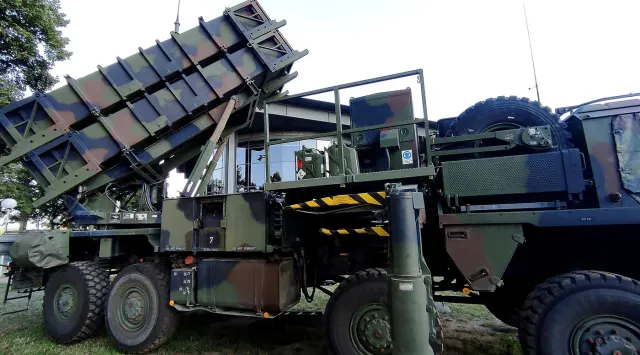
Air defense system
Patriot PAC-3
Missile
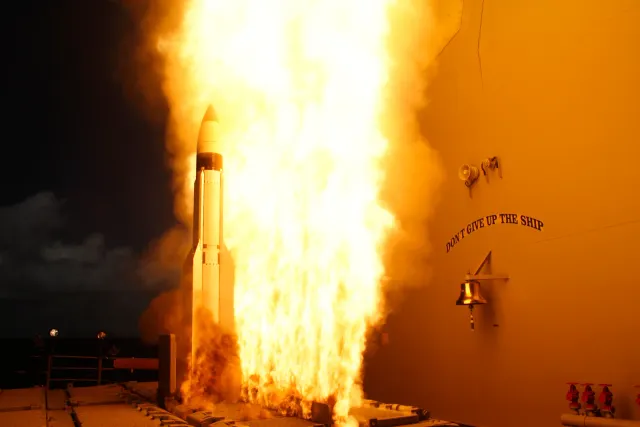
SM-3 Block IIA
Air defense system
S-400 TriumfFrequently asked questions
How much did U.S. Patriot interceptor stockpiles fall during the 2026 Iran conflict? +
CSIS estimates put U.S. Patriot interceptor stocks at roughly 2,330 before the conflict, down to about 1,030 by the April 2026 ceasefire, and further to between 759 and 827 by the end of the most recent fighting, a decline of at least 65%. This is an independent think-tank estimate, not an official Pentagon-published figure; the Department of War has not released its own inventory numbers.
What does a PAC-3 MSE interceptor actually cost? +
The Army's FY2026 budget request lists a flyaway unit cost of $3.87 million per PAC-3 MSE missile. That figure is not comparable to what allies pay through Foreign Military Sales: Germany's August 2024 case for up to 600 rounds was notified at $5.0 billion, more than $8 million per missile once training, spares, and support services are bundled in.
How many missiles will the Army's new $58.6 billion PAC-3 contract actually deliver? +
No missile quantity has been disclosed. Dividing the full $58.62 billion contract value by the $3.87 million flyaway unit cost yields an illustrative ceiling of roughly 15,100 missiles if every dollar went to rounds alone, which it will not; the deal also funds facility and tooling expansion, and multiyear per-unit prices typically rise over the life of a contract. Treat 15,100 as an upper bound, not a delivery estimate.
Why does it take years to rebuild an interceptor stockpile even with new funding? +
Because money doesn't compress a factory's throughput. CSIS reports current delivery lead times of about 42 months for PAC-3 MSE and about 53 months for THAAD interceptors. Deputy Defense Secretary Steve Feinberg's August 5, 2026 memo to contractors demanded 21-day plans to expand production capacity specifically because a bigger check on its own cannot shorten those lead times.
Did THAAD interceptor stocks fall as much as Patriot's? +
No. CSIS estimates THAAD interceptors fell from about 452 to between 234 and 278, a decline of at least 38%, roughly half the severity of Patriot's at-least-65% drop, though the underlying shortfall (174 to 218 missiles) still equals about 3.6 to 4.5 full THAAD batteries' worth of interceptors.
Related reading


