Just 4 Countries Design 58% of the World's Rifles
Just 4 of the 20 countries represented in our 81-rifle database, the US, Russia, Germany, and Belgium, together design 58% of every system we track.

TSGT M.J. Creen, U.S. Department of Defense, public domain, via Wikimedia Commons
Four countries design 58% of every rifle-category system in the WeaponSpecs database. Of the 81 systems tracked as rifles, drawn from 20 countries of origin, the United States, Russia, Germany, and Belgium together account for 47. A national service-rifle program rarely starts as a blank sheet: it starts as a choice among established lineages, and the lineage a country picks decides its ammunition standard, parts pipeline, and licensing terms.
How concentrated is rifle design, really?
Across all 81 rifles in the database, origin traces to just 20 countries. The top four reach 58.0%; add Israel, fifth, and the top five cover 65.4%. Our database-wide audit of every system’s country of origin found the same pattern elsewhere: design capability clusters far tighter than fielded-weapon counts suggest.
The full census:
| Country | Designs | % of 81 | Cumulative |
|---|---|---|---|
| United States | 16 | 19.8% | 19.8% |
| Russia | 13 | 16.0% | 35.8% |
| Germany | 10 | 12.3% | 48.1% |
| Belgium | 8 | 9.9% | 58.0% |
| Israel | 6 | 7.4% | 65.4% |
| Italy | 4 | 4.9% | 70.4% |
| China | 4 | 4.9% | 75.3% |
| United Kingdom | 3 | 3.7% | 79.0% |
| Czech Republic | 3 | 3.7% | 82.7% |
| Switzerland | 2 | 2.5% | 85.2% |
| South Korea | 2 | 2.5% | 87.7% |
| Turkey | 2 | 2.5% | 90.1% |
| Austria | 1 | 1.2% | 91.4% |
| France | 1 | 1.2% | 92.6% |
| Ukraine | 1 | 1.2% | 93.8% |
| Japan | 1 | 1.2% | 95.1% |
| Soviet Union | 1 | 1.2% | 96.3% |
| Finland | 1 | 1.2% | 97.5% |
| Czechoslovakia | 1 | 1.2% | 98.8% |
| Yugoslavia | 1 | 1.2% | 100.0% |
Eight of those 20 countries contribute exactly one design each. That is 40% of the roster accounting for 9.9% of the systems. Over half the world’s rifle architectures still trace to four capitals.
Which four countries dominate, and why these four?
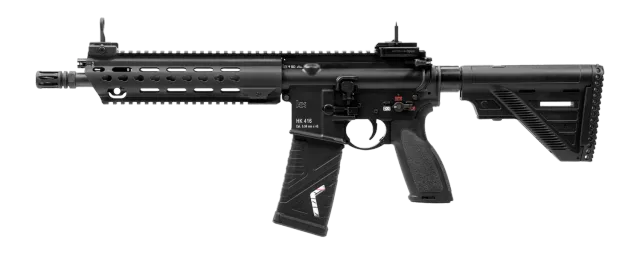
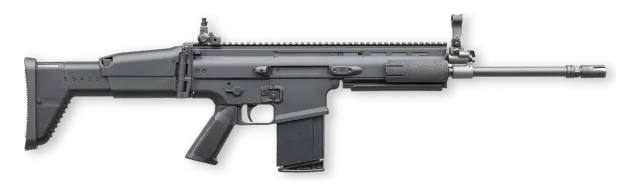
The United States leads with 16 designs (19.8%): the M4A1, the M16A4, the newer XM7. Russia follows with 13 (16.0%), nearly all Kalashnikov-lineage: the original AK-47, the AK-74M, the AK-12. Germany contributes 10 (12.3%), from the G3 and G36 through Heckler & Koch’s HK416 A5. Belgium rounds out the top four with 8 (9.9%), all FN Herstal: the FAL, the FNC, the SCAR family.
Three of the four are NATO members; the fourth is Russia, whose lineage spread through Warsaw Pact and Soviet-client transfers, not alliance sales. FN Herstal and Heckler & Koch built export businesses around selling complete designs and licenses to allied militaries: the FAL was adopted so widely it earned the nickname “the right arm of the free world.” Kalashnikov Concern’s reach came the same way in reverse, standardize once, then push it through every client state. Our AK-12 vs M4 vs HK416 comparison breaks down how the lineages perform head to head.
The drop-off after Belgium is sharp: Israel, in fifth place, holds fewer designs than any single member of the top four.
What does the long tail of one-off national designs look like?
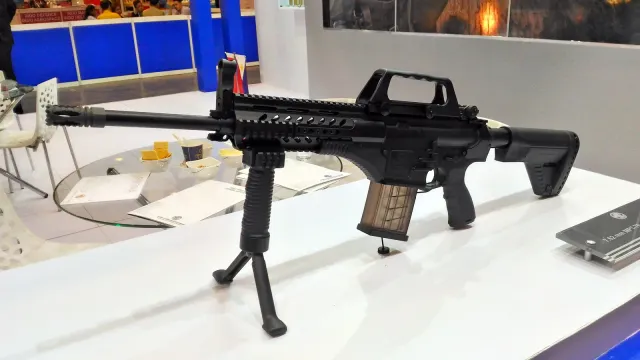
Eight countries hold exactly one design each: Austria’s AUG A3, France’s FAMAS, Ukraine’s Fort-221, Japan’s Type 89, the Soviet Union’s PKM, Finland’s TRG-42, Czechoslovakia’s vz.58, Yugoslavia’s M70. Those eight designs come to 9.9% of the database, the exact share Belgium holds on its own. Three of those labels are dissolved states: Soviet Union, Czechoslovakia, Yugoslavia. That’s lineage, not a data error: the PKM line runs through Kalashnikov Concern, vz.58 continues through CZ, and Zastava still builds M70 derivatives today.
Does building a rifle at home mean you are not dependent on someone else’s design?
Turkey, India, and Serbia all run substantial small-arms manufacturing under license, a real capability: tooling, labor, a domestic parts chain. But the architecture, and often the chambering, still traces to the design’s country of origin. Building a rifle at home isn’t independence, it’s inheritance: the decisions were made elsewhere, years before the local line opened.
Origin and adoption footprint are different measures:
| System | Origin | Operator countries |
|---|---|---|
| AK-47 | Russia | 106 |
| FN FAL | Belgium | 90 |
| M4A1 | United States | 60 |
| G36 | Germany | 40 |
| FN SCAR-H | Belgium | 20 |
| HK416 A5 | Germany | 15 |
| MPT-76 | Turkey | 5 |
Belgium designs 8 of the 81 rifles here, but the FN FAL alone is logged with 90 operator countries across its service life; Turkey’s MPT-76 has 5. These are open-source adoption tallies, not audited records; the AK-47 figure traces through Russian manufacturer material, the same caveat that applies to Chinese-origin figures elsewhere.
Switching lineage entirely is rare and visible. Moldova is doing it now, replacing Soviet-pattern arms with NATO-caliber equipment; it is not a NATO member, but is re-equipping toward NATO small-arms standards.
“We are modernizing infantry weapons: we are replacing Soviet PMs with Glock pistols, Kalashnikov assault rifles with 5.56 mm NATO caliber,” said Anatolie Nosatii, Moldova’s Defense Minister (Logos Press, March 2026).
That sentence covers a caliber change, a new parts pipeline, and new allies able to resupply ammunition, what changing lineage actually costs.
Why this matters more than a trivia stat
Ammunition and parts logistics don’t respect national pride. A country running Kalashnikov-pattern rifles buys into 7.62x39mm and 5.45x39mm supply chains and, increasingly, sanctions exposure tied to Russia’s defense industry. A country running an FN- or HK-derived platform sits inside the 5.56x45mm NATO standard, and NATO standardization pulls harder on that choice than any spec sheet does: ammunition compatibility with allies matters more in a sustained conflict than a marginal ballistic edge. Four countries at 58% of design origins means four licensing regimes account for most of what soldiers worldwide carry.
The buyer’s takeaway
A procurement officer evaluating “our own” rifle program is choosing which existing lineage to marry, and for how long. Compare any two head to head before committing budget to a program built on Belgian, German, American, or Russian design DNA, since the specs that decide sustainment costs rarely show up in a headline number. To weigh a lineage against your own threat and alliance profile, run your own procurement profile in the WeaponSpecs Advisor.
Sources
Systems in this comparison
Every system covered above, with its photo and, where available, a video. Tap a card to open the full spec sheet.
Compare these side by side →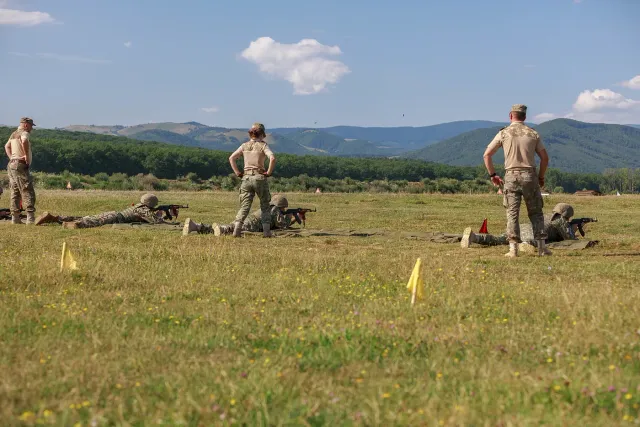
Frequently asked questions
How does WeaponSpecs determine a rifle's country of origin? +
It is the home country of the design's original manufacturer, FN Herstal for the FAL or SCAR, Kalashnikov Concern for the AK series, not necessarily where every fielded unit was built. Many countries manufacture the same design domestically under license, which this field does not separately count, so the true concentration of design know-how worldwide is likely even narrower than the design-origin count alone suggests.
Why do just 4 countries account for over half the rifle designs in the database? +
Scale economics, Cold War bloc alignment, and NATO ammunition standardization all reward adopting an existing design over starting from scratch. Belgium's FN Herstal and Germany's Heckler and Koch built export businesses specifically around selling designs and licenses to allied militaries, while the Kalashnikov lineage spread through Warsaw Pact and Soviet-client distribution over the same period.
Does building rifles domestically under license mean a country has no real arms industry? +
No. License production is a genuine domestic manufacturing capability, and Turkey, India, and Serbia all run substantial small-arms industries this way. But the underlying architecture, tooling, and often the chambering and parts supply chain still trace back to the original design's country of origin, so licensing relocates the factory without removing the dependency this analysis measures.
Why is Belgium responsible for 8 of the database's 81 rifle designs? +
FN Herstal built its post-war business on exporting complete designs rather than only finished rifles. The FN FAL was adopted so widely across NATO-aligned forces that it earned the nickname the right arm of the free world, and the same company's FNC, SCAR family, and belt-fed machine guns extended that footprint into the modern era.
What does this mean for a country buying a new service rifle today? +
The choice is rarely a green-field pick between independent options. It is a choice among a short list of established design lineages, and each one carries its own ammunition standard, parts pipeline, and licensing terms. Moldova's current shift from Soviet-pattern weapons to NATO-caliber equipment is a live example of what changing lineage actually involves.
Related reading


