Trump Orders Navy Back to Steam Catapults, Opens Yards to Allies
A White House memo orders the Navy to strip EMALS from future carrier Doris Miller for steam catapults, and opens U.S. shipyards to allied builders.

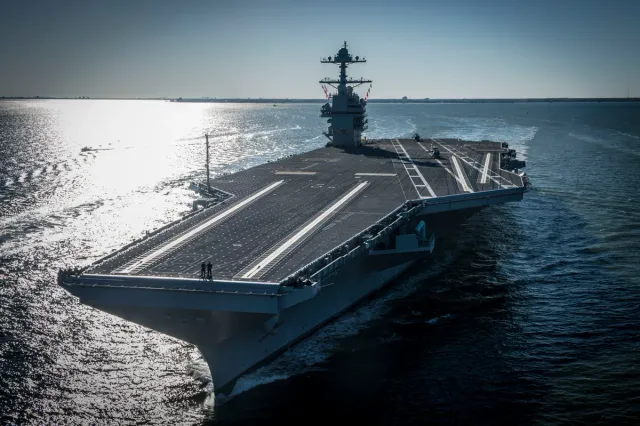
Mass Communication Specialist 2nd Class Mariano Lopez, U.S. Navy, DVIDS, public domain, Sept. 3, 2025.
President Trump signed a National Security Presidential Memorandum on Aug. 13 ordering the Navy to study replacing the electromagnetic launch system on the future carrier USS Doris Miller (CVN-81) with steam catapults, and to open a path for allied shipyards to build hulls destined for the U.S. fleet. The memo, titled “Rebuilding the United States Navy and America’s Shipbuilding Industrial Base,” directs Defense Secretary Pete Hegseth to deliver a 60-day plan on the catapult and elevator swap, and a separate 120-day plan for a fifth public shipyard near the Pacific Fleet.
What the memo actually orders
The directive does not rewrite a single contract. It instructs Hegseth, in consultation with the Secretary of the Navy, to produce a 60-day plan for replacing the Electromagnetic Aircraft Launch System (EMALS) and the Advanced Arresting Gear on CVN-81 and subsequent Ford-class hulls with steam catapults and hydraulic recovery systems, the technology every U.S. carrier used from the Forrestal class through the Nimitz class before Ford broke with it. CVN-78 (Gerald R. Ford), CVN-79 (John F. Kennedy) and CVN-80 (Enterprise), all already under construction or in service with EMALS installed, are explicitly excluded. Only Doris Miller, which General Atomics says is nearly 50 percent complete on the production side, and any hull after it are in scope, and only pending the study’s outcome.
A second track directs a 120-day plan for a fifth public shipyard, with up to three new drydocks located near the Pacific Fleet and financed in part through public-private partnerships, a structure OMB Director Russ Vought has been pushing as the financing model for expanded naval infrastructure. Navy leadership is not uniformly enthusiastic. Chief of Naval Operations Adm. Daryl Caudle summed up the workforce problem plainly: “A new yard is expensive, and so is that infrastructure worth it if I can’t get the workforce there?”
The foreign-shipyard opening
The memo’s most structurally significant provision has nothing to do with catapults. It creates a pathway, officials are calling it the “Finland model,” for allied shipbuilders that make substantial and durable investments in U.S. shipyards to temporarily build up to two ships in their parent shipyards overseas, for eventual delivery to the U.S. Navy. That is a real crack in a wall that has held for decades: the Navy has not built a warship in a foreign yard in generations, and Title 10 currently requires a presidential national-security waiver to do it at all.
The provision reads as custom-built for South Korea’s Hanwha Group, which bought the Philadelphia Shipyard in 2024 and has an active non-binding bid to acquire Austal USA, the Mobile, Alabama, builder covered in WeaponSpecs’ reporting on that deal. Korea Times framed the memo directly around Hanwha, reporting it would let the company build initial hulls at its Geoje yard in South Korea before shifting output to Philadelphia as that yard’s capacity ramps. Congress is not on board with the concept as written: the Senate Armed Services Committee’s FY2027 NDAA mark would strip the existing Title 10 waiver authority for foreign-built warships entirely, carving out only an exception for auxiliary vessels, a direct collision course with the memo’s foreign-build track.

Why reverting to steam is not a small ask
EMALS was billed as the Ford class’s signature innovation when the program launched, meant to reduce airframe stress through smoother, tunable acceleration and support higher sortie rates than steam ever could. The Navy has not bought or built a steam catapult system in more than 20 years, and the supply base for it, the specialized boiler plumbing, the hydraulic runs, the steam distribution architecture that older carriers were designed around from the keel up, has largely atrophied.
Bryan Clark, a senior fellow at the Hudson Institute’s Center for Defense Concepts and Technology, laid out the mechanical problem for Breaking Defense:
“These functions all used steam in previous carrier classes. Restoring steam lines to at least the catapults will require extensive redesign of the ship. Also, the Navy has not bought a steam catapult in more than 20 years, so it is unlikely the suppliers are able to build them without substantial up-front investment and time to establish the necessary production lines,” said Bryan Clark, senior fellow at the Hudson Institute Center for Defense Concepts and Technology (Breaking Defense, Aug. 13, 2026).
General Atomics, EMALS’s contractor, put its objection in cost-and-schedule terms rather than technical ones, saying that “with nearly 50% of production complete, changing course now would introduce significant cost, schedule, and integration risks” on Doris Miller specifically. That ship was already pushed back to a February 2034 delivery before this memo, and a mid-build systems swap of this scale, ripping electromagnetic rail infrastructure back out and re-plumbing for steam, is not the kind of change that tends to come in on the schedule a 60-day study projects.
This is not the first time Trump has pushed this idea. He complained about EMALS by name during his first term, at one point telling military officials he wanted carriers to go back to “goddamned steam,” comments that date to 2017 and 2019 and that made this week’s memo feel to some observers less like a new policy shift than a long-deferred one finally landing in writing.
What happens next
Nothing changes in a shipyard tomorrow. The memo sets clocks running, 60 days for Hegseth’s catapult study, 120 days for the fifth-shipyard plan, and Congress is already positioned to contest the foreign-build piece before it can be used. The practical test will be whether General Atomics and the broader supplier base can even price out a steam-catapult swap on a hull that is nearly half-built, and whether the Senate mark or a negotiated compromise leaves Hanwha’s Geoje option intact by the time any of this reaches procurement paper.
Sources
- New White House Memo Calls for Foreign-Built Warships, Return to Steam Catapults on Ford Carriers — USNI News, Aug 13, 2026
- Trump orders return of steam catapults on carriers, fifth public shipyard — Breaking Defense, Aug 13, 2026
- 'Very outdated': Trump's directive to revert to steam catapults on new aircraft carrier baffles naval experts — CNN, Aug 14, 2026
- Full steam in reverse: Trump orders US Navy back to old-style aircraft catapults — Navy Lookout, Aug 13, 2026
- Fact Sheet: President Donald J. Trump Rebuilds the U.S. Navy and America's Shipbuilding Industrial Base — The White House, Aug 13, 2026
- Trump order on foreign-built US ships boosts Hanwha, but strings attached — Korea Times, Aug 14, 2026
Systems mentioned
Every system named in this story, with its photo and, where available, a video. Tap a card to open the full spec sheet.
Frequently asked questions
Does this affect the existing USS Gerald R. Ford or carriers already under construction? +
No. CVN-78 (Ford), CVN-79 (Kennedy) and CVN-80 (Enterprise) retain EMALS. Only CVN-81 (Doris Miller) and later hulls are directed toward steam, pending the 60-day study Defense Secretary Pete Hegseth must deliver.
Is this an executive order or just a memo? +
It is a National Security Presidential Memorandum, not an executive order. It directs agency studies and plans rather than immediately rewriting procurement contracts, so nothing changes on the shop floor yet.
Can foreign shipyards now build any U.S. Navy warship? +
No. Only shipyards belonging to companies that have made substantial and durable investments in U.S. shipyards qualify, and each is capped at building up to two ships in their home yards as a bridge before production shifts stateside.
Why does this matter for South Korea's Hanwha? +
Hanwha owns the Philadelphia Shipyard and has bid to buy Austal USA. The memo's foreign-build provision is widely read as tailored to let it build initial hulls at its Geoje yard in South Korea before shifting production to Philadelphia.
More news


