Documents
 South Korea
 HD Hyundai Heavy Industries
Incheon-class Frigate
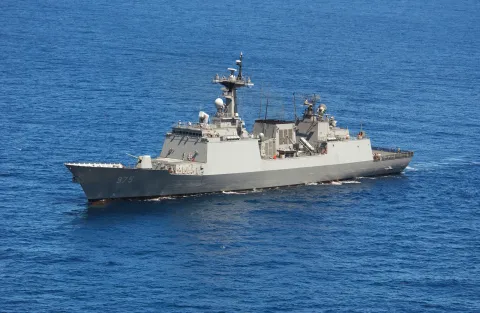
South Korea's Future Frigate eXperimental Batch I class, lead-designed and majority-built by Hyundai Heavy Industries to replace the aging Pohang-class corvettes and Ulsan-class frigates, a naval class not previously represented in this brand's destroyer/LPH/submarine coverage.
In service since 2013
Compiled from public sources ·primary reference ↗ ·last verified 2026-07-19
2,500
t
30
kn
4,500
nmi
140
crew
Procurement snapshot
Availability & export
ROK export-licensed
DAPA-administered; aggressive export posture with financing/offset packages.
Channel: Government-to-government
Fielded & proven
Operator data not public
In service since 2013. Status: active · ~6 built.
Lifecycle cost (est.)
No public unit price to model from. Why so few systems publish one →
Interoperability
No standardised NATO calibre / datalink detected in public specs.
Derived guidance from public data, export regime by country of origin, lifecycle from the GAO ~30% acquisition rule. Verify eligibility, pricing and offsets with the manufacturer and your acquisition authority.
Overview
The Incheon-class frigate, developed under the Future Frigate eXperimental (FFX) programme, is a Republic of Korea Navy coastal-defense frigate class replacing the older Ulsan-class frigates and Pohang-class corvettes. The lead ship ROKS Incheon was launched by Hyundai Heavy Industries on 29 April 2011 and commissioned in January 2013; of the six ships built, three (Incheon, Gyeonggi, Jeonbuk) were built by HHI and three (Gangwon, Chungbuk, Gwangju) by STX Offshore & Shipbuilding, with HHI as lead/design yard. Per Wikipedia's infobox, the class displaces 2,500 tons empty and 3,300 tons full load, is 114 m long with a 14 m beam and 4 m draft, and uses a CODOG propulsion plant of two MTU 12V 1163 TB83 diesels and two GE LM2500 gas turbines for a 30-knot maximum speed (18 knots cruise) and 4,500 nautical mile range, with a complement of 140. Sensors include an SPS-550K 3D air-search radar, SPG-540K fire-control radar, SQS-240K hull sonar and a Naval Shield combat management system, backed by a LIG Nex1 SLQ-200(V)K Sonata electronic-warfare suite. Armament comprises a 127mm/L62 Mk 45 Mod 4 naval gun, a 20mm Phalanx CIWS, a 21-round RAM Block 1 point-defense launcher, two triple torpedo tubes for the K745 Blue Shark lightweight torpedo, and eight SSM-700K Haeseong anti-ship missiles; batch-1 ships were later retrofitted (from September 2016) with the land-attack derivative of Haeseong, giving them a 150-200 km-range land-attack strike option. The class carries a Super Lynx or AW159 Wildcat helicopter with hangar and flight-deck facilities. An improved derivative, the Daegu-class (FFX Batch II), is split-built between HHI and Hanwha Ocean and is not modeled as a separate record here.
Compatible munitions & weapons
Publicly reported weapons the Incheon-class Frigate can carry. Linked items have a full spec page.


Full specifications
Firepower
Armament, payload and guidance.
| Main armament Primary weapon: main gun, cannon or missile type. | 1x 127mm/L62 Mk 45 Mod 4 naval gun |
|---|---|
| Secondary armament Additional weapons: coaxial MG, remote weapon station, gun pods. | 1x 20mm Phalanx CIWS, 1x RAM Block 1 21-round point-defense launcher |
| Torpedo tubes Number of torpedo tubes (submarines and some surface ships). | 6 |
Physical
Dimensions, weight and crew.
| Length Overall length including gun/probe where applicable. | 114 m |
|---|
Sensors & avionics
Radar, sensor suite and datalinks.
| Radar Primary radar. AESA (active electronically scanned array) is the current state of the art. | SPS-550K 3D air-search radar, SPG-540K fire-control radar |
|---|---|
| Sensors IRST, EO/IR turrets, laser designators, sniper pods, thermal sights. | SQS-240K hull-mounted sonar, SAQ-540K electro-optical tracking system, Naval Shield combat management system, LIG Nex1 SLQ-200(V)K Sonata electronic-warfare suite, SLQ-261K torpedo acoustic countermeasures, KDAGAIE Mk 2 decoy launchers |
Program
Cost, production scale and operators.
| Units built Total production run. Higher means proven manufacturing, mature logistics and spares availability. | 6 |
|---|
Specifications compiled from public HD Hyundai Heavy Industries and reference sources ↗. Published defense figures are approximations, treat comparisons as directional. Last verified 2026-07-19.
Compare with rivals
See how it stacks up
 Naval Group Amiral Ronarc'h-class Frigate (FDI)
  Navantia Alvaro de Bazan class (F100)
 Frequently asked questions
What is the main armament of the HD Hyundai Heavy Industries Incheon-class Frigate? +
The HD Hyundai Heavy Industries Incheon-class Frigate's primary weapon is the 1x 127mm/L62 Mk 45 Mod 4 naval gun.
What is the HD Hyundai Heavy Industries Incheon-class Frigate used for? +
The HD Hyundai Heavy Industries Incheon-class Frigate is a warship typically used for anti submarine, anti ship, air defense.
Similar systems
Related coverage