Boeing's $219M T-7A Deal Isn't a $15.6M Unit Price
Boeing's April 2026 T-7A contract divides to $15.6M a jet, half our database's $32M figure. Only 5 of 17 trainer jets publish a price at all.

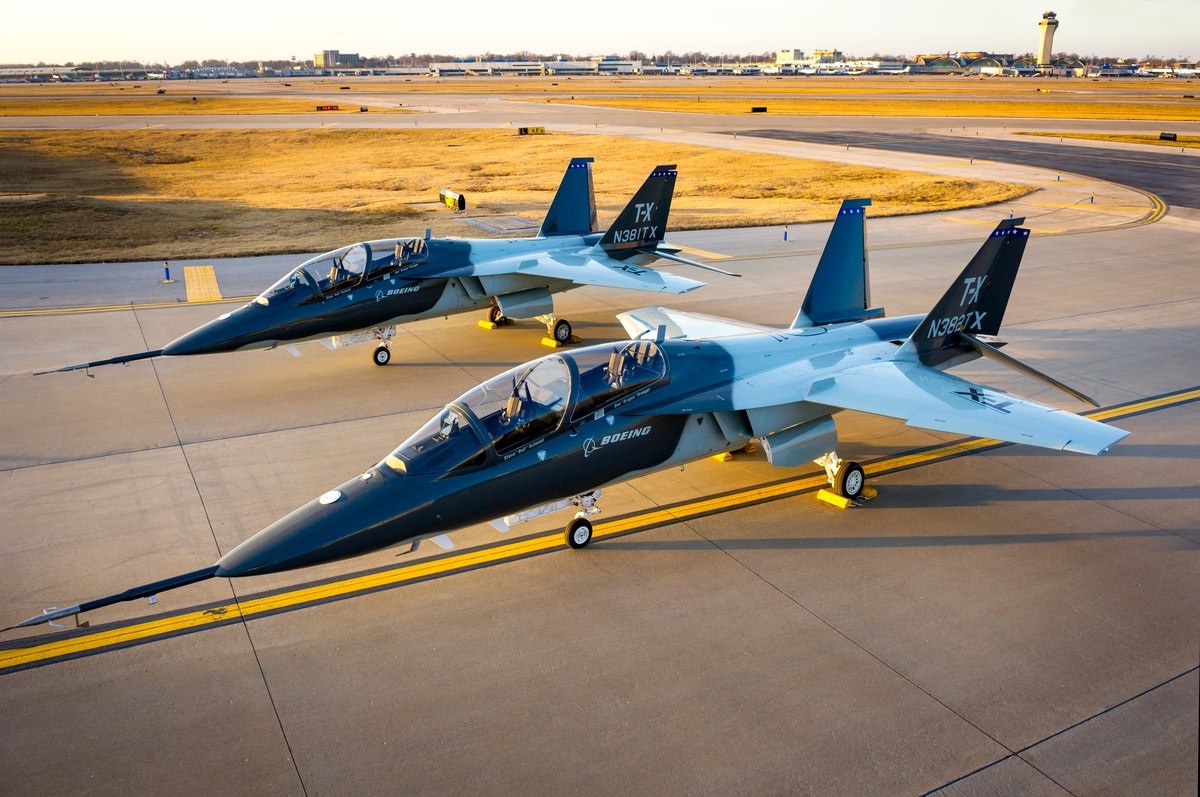
U.S. Air Force photo by Bryce Bennett, public domain, via DVIDS/Wikimedia Commons
Boeing’s $219 million Milestone C contract for the first 14 T-7A Red Hawk trainers divides to $15.6 million a jet, but that is not the T-7A’s unit price, it is a bundled early-production contract total split by aircraft count. WeaponSpecs’ own database carries a $32 million “approximate unit procurement cost” for the T-7A, more than double the naive division. Both numbers are real. They measure different things, and only 5 of the 17 trainer-jet systems in our database publish any unit cost figure at all.
So is the T-7A really a $15.6 million jet?
Not by our database’s own figure. WeaponSpecs lists the T-7A’s 32 million dollar unit cost as an “approximate unit procurement cost,” sourced from the program’s public record. Set the Milestone C contract’s naive per-jet division next to the other four trainer jets in the database that publish any cost figure, and the T-7A sits at the expensive end, roughly on par with Italy’s M-346 and well above China’s export-market JL-8:
| System | Country | Published unit cost | What the figure actually measures |
|---|---|---|---|
| JL-8 | China (Hongdu) | $8.5 million | Publicly cited export unit price estimate |
| A-29 Super Tucano | Brazil (Embraer) | $10 million | Base aircraft price; real export deals cluster near this figure (Chile ~$10M, Colombia ~$9.4M, Ecuador ~$11.25M), but fully equipped versions with sensors, weapons and logistics packages have run $18M-$30M in other deals |
| Yak-130 | Russia (Yakovlev) | $15 million | Estimated export unit cost, a Russian manufacturer/state-linked figure, not independently verified |
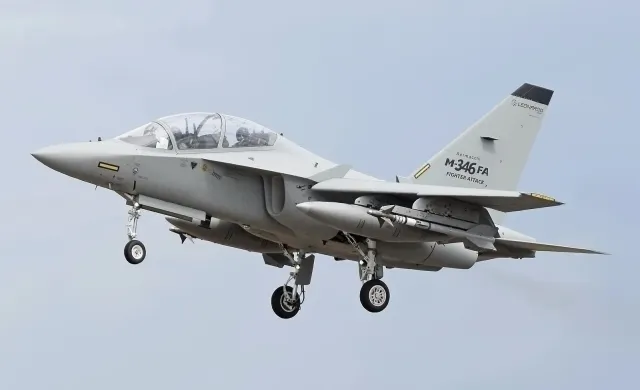
| M-346 Master | Italy (Leonardo) | $30 million | Approximate flyaway cost |
| T-7A Red Hawk | United States (Boeing) | $32 million | Approximate unit procurement cost, WeaponSpecs database estimate as of the program’s July 2026 public record |
See the T-7A Red Hawk’s own system page for the full spec record behind that $32 million figure. Notice what that priceNote column already tells you: a “flyaway cost,” an “export unit price,” a “base aircraft price” and a “unit procurement cost” are four different accounting boundaries wearing the same dollar sign. None of the five is wrong, but stacking them into one ranking without reading the fine print produces a comparison that looks precise and isn’t.
The chart below adds the sixth number, the one WeaponSpecs computed from Boeing’s own contract, placed directly next to the T-7A’s database figure so the gap is impossible to miss.
The dashed bar is the same aircraft as the bar above it: $15.6 million is Boeing's April 2026 Milestone C contract, $219 million, divided by 14 aircraft, a WeaponSpecs calculation, not a published price, sitting well below our database's own $32 million T-7A estimate.
What did the $219 million Milestone C contract actually buy?
On April 23, 2026, the T-7A program cleared Milestone C, the Pentagon’s formal go-ahead for full production, after a certification process dragged out for years by the ACES 5 ejection seat’s failure to clear Air Force airworthiness requirements. Air Force Public Affairs reported that “following Milestone C approval on April 23, the Air Force is moving forward with a $219 million contract for the first 14 advanced trainer aircraft, along with associated spares, support equipment, and training from Boeing Defense, Space & Security.”
That bundling phrase is doing the real work. $219 million did not buy 14 bare airframes: it bought airframes plus spare parts, ground support equipment and a training package in one contract line. Divide the whole bundle by aircraft count and every dollar of spares and training gets misattributed to the jet itself.
“Reaching Milestone C is a testament to the dedicated government and industry teams who have worked diligently to overcome complex technical hurdles,” said William Bailey, Performing the Duties of the Assistant Secretary of the Air Force for Acquisition, Technology and Logistics (Air Force Public Affairs via GlobalSecurity.org, May 4, 2026).
The 14 jets under this contract are also a Low-Rate Initial Production lot, the first slice of output before the assembly line reaches full-rate volume. LRIP pricing typically runs higher per unit than eventual full-rate production, not lower, since tooling, workforce ramp-up and supplier setup costs get spread across a small early batch. That makes the naive $15.6 million figure doubly misleading: it folds in spares and training that aren’t the jet, and it comes from the exact production phase where per-unit costs run highest, not lowest.
First T-7A pilots from the 99th Flying Training Squadron qualified on June 4, 2026, per Army Recognition, and the Air Force is targeting Initial Operational Capability for November 2027. Darlene Costello, Principal Deputy Assistant Secretary of the Air Force for Acquisition, Technology, and Logistics, told Air & Space Forces Magazine that “we worked with our training community to make sure we are meeting AETC IOC requirement of November 2027.” The ejection-seat certification fight that delayed the program is a separate story of program risk, worth keeping apart from the pricing question above.
Why can’t you just divide a contract total by aircraft count?
The gap between $15.6 million and $32 million isn’t a price cut, it’s two different measurements answering two different questions. The contract-division number answers “what did this 14-jet LRIP lot, spares and training included, cost the Air Force?” The database’s figure answers “what does a T-7A cost to procure across the program?” No amount of arithmetic on the first question turns it into an answer to the second.
The same trap catches any defense-contract headline: a $2 billion award for “40 vehicles and sustainment” is not a $50 million vehicle, any more than $219 million for “14 aircraft, spares, support equipment, and training” is a $15.6 million jet. Read a bundled contract total as a program-cost data point, not a per-unit price, unless the source explicitly breaks out airframe cost alone.
How often do trainer jets publish a price at all?
Even setting the T-7A’s two competing numbers aside, the trainer-jet category as a whole is thin on pricing data. Of the 17 systems classified as trainers in the WeaponSpecs database, only 5 publish any commercial.unitCostUSD figure, 29.4%. The other 12, over two-thirds of the category, carry no public unit cost at all. That tracks the pattern we found across the full WeaponSpecs database, where only 22% of all 1,017 systems publish a price, though trainers actually run somewhat above that sitewide average.
The 5 that do disclose a figure each measure "cost" a different way, a bare flyaway estimate, a bundled procurement figure, and an export-market claim, so even the transparent fifth of the category is not directly comparable system to system.
That 29.4% is a small sample, and a mismatched one at that. JL-8’s figure is an export-market estimate, A-29’s is a base price real contracts have exceeded by 80% or more once sensors and weapons are added, M-346’s is a flyaway cost, and the T-7A’s is a bundled program-level estimate. Ranking these five against each other, before you even reach the T-7A’s own contract-vs-database mismatch, means ranking five different accounting definitions as if they were one spec.
Why do fighters disclose price almost twice as often as trainers?
Widen the lens past trainers and a genuinely counter-intuitive pattern shows up. Fighter jets, the more expensive, more strategically sensitive aircraft class, publish a unit cost far more often than trainers do:
| System type | Systems publishing unit cost | Total systems | Disclosure rate |
|---|---|---|---|
| Fighter | 35 | 65 | 53.8% |
| Trainer | 5 | 17 | 29.4% |
| Helicopter | 14 | 48 | 29.2% |
| UAV | 19 | 101 | 18.8% |
| Air defense | 14 | 76 | 18.4% |
| Tank | 10 | 57 | 17.5% |
| Missile | 31 | 219 | 14.2% |
| IFV | 7 | 77 | 9.1% |
53.8% for fighters versus 29.4% for trainers is close to a two-to-one gap, and it runs backward from what a buyer might guess. A trainer jet exists purely to produce a qualified pilot cheaply and safely, so it should be the less sensitive, more shoppable purchase. Instead, fighter programs are older and higher-volume, surfaced by decades of export deals and defense-press coverage almost as a byproduct. Trainer programs like the T-7A are newer and more often sold as bundled contracts, exactly the structure that produces headline dollar figures without a clean per-unit price attached. The jet that trains the pilot, it turns out, is harder to price-shop than the jet the pilot eventually flies.
Unit cost is one axis of a much bigger picture. For the performance side of the same aircraft class, see our companion piece on what top speed actually means on a trainer jet spec sheet, and for the small subset of trainers built to carry weapons, see jet trainers that carry weapons.
Where this leaves a buyer, or a reader
Treat any defense-contract headline the same way: check whether the dollar figure is a bare unit price, a bundled lot total, or a program-level estimate before you divide anything. The T-7A’s own database page carries the caveats above baked into its own priceNote field, and the broader trainer-jet category shows this gap is the norm, not a one-off, for a category that discloses price less than a third of the time. Run your own comparison across trainer jets, or any other category, in the Advisor, where every published figure carries the same sourcing caveat this piece just walked through.
Sources
- Air Force greenlights T-7A Red Hawk for production following Milestone C (Air Force Public Affairs via GlobalSecurity.org)
- T-7 New Ejection Seat, November 2027 IOC (Air & Space Forces Magazine)
- US Air Force T-7A Red Hawk Enters Pilot Training as T-38 Replacement Program Advances (Army Recognition)
- New Details About T-7A Red Hawk Jet Trainer Ejection System Woes Emerge (The War Zone)
Systems in this comparison
Every system covered above, with its photo and, where available, a video. Tap a card to open the full spec sheet.
Compare these side by side →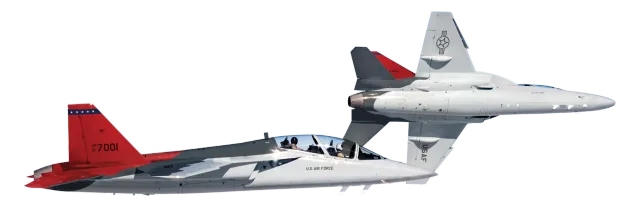
Trainer & light attack
T-7A Red Hawk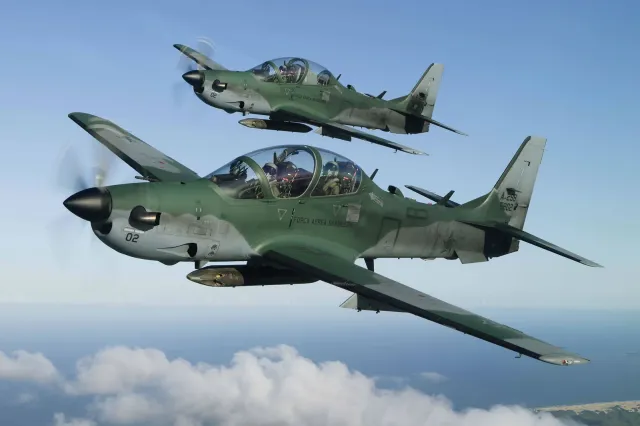
Trainer & light attack
A-29 Super Tucano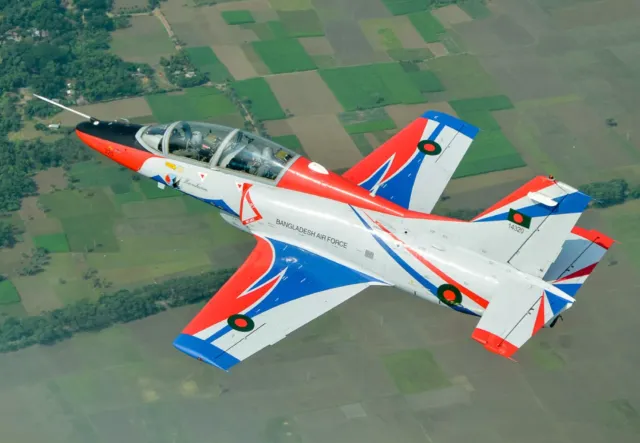
Trainer & light attack
M-346 Master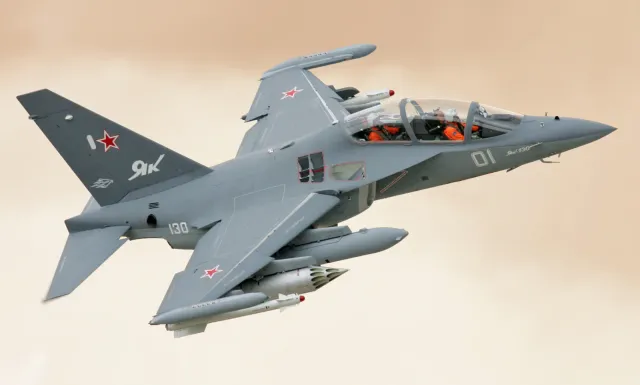
Frequently asked questions
Is the T-7A Red Hawk really a $15.6 million jet? +
No. That figure comes from dividing Boeing's $219 million Milestone C contract by 14 aircraft, a WeaponSpecs calculation, not a published unit price. The contract also covers spares, support equipment and training, and it prices an early low-rate production lot, which historically costs more per jet than full-rate production. Our database's own T-7A estimate, sourced from the program's public record, is $32 million, roughly double.
How many trainer jets publish a unit cost at all? +
5 of the 17 systems in the WeaponSpecs trainer-jet category publish any commercial.unitCostUSD figure, 29.4%. The other 12 have no public unit cost on record.
Why do fighter jets disclose price more often than trainer jets? +
In our database, 35 of 65 fighters (53.8%) publish a unit cost versus 5 of 17 trainers (29.4%). Trainers are the aircraft that exist to produce pilots cheaply, so a buyer might expect them to be the more price-transparent purchase. The data runs the other way: trainer contracts are newer, smaller-volume, and more often bundled with support packages that resist a clean per-unit figure.
How is this post different from your top-speed spec-sheet piece on trainer jets? +
Our companion piece, what top speed means on a trainer jet spec sheet, explains why a trainer's Mach number is a design compromise, not a performance flex. This post covers a different spec entirely, unit cost, and uses the live T-7A Milestone C contract to show why a published or derived price figure needs the same skepticism as a published top speed.
How is this different from your earlier price-transparency piece on the whole database? +
Why only 22% of weapons publish a price surveyed all 1,017 systems in the WeaponSpecs database as a category census. This post is narrower and news-driven: it uses one live contract, Boeing's April 2026 T-7A Milestone C award, to show exactly how a naive per-unit calculation goes wrong, then checks whether that trap is common across the 17-system trainer category specifically.
Related reading


