What Top Speed Means on a Trainer Jet Spec Sheet
Trainer aircraft in our database span 574 to 1,840 km/h, a 3.2x spread, and the newest US jet's own sources cannot agree if it clears Mach 1.

Boeing, official product image, background removed
Of the 17 aircraft classified as trainers in the WeaponSpecs database, published top speed runs from 574 km/h to 1,840 km/h, a 3.2x spread that looks like a mess until you sort it by mission: it splits cleanly into three training stages, primary, intermediate, and advanced, with no overlap between them. The catch is that the newest aircraft in the fastest tier, the US Air Force’s T-7A Red Hawk, doesn’t have a top speed its own public sources agree on, and the disagreement is over whether it’s even supersonic.
How wide is the speed gap between trainer aircraft?
Line up the 15 trainer aircraft in our database with a published or manufacturer-claimed top speed and the gap isn’t gradual. It jumps in blocks.
The three tiers stack with zero overlap once you sort by propulsion type: every turboprop sits below 600 km/h, every subsonic jet lands in a 770-1,090 km/h band, and only the two clearly supersonic designs clear Mach 1.4. The asterisked figures for the Yak-130, L-15 Falcon and JL-8 are Russian or Chinese manufacturer claims, not independently verified.
The full dataset behind that chart, with range figures alongside speed, looks like this:
| System | Country | Tier | Max speed (km/h) | Mach | Range (km) |
|---|---|---|---|---|---|
| T-50 Golden Eagle | South Korea | Advanced | 1,840 | 1.5 | 1,851 |
| L-15 Falcon | China* | Advanced | 1,520 | 1.4 | 3,100 |
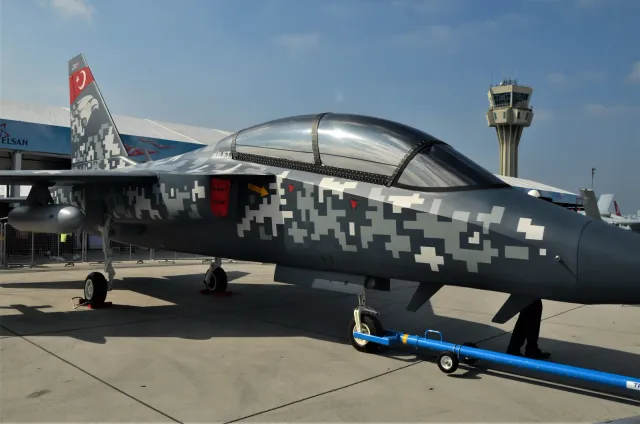
| Hürjet | Turkey | Advanced | N/A | 1.4 | 2,222 |
| Boeing T-7A Red Hawk | United States | Advanced (disputed) | N/A | 0.97+ | N/A |
| Leonardo M-346 Master | Italy | Intermediate | 1,090 | 0.95 | 1,900 |
| Yakovlev Yak-130 | Russia* | Intermediate | 1,060 | N/A | 2,100 |
| Kawasaki T-4 | Japan | Intermediate | 1,038 | 0.9 | 1,300 |
| BAE Hawk T2 | United Kingdom | Intermediate | 1,028 | 0.84 | 2,520 |
| Dassault/Dornier Alpha Jet | France/Germany | Intermediate | 1,000 | N/A | 2,900 |
| AIDC T-5 Brave Eagle | Taiwan | Intermediate | 1,000 | 0.85 | 1,668 |
| HAL HJT-36 Sitara/Yashas | India | Intermediate | 950 | 0.8 | 925 |
| Leonardo/Aermacchi MB-339 | Italy | Intermediate | 898 | 0.82 | 1,760 |
| Hongdu JL-8 | China* | Intermediate | 800 | N/A | 1,560 |
| Saab 105 | Sweden | Intermediate | 770 | N/A | 1,100 |
| Embraer A-29 Super Tucano | Brazil | Primary | 590 | N/A | 1,330 |
| KT-1 Woongbi | South Korea | Primary | 574 | N/A | 1,333 |
| TAI Hürkuş | Turkey | Primary | 574 | N/A | 1,650 |
*Russian and Chinese manufacturer figures, not independently verified.
Read the table by tier, not by rank, and the pattern is obvious. Primary turboprops top out under 600 km/h. Intermediate jets cluster tightly between 770 and 1,090 km/h, a 320 km/h band that’s nine different designs from eight countries converging on roughly the same performance envelope. Advanced trainers, when they clear Mach 1.4, jump clean over that band to 1,520-1,840 km/h. There is no aircraft anywhere in this dataset sitting between 600 and 770 km/h, or between 1,090 and 1,500 km/h. Those gaps aren’t a coincidence, they’re where an aircraft would be the wrong tool for any training stage: too fast and expensive to justify against a turboprop’s job, too slow to teach what a lead-in fighter trainer needs to teach.
Range tells a smaller but related story. The advanced tier doesn’t just fly faster, several of its aircraft also fly farther, with the L-15 Falcon claiming 3,100 km and the T-50 Golden Eagle a more modest 1,851 km, both comfortably ahead of the primary turboprops’ roughly 1,300-1,650 km. That’s a side effect of the larger, more capable airframe a supersonic-class design requires, not a training requirement in its own right. Nobody buys a lead-in fighter trainer for its range, a cadet sortie for high-G handling practice doesn’t need to cover 3,000 km, but it’s worth noting when a buyer starts comparing spec sheets line by line instead of tier by tier.
WeaponSpecs has already covered which of these aircraft carry weapons; this piece is about what the speed numbers alone tell a buyer, separate from payload.
Why do air forces need three different trainer aircraft instead of one?
Cost per flight hour scales steeply with speed, complexity and engine count, so no air force wants to burn advanced-jet money teaching a skill a turboprop can teach just as well. The pipeline exists to match spend to lesson.
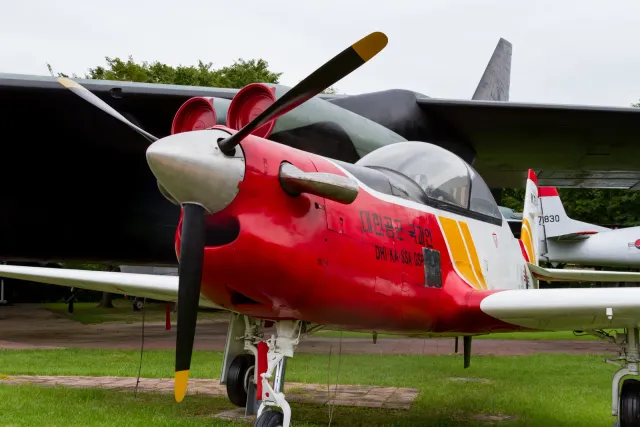
Primary trainers like the KT-1 Woongbi and TAI Hurkus, both capped at 574 km/h, exist to teach a cadet the fundamentals: basic stick-and-rudder control, checklist discipline, pattern work, the first solo flight. None of that requires speed. A single turboprop engine, simple systems and a low fuel burn mean a flight hour here costs a fraction of what it costs in a jet, so this is where air forces put the bulk of early training hours.
Intermediate and basic jet trainers, the crowded 770-1,090 km/h band that includes the Hawk T2, the M-346 Master, the Kawasaki T-4 and seven others, step the cadet up to jet handling: faster reflexes, instrument flying, formation work, and the workflow of managing a turbofan or turbojet rather than a propeller. This is deliberately still subsonic. It doesn’t need to be faster, because the skills it teaches (managing airspeed and energy in a jet, not in a fighter) don’t require supersonic performance, only jet performance.
Advanced, or lead-in fighter trainers, the Mach 1.4-plus tier occupied by the T-50 Golden Eagle, the L-15 Falcon, and Turkey’s own afterburning Hürjet (plus, disputedly, the T-7A), exist for exactly one purpose: teaching high-G sustained turns, energy management at fighter-relevant speeds, and radar and weapons-system workflow, immediately before a cadet gets a type rating on an actual fighter. Skip this stage and a fighter squadron inherits training risk it shouldn’t have to absorb. This tier is also the most expensive to fly and the smallest by aircraft count in our dataset, because air forces only fly it as many hours as absolutely necessary.
South Korea’s KAI is the rare manufacturer building for two of these three tiers itself: the KT-1 Woongbi for primary and the T-50 Golden Eagle for advanced, letting Seoul (and export customers such as the Philippines and Indonesia) buy a training pipeline’s bookends from one supplier while filling the middle stage from elsewhere.
Is the US Air Force’s new trainer even supersonic?
This is where the T-7A Red Hawk’s spec sheet stops being reassuring. Boeing’s own published figures, as reflected on Wikipedia, list a top speed of Mach 0.975 and describe the aircraft as transonic, meaning it does not reliably clear the sound barrier in level flight. Air & Space Forces Magazine, covering the same program, lists Mach 1.05 or higher and calls the aircraft supersonic. The Defense Post gives a third figure, Mach 0.95, equivalent to 1,173 km/h. Three sources any buyer would call reputable, describing one airframe, and they can’t settle whether it crosses Mach 1, a difference that isn’t rounding error, it’s the entire question of which training tier the aircraft belongs in.
Contrast that with the aircraft the T-7A replaces. The Northrop T-38 Talon, in service since 1961, has a top speed the Smithsonian’s National Air and Space Museum states plainly: Mach 1.3, or 1,382 km/h, a figure the museum uses to call the T-38 “the world’s first supersonic jet trainer.” One institution, one number, no hedging, for a design older than the Boeing program by six decades.
“The T-38 is a true workhorse training Air Force fighter and bomber pilots for Air Education and Training Command, but the T-7A Red Hawk is a game changer, providing advanced mission systems, a glass touchscreen cockpit, stadium seating, and embedded training capability,” said Col. Kirt Cassell, U.S. Air Force T-7A program manager (SimpleFlying).
Cassell’s comment, notably, sells the T-7A on cockpit technology and instructor visibility, not top speed. That’s consistent with what the sourcing conflict suggests: the T-7A may be a better trainer than the T-38 in several respects that matter for modern flight instruction, but “supersonic” isn’t a claim its own public documentation can make cleanly. For a jet whose entire job in the pipeline is bridging cadets to supersonic fighter cockpits, that’s a gap worth noticing before drawing conclusions from a single spec line.
What should a buyer take from this
The lesson isn’t that any of these aircraft are mis-specified. It’s that “trainer aircraft” is not one procurement decision, it’s three, each with its own speed envelope, cost structure and training objective, and the T-7A’s unresolved top speed is a reminder to check a spec against more than one source before treating it as settled, especially for a program still this early in its public life.
For anyone evaluating a training pipeline rather than a single airframe, the practical takeaway is to budget and negotiate each tier separately: a primary-trainer contract, an intermediate-jet contract, and an advanced-jet contract, rather than expecting one manufacturer’s brochure to cover all three jobs at once. Even South Korea’s KAI, which builds for two of the three tiers, still sells the KT-1 and the T-50 as distinct programs with distinct price tags, not a bundled trainer family. Browse the full trainer aircraft category to compare these programs side by side, or use the comparison advisor to weigh them against a specific pipeline requirement.
Sources
Systems in this comparison
Every system covered above, with its photo and, where available, a video. Tap a card to open the full spec sheet.
Compare these side by side →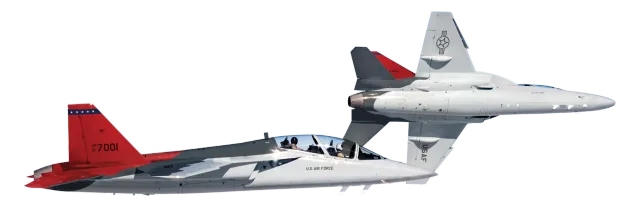
Trainer & light attack
T-7A Red Hawk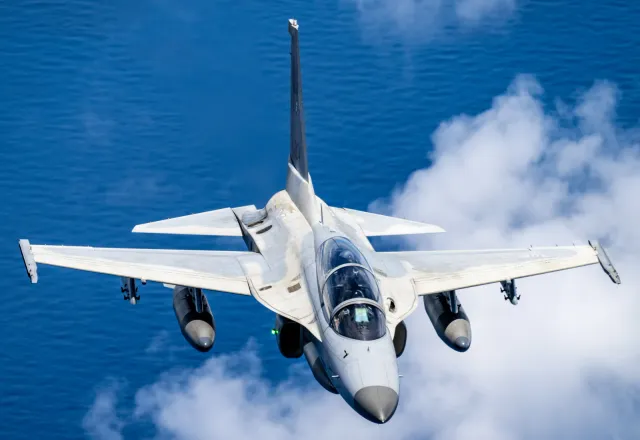
Trainer & light attack
T-50 Golden Eagle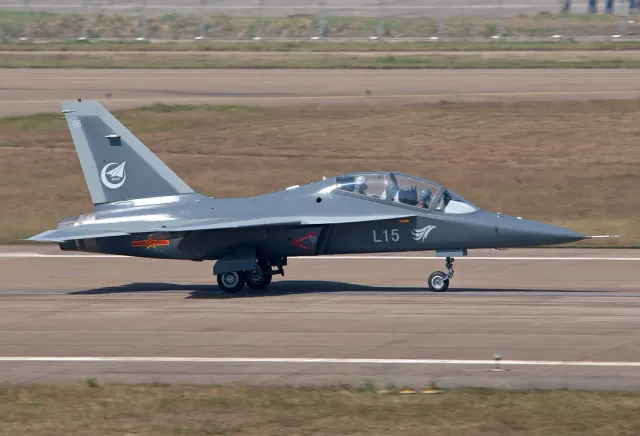
Trainer & light attack
KT-1 Woongbi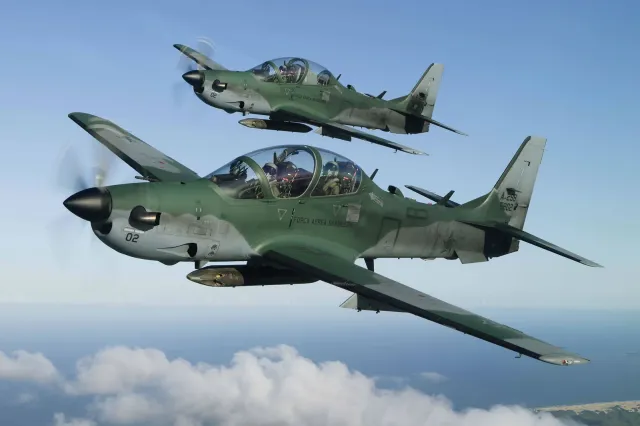
Trainer & light attack
A-29 Super TucanoFrequently asked questions
Is the Boeing T-7A Red Hawk supersonic? +
Depends which public source you read. Wikipedia, citing Boeing's own published spec, lists Mach 0.975 and calls the aircraft transonic, meaning it does not clear the sound barrier. Air & Space Forces Magazine lists Mach 1.05 or higher and calls it supersonic. The Defense Post lists Mach 0.95 (1,173 km/h). Three reputable sources describing the same airframe cannot agree on whether it crosses Mach 1, let alone by how much.
What is the fastest trainer aircraft in the WeaponSpecs database? +
The KAI/Lockheed Martin T-50 Golden Eagle, at a published 1,840 km/h (Mach 1.5), the only unambiguously supersonic design in the set with a Western manufacturer figure behind it. The Chinese Hongdu L-15 Falcon claims Mach 1.4, but that number comes from the manufacturer and has not been independently verified.
What is the slowest trainer aircraft in the database? +
The KAI KT-1 Woongbi and the TAI Hurkus tie at 574 km/h. Both are single-engine turboprops built for the primary stage of pilot training, where the job is teaching basic stick-and-rudder flying, not speed.
Why do air forces operate more than one type of trainer aircraft? +
Because no single airframe can affordably teach every stage of building a fighter pilot. Cadets start on cheap turboprops for basic airmanship, move to subsonic jets for instruments and formation flying, and only fly the expensive supersonic-class trainer for the high-G handling and energy management a fighter cockpit demands. Running all three stages on one aircraft would mean burning advanced-jet flight-hour costs on lessons a turboprop can teach just as well.
Was the T-38 Talon really the first supersonic trainer? +
Yes. The Smithsonian's National Air and Space Museum credits the Northrop T-38 Talon, which entered service in 1961, as the world's first supersonic jet trainer, with a published top speed of Mach 1.3 (1,382 km/h).
Related reading


