Product photos coming soon
 South Korea
 Korea Aerospace Industries (KAI)
KT-1 Woongbi
South Korea's indigenous single-engine turboprop basic trainer, developed by KAI and in production since the late 1990s. The KT-1 is powered by a Pratt & Whitney Canada PT6A turboprop of roughly 950 shaft horsepower and serves as the primary trainer of the Republic of Korea Air Force, with exports to Indonesia, Turkey (as the KT-1T), Peru and Senegal. The armed KT-1C export variant adds a forward-looking infrared pod and hardpoints for a 12.7mm gun pod, rockets, training missiles and unguided bombs for light-attack and lead-in fighter training roles.
In service since 2000 · 5 operator countries
Compiled from public sources ·primary reference ↗ ·last verified 2026-07-16
574
km/h
1,333
km range
Pricing: In production; ROK Air Force plus exports to Indonesia, Turkey, Peru and Senegal
Procurement snapshot
Availability & export
ROK export-licensed
DAPA-administered; aggressive export posture with financing/offset packages.
Channel: Government-to-government
Fielded & proven
Established · 5 operators
In service since 2000. Status: active.
Lifecycle cost (est.)
No public unit price to model from. Why so few systems publish one →
Interoperability
No standardised NATO calibre / datalink detected in public specs.
Derived guidance from public data, export regime by country of origin, lifecycle from the GAO ~30% acquisition rule. Verify eligibility, pricing and offsets with the manufacturer and your acquisition authority.
Full specifications
Performance
Speed, range, altitude and engagement capability.
- Max speed
Maximum level speed. For aircraft this is at optimal altitude; for ground vehicles, top road speed. Higher means faster response and better kinematic performance.
- 574 km/h Bottom 7% of trainers
- Range
Maximum distance: ferry range for aircraft, operational range for vehicles, maximum engagement distance for missiles. Higher means more standoff or persistence.
- 1,333 km Stronger than 28% of trainers
Physical
Dimensions, weight and crew.
- Crew
Personnel required to operate. Fewer reduces exposure; autoloaders trade a loader for mechanical complexity.
- 2
Propulsion
Engine, power and fuel.
- Engine
Powerplant model and type.
- Pratt & Whitney Canada PT6A-62 turboprop
- Engine power
Engine output power. Higher moves more weight faster.
- 950 hp
- Propulsion type
Turbofan, turboshaft, diesel, gas turbine, solid-fuel rocket, ramjet…
- Turboprop
Program
Cost, production scale and operators.
- Operator countries
Number of countries operating the system. More operators means broader support ecosystem.
- 5 Stronger than 53% of trainers
Specifications compiled from public Korea Aerospace Industries (KAI) and reference sources ↗. Published defense figures are approximations, treat comparisons as directional. Last verified 2026-07-16.
Compare with rivals
See how it stacks up
 Leonardo M-346 Master
  Yakovlev Yak-130
 Frequently asked questions
What is the top speed of the Korea Aerospace Industries (KAI) KT-1 Woongbi? +
The Korea Aerospace Industries (KAI) KT-1 Woongbi has a maximum speed of 574 km/h.
What is the range of the Korea Aerospace Industries (KAI) KT-1 Woongbi? +
The Korea Aerospace Industries (KAI) KT-1 Woongbi has a maximum range of 1,333 km.
How many crew does the Korea Aerospace Industries (KAI) KT-1 Woongbi require? +
The Korea Aerospace Industries (KAI) KT-1 Woongbi requires a crew of 2.
What engine does the Korea Aerospace Industries (KAI) KT-1 Woongbi use? +
The Korea Aerospace Industries (KAI) KT-1 Woongbi is powered by the Pratt & Whitney Canada PT6A-62 turboprop.
What is the Korea Aerospace Industries (KAI) KT-1 Woongbi used for? +
The Korea Aerospace Industries (KAI) KT-1 Woongbi is a trainer & light attack typically used for training, close air support.
How many countries operate the Korea Aerospace Industries (KAI) KT-1 Woongbi? +
The Korea Aerospace Industries (KAI) KT-1 Woongbi is operated by 5 countries.
How much does the Korea Aerospace Industries (KAI) KT-1 Woongbi cost? +
Korea Aerospace Industries (KAI) KT-1 Woongbi: In production; ROK Air Force plus exports to Indonesia, Turkey, Peru and Senegal. Defense program costs are rarely fully public and vary by contract and configuration.
Similar systems
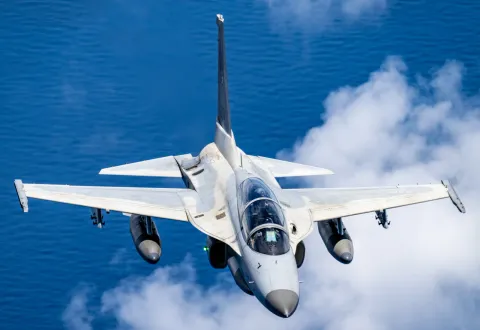
Korea Aerospace Industries (KAI)
T-50 Golden Eagle
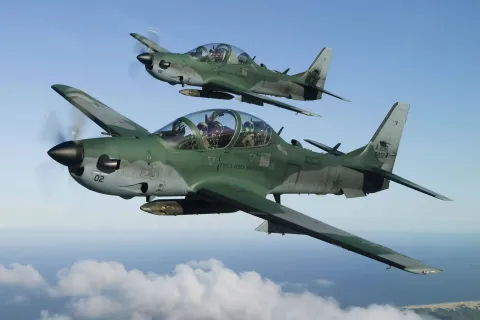
Embraer Defense & Security
A-29 Super Tucano
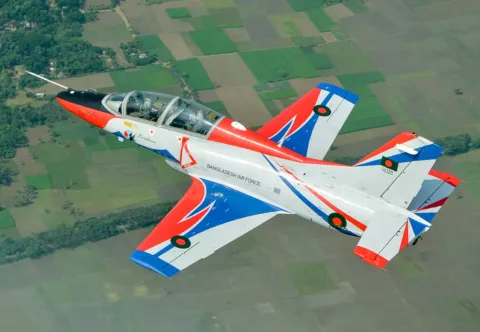
Hongdu Aviation Industry Group
JL-8
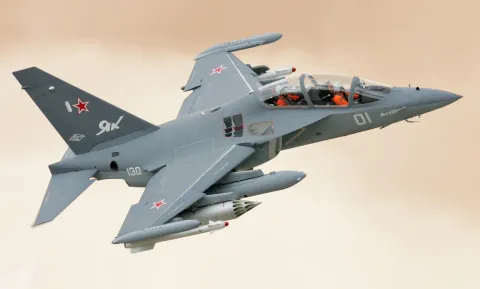
Yakovlev