Attack Helicopter Climb Rate: Why More Power Isn't Faster
AH-1Z Viper tops 22 database helicopters at 15.24 m/s climb, but hp-per-kg barely predicts who's fastest (r=-0.11), and fighters still climb 15-20x quicker.

Via Wikipedia, Bell AH-1Z Viper (shown for identification)
Eurofighter Typhoon climbs at 315 m/s. AH-1Z Viper, the fastest-climbing helicopter in the WeaponSpecs database, manages 15.24 m/s: a 20.7x gap that says more about airframe physics than about any single cockpit. The more useful finding sits inside the helicopter fleet itself. Across the 22 database helicopters that publish both installed power-to-weight and climb rate, more horsepower per kilogram does not buy a faster climb (Pearson r = -0.114, n=22). Turkey’s T129 ATAK carries the highest power-to-weight ratio in the set, 0.544 hp/kg, and still climbs slower than the Viper, which runs a merely middling 0.429 hp/kg.
Why does climb rate matter for a helicopter built to fly low?
Attack helicopters do not fly low by accident. They fly low because altitude is where they die: too slow and too radar-reflective to survive against a modern integrated air-defense network, a helicopter above tree-line becomes reachable by MANPADS, radar-guided guns and shoulder-fired missiles all at once. The doctrine that survives contact with that reality is the pop-up: rise from behind a ridge or tree-line just long enough to acquire a target and fire, then drop back under cover, holding exposure time to single-digit seconds.
Early in Russia’s full-scale invasion of Ukraine, crews that skipped this discipline paid for it.
“They flew their helicopters low and slow, which made them vulnerable to a host of ground-launched effects,” wrote Rob Bodisch, a retired U.S. Marine Corps colonel, in Small Wars Journal (March 27, 2026).
By 2023, Russian crews had adapted with a maneuver called lofting: hold the helicopter low behind cover, then pitch the nose up 15 to 30 degrees to launch unguided rockets from a stand-off distance before dropping back down, trading precision for survival, as The War Zone has reported. Climb rate is the physical resource underneath both tactics. A helicopter that gains altitude quickly buys itself more stand-off distance, or a shorter window exposed in the open, for the same maneuver.
How much faster do fighter jets climb than the best attack helicopter?
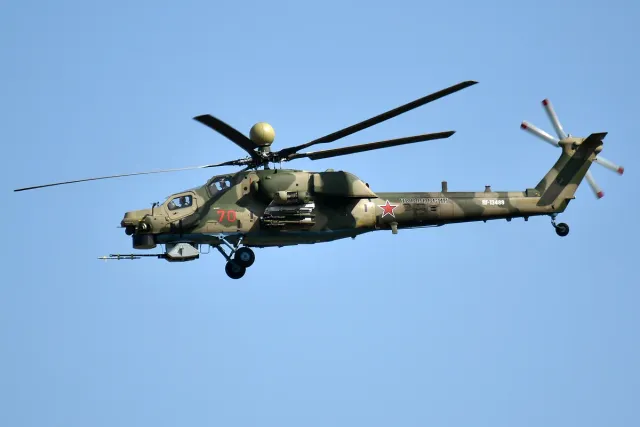
Put all 34 systems in the WeaponSpecs database that publish performance.rateOfClimbMs on one chart and the helicopter bars nearly vanish. Eurofighter Typhoon leads at 315 m/s, Su-35S claims 280 m/s (a Russian manufacturer figure, not independently verified), and F-22A Raptor sits at 254 m/s. AH-1Z Viper, the best-climbing helicopter in the set, tops out at 15.24 m/s: 20.7 times slower than the Typhoon. Russia’s Mi-28NM leads the rest of the helicopter field at 13.6 m/s, also a manufacturer claim.
AH-1Z Viper, the fastest-climbing helicopter here, would need to more than double its climb rate just to match the slowest fighter shown. Bars marked * are Russian manufacturer or state figures, not independently verified.
Treat the fighter ranking itself with some skepticism too. F-15EX Eagle II, F-16C Block 70/72 and F-22A Raptor all land at exactly 254 m/s in this database despite being different airframes with very different public reputations (the Raptor in particular is popularly regarded as the most capable US air-superiority fighter). That tie is not evidence the three climb identically in the real world. Climb rate gets measured at different reference conditions (altitude, fuel and loadout state, power setting, clean versus combat-loaded) by different manufacturers and militaries, so a database tie or a few percent of separation between fighters should not be read as a capability ranking. The number is far more useful for showing the fixed-wing-versus-rotary-wing gap than for sorting fighters against each other. Climb rate’s companion metric, service ceiling, tells you how high a fighter can operate once it gets there; thrust-to-weight ratio is the sibling spec that helps explain why it climbs that fast in the first place.
Does more horsepower per kilogram make a helicopter climb faster?
Compute installed power-to-weight (total shaft horsepower divided by combat weight in kilograms) for all 22 helicopters in the database that publish both fields, then plot it against climb rate, and the relationship all but disappears.
Pearson correlation across all 22 helicopters: r = -0.114. Knowing a helicopter's installed horsepower per kilogram tells you almost nothing about how fast it actually climbs.
Drop UH-60M Black Hawk, the one clear outlier and the database’s only pure utility/transport airframe in this group, and the correlation barely moves: r = -0.167 (n=21). Even restricted to purpose-built attack and scout helicopters, raw installed power per kilogram does not explain who climbs fastest.
T129 ATAK carries the highest power-to-weight ratio of any helicopter in the set, 0.544 hp/kg, yet ranks 10th of 22 in actual climb at 10.9 m/s, well behind AH-1Z Viper’s 15.24 m/s despite less installed power per kilogram (0.429 hp/kg). Japan’s Kawasaki OH-1 Ninja carries the second-highest ratio, 0.475 hp/kg, and still only manages a mid-pack 12 m/s. AH-1Z Viper leads the whole field with a merely middling ratio, roughly ninth of 22, less installed power per kilogram than T129 ATAK, OH-1 Ninja, Ka-52 Alligator (0.4615 hp/kg) or Ka-50 Black Shark (0.449 hp/kg), and it still out-climbs all four. Rotor design, disc loading and control-system tuning are doing more work here than the engine spec sheet.
UH-60M Black Hawk is the clearest outlier of all. Its power-to-weight ratio, 0.3996 hp/kg, sits in the same range as several attack helicopters and gives no hint of what follows: a 3.7 m/s climb, less than a third of the next-worst performer, AH-6 Little Bird’s 8.1 m/s. Horsepower per kilogram does not explain that gap. Mission role does: the Black Hawk is a utility troop-transport, and its rotor and flight-control tuning were never optimized for the aggressive vertical maneuver an attack helicopter’s are.
Kamov’s coaxial helicopters, two counter-rotating rotors and no tail rotor, are commonly assumed to hold a climb edge because they don’t lose power driving a tail-rotor gearbox. The data doesn’t back that up. Ka-50 Black Shark (10 m/s), Ka-52 Alligator (10 m/s) and Ka-29 (9 m/s) all sit in the bottom half of the climb ranking despite reasonably high power-to-weight ratios (0.449, 0.4615 and 0.387 hp/kg). The tail-rotor-power myth isn’t wrong about where the power goes, it’s wrong about what that power buys in climb rate. All three are Russian manufacturer or state figures, the same independent-verification caveat that applies to China’s Z-10, Z-19 and the CH-6 UAV elsewhere in this dataset.
What does two seconds of climb actually buy a helicopter crew?
Turn climb rate into something more visceral than m/s. Divide an illustrative 30-meter mask height, roughly a treeline or a low ridge, by each helicopter’s published climb rate, and you get a rough sense of how long a crew is exposed while popping up to fire: about 2.0 seconds for AH-1Z Viper, about 3.0 seconds for Ka-52 Alligator, and about 8.1 seconds for UH-60M Black Hawk.
Treat that math as illustration, not a validated tactical model. It is a simplified straight-line division of 30 meters by a single published climb-rate figure, not an exposure-time model that accounts for acceleration and deceleration through a real pop-up maneuver. Published rate-of-climb numbers are typically measured in sustained forward-flight climb, not a vertical hover-to-hover pop-up, and the Black Hawk is not actually flown this way in the first place since it is a transport, not a gunship. It’s included here only to make the physics gap feel concrete, not as a claim about how a Black Hawk crew would behave under fire.
Climb rate is a real lever against a ground gunner’s reaction time, but the threat picture has already moved past what a fast pop-up alone can answer. In March 2026, a Ukrainian fiber-optic FPV drone, immune to the radio-frequency jamming that grounds most radio-controlled drones, struck a Russian Ka-52 near Nadiivka in Donetsk Oblast, forcing an emergency landing, per Army Recognition. A two-second pop-up buys real cover from a gunner tracking a helicopter by eye or radar. It buys nothing against a threat category climb rate was never built to answer.
Where does every system in the database rank?
All 34 WeaponSpecs systems publishing performance.rateOfClimbMs, sorted fastest to slowest. For a full capability ranking instead of this single-metric cut, see WeaponSpecs’ Best Attack Helicopters of 2026; the helicopter type page covers the wider rotary-wing catalog beyond these 22.
| System | Type | Origin | Rate of Climb (m/s) |
|---|---|---|---|
| Eurofighter Typhoon | Fighter | Multi-national | 315 |
| Rafale F4 | Fighter | France | 305 |
| Mirage 2000-5 | Fighter | France | 285 |
| Su-35S | Fighter | Russia | 280* |
| F-15EX Eagle II | Fighter | USA | 254 |
| F-16C Block 70/72 | Fighter | USA | 254 |
| F-22A Raptor | Fighter | USA | 254 |
| F/A-18E/F Super Hornet | Fighter | USA | 228 |
| U-2 Dragon Lady | Fixed-wing ISR | USA | 45.7 |
| CH-6 Caihong | UAV | China | 20* |
| AH-1Z Viper | Attack helicopter | USA | 15.24 |
| Mi-28NM | Attack helicopter | Russia | 13.6* |
| Mi-35M | Attack helicopter | Russia | 13.3* |
| AH-2 Rooivalk | Attack helicopter | South Africa | 13.3 |
| AH-64D Apache Longbow | Attack helicopter | USA | 12.7 |
| AH-64E Apache Guardian | Attack helicopter | USA | 12.7 |
| Mi-24 Hind | Attack helicopter | Russia | 12.5* |
| HAL Rudra | Attack helicopter | India | 12 |
| Mi-24P | Attack helicopter | Russia | 12* |
| Kawasaki OH-1 Ninja | Scout helicopter | Japan | 12 |
| HAL Prachand (LCH) | Attack helicopter | India | 12 |
| T129 ATAK | Attack helicopter | Turkey | 10.9 |
| Z-10 | Attack helicopter | China | 10.8* |
| A129 Mangusta | Attack helicopter | Italy | 10.7 |
| Tiger HAD | Attack helicopter | France/Germany | 10.7 |
| Ka-50 Black Shark | Attack helicopter | Russia | 10* |
| Ka-52 Alligator | Attack helicopter | Russia | 10* |
| P-3 Orion | Fixed-wing MPA | USA | 9.9 |
| Ka-29 | Assault transport helicopter | Russia | 9* |
| AH-1W Super Cobra | Attack helicopter | USA | 8.87 |
| Z-19 | Scout/attack helicopter | China | 8.7* |
| AH-6 Little Bird | Light attack helicopter | USA | 8.1 |
| UH-60M Black Hawk | Utility/transport helicopter | USA | 3.7 |
| PD-2 UAS | UAV | Ukraine | 3 |
* Manufacturer or state-published figure, not independently verified.
Background on the airframes above: Wikipedia’s entries on the Eurofighter Typhoon, the Bell AH-1Z Viper, the Sikorsky UH-60 Black Hawk, and its rate of climb definition.
Climb rate is one input into a bigger procurement question, and installed power alone doesn’t answer it. Weigh it against weapons load, sensors and protection in the Compare tool, or build a threat-driven shortlist in the Advisor.
Sources
- Attack Helicopters Remain Vital to the American Way of War
- Russian Attack Helicopters Are Now Wildly Lobbing Rockets Over Ukraine
- Ukraine's fiber-optic drone shoots down Russian Ka-52 attack helicopter in flight for the first time
- Rate of climb
- Bell AH-1Z Viper
- Sikorsky UH-60 Black Hawk
- Eurofighter Typhoon
Systems in this comparison
Every system covered above, with its photo and, where available, a video. Tap a card to open the full spec sheet.
Compare these side by side →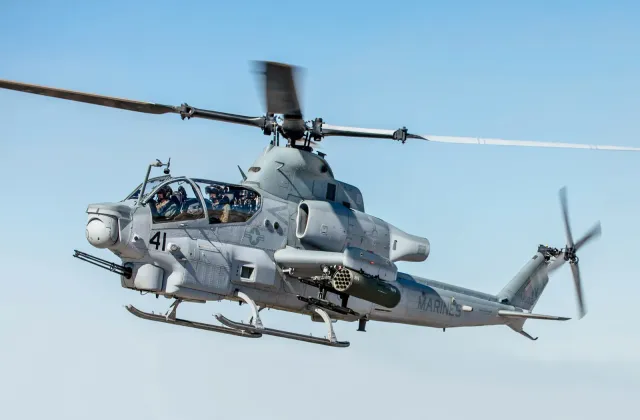
Helicopter
AH-1Z Viper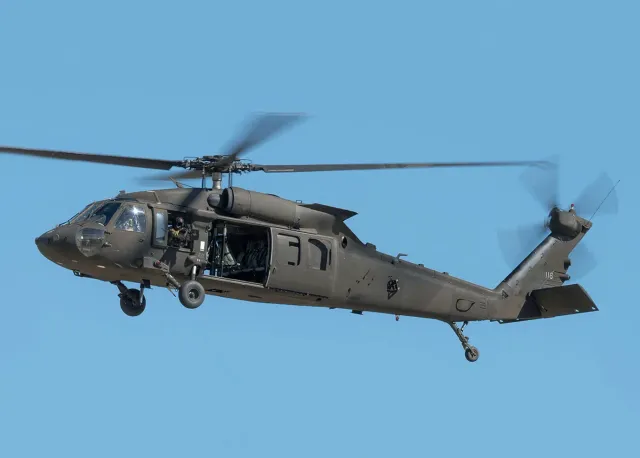
Helicopter
UH-60M Black Hawk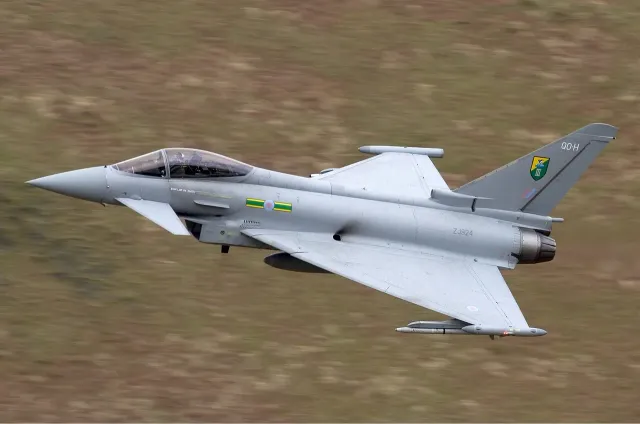
Fighter aircraft
Eurofighter Typhoon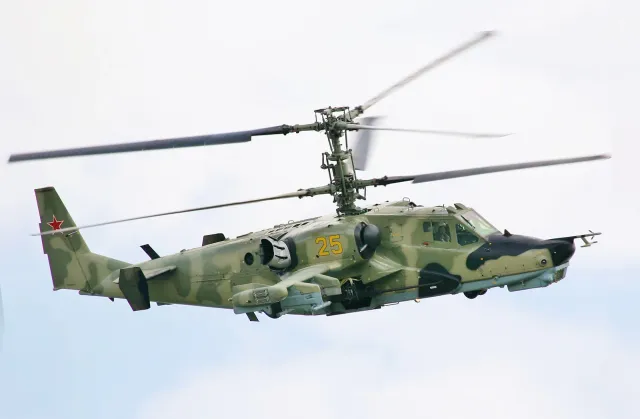
Helicopter
Ka-52 Alligator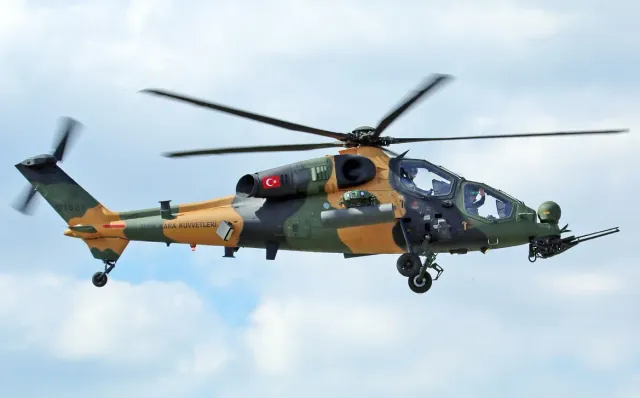
Frequently asked questions
What is helicopter rate of climb and how is it measured? +
Rate of climb is how fast an aircraft gains altitude in sustained forward flight, expressed in meters per second. In the WeaponSpecs database it comes from manufacturer or government-published performance figures, not a standardized independent flight test, so treat it as a published capability claim rather than a certified benchmark, especially for Russian- and Chinese-origin systems.
Why doesn't higher power-to-weight guarantee a faster-climbing helicopter? +
Because installed horsepower per kilogram only measures how much engine a helicopter carries, not how efficiently its rotor turns that power into lift. Across the 22 database helicopters that publish both figures, the correlation between hp/kg and climb rate is essentially zero (r = -0.114). T129 ATAK carries the highest ratio in the set and still climbs slower than AH-1Z Viper, which runs a middling ratio. Rotor design, disc loading and flight-control tuning explain more of the gap than the engine spec sheet does.
How much faster do fighter jets climb than attack helicopters? +
Eurofighter Typhoon, the fastest-climbing system in the WeaponSpecs database at 315 m/s, climbs roughly 20.7 times faster than AH-1Z Viper, the best-climbing helicopter at 15.24 m/s. That gap is expected given fixed-wing versus rotary-wing aerodynamics; the database just puts a precise number on it.
Why do attack helicopters fly low instead of climbing to altitude to avoid ground fire? +
Altitude is where a helicopter becomes visible and reachable to radar-guided guns, MANPADS and other ground-launched threats it is too slow to outrun. Doctrine built around that reality favors brief pop-ups from behind terrain cover over sustained climbs, trading a few seconds of exposure for the cover a low-altitude profile provides the rest of the time.
How is this different from WeaponSpecs' 'Best Attack Helicopters of 2026' ranking? +
That ranking scores helicopters across their full spec sheet: weapons load, sensors, protection, range and more. This piece isolates one performance metric, climb rate, and asks a narrower question: does raw installed power predict it. Several helicopters that rank well overall, including some higher-hp/kg systems, don't climb particularly fast, exactly the kind of single-metric nuance a full ranking necessarily smooths over.
Related reading


