Fighter Thrust-to-Weight Ranked: F-35 Trails at 0.87
The Eurofighter Typhoon tops 44 ranked fighters at a 1.15 thrust-to-weight ratio; the hyped F-35 family trails at 0.75-0.94, ranking 40th of 44.
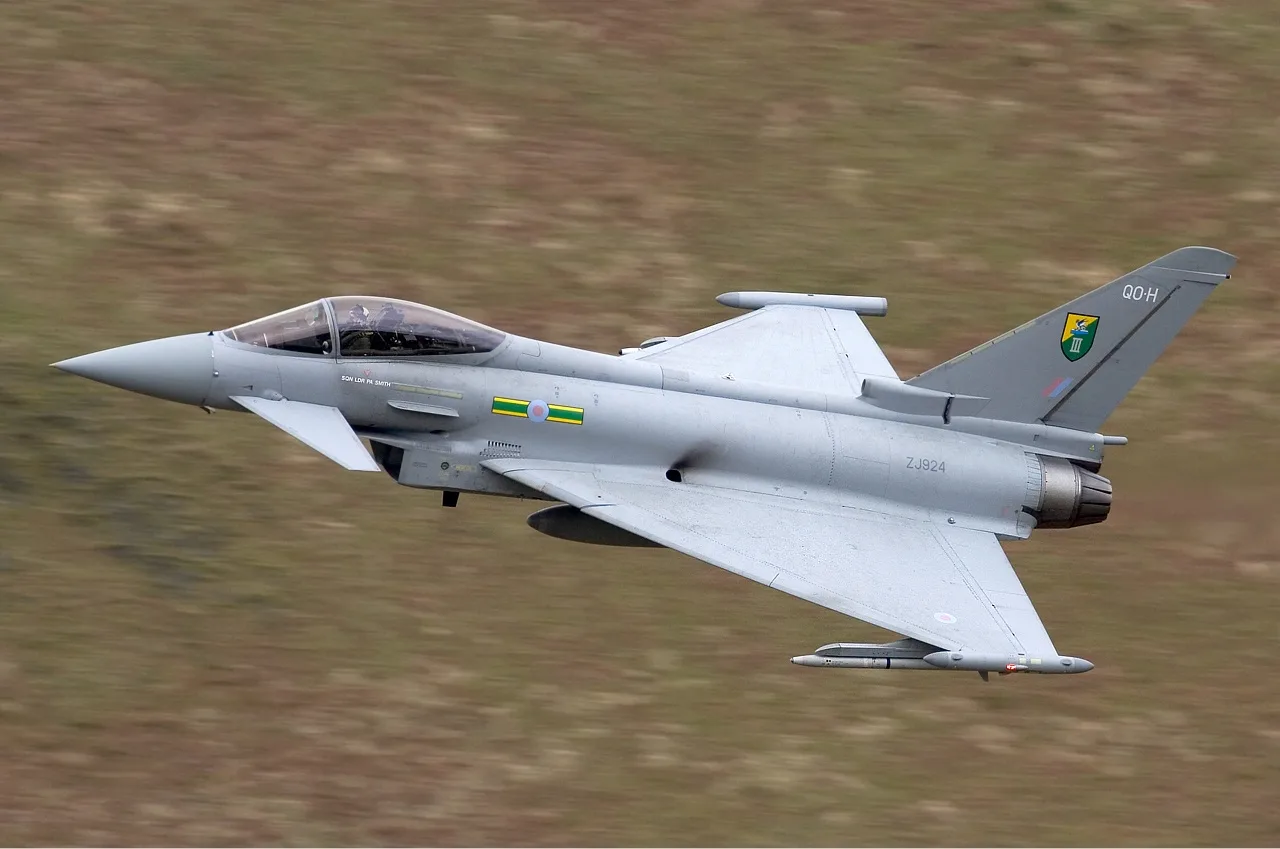
Via Wikipedia, Eurofighter Typhoon (shown for identification)
The Eurofighter Typhoon publishes the highest thrust-to-weight ratio of any fighter jet in WeaponSpecs’ database: 1. The F-35, the most-hyped and most-produced fifth-generation fighter in service anywhere, does not come close. The F-35A sits at 1, the F-35B at 1, and the F-35C, the Navy’s carrier variant, at just 1. Ranked against every other fighter that publishes the figure, the F-35A lands 40th of 44.
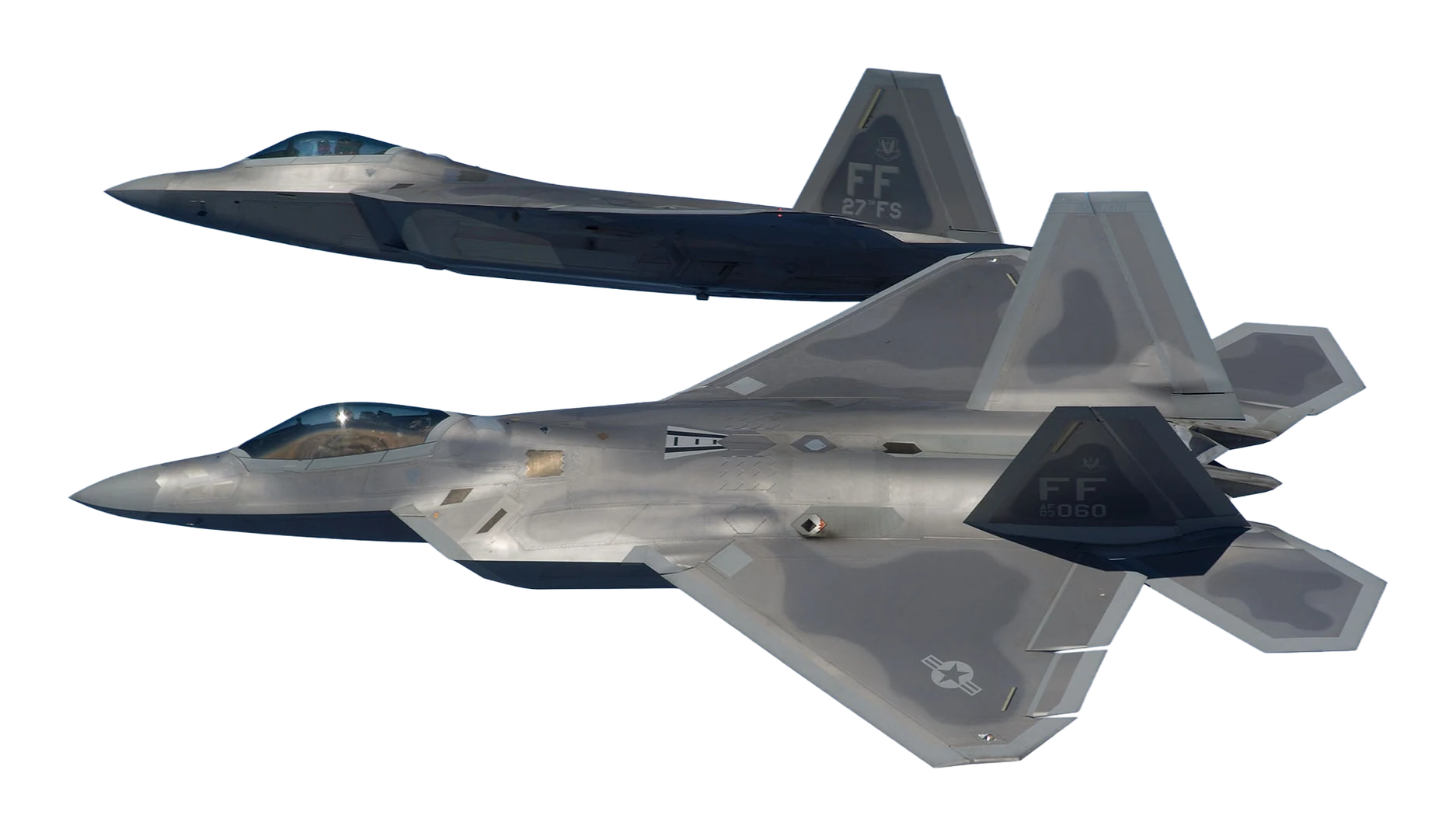
Of the 59 fighter jets in WeaponSpecs’ spec database, 44 (75%) publish a thrust-to-weight figure at all; the other 15 (25%) simply do not disclose it, a data-transparency gap worth flagging on its own before trusting any ranking built from what manufacturers choose to release. Ranking the 44 that do, this is not a “stealth jets underperform” story. Two other fifth-generation stealth fighters, the Su-57 and the F-22A Raptor, sit tied for third at 1, right behind the Eurofighter. It is specifically an F-35 story, and the explanation is a deliberate design tradeoff, not a flaw.
What does thrust-to-weight ratio actually measure?
Thrust-to-weight ratio is engine thrust at maximum power, measured in kilonewtons, divided by the aircraft’s weight converted to the same force units. A ratio above 1.0 means the engines can theoretically push the jet straight up against gravity, no wings required. Below 1.0, the aircraft depends on its wings for lift the way most aircraft do. In practice the number is a shorthand for acceleration and climb potential: a high ratio lets a fighter build energy fast, chase or disengage on its own terms, and sustain hard turns without bleeding speed as quickly.
It says nothing about radar performance, weapons range, stealth, or sensor fusion, and different manufacturers do not all define “combat weight” the same way. Some use empty weight plus a pilot and partial fuel, others use full internal fuel with a typical air-to-air loadout. That inconsistency is why small gaps of a few hundredths between similar jets in the table below should not be over-read as meaningful. It is also why the F-35’s gap is the real story here rather than noise: 0.75-0.94 sitting clearly apart from the 1.00-1.15 cluster at the top is too large to explain away as a rounding or definitional difference.
Three of the seven stealth jets shown, Su-57, F-22A, and J-20, rank above every F-35 variant, so the F-35's position is not a generational pattern.
Why does the F-35 rank near the bottom?
The short answer is that thrust-to-weight was never the metric the F-35 was optimized to win. The airframe was built around beyond-visual-range detection and networked sensor fusion, using an AESA radar and a distributed infrared tracking system feeding a single fused picture to the pilot, rather than around the kind of raw aerodynamic performance that produces a high thrust-to-weight number (background on the airframe: Wikipedia, F-35 Lightning II).
A recent National Interest analysis makes the tradeoff explicit: the F-35’s stealth shaping restricts canards, leading-edge extensions, and large control surfaces that would otherwise boost maneuverability, and its single-engine, moderate thrust-to-weight design was a deliberate choice by engineers who anticipated that “beyond-visual-range (BVR) engagement” would be the primary mode of future aerial combat, building sensors and data fusion to detect and engage targets before a dogfight could start rather than to win one, see The F-35 Lightning Fighter Can Do Anything, Except Win a Dogfight, The National Interest. That is a design choice, not an admission that the jet is inferior. A fighter whose doctrine says “kill before being seen” has less reason to chase a high climb-rate number than one built to out-turn an opponent at close range.
The F-35C’s 1 is the lowest thrust-to-weight ratio of any true air-superiority-capable fighter in the database. Only the Su-34, a dedicated strike/bomber derivative of the Su-27 family built for ground attack rather than air-to-air combat, ranks lower at 1, and that comparison is not a fair one given the two aircraft have entirely different missions.
Are the other fifth-generation fighters different?
Yes, clearly. If thrust-to-weight ratio simply tracked “stealth versus non-stealth,” every fifth-generation jet in the table would cluster near the bottom with the F-35. Instead, the Su-57 and F-22A Raptor sit tied for third at 1, ahead of all but two conventional 4th/4.5-generation jets. China’s J-20 sits mid-pack at 1, and its J-35 at 1. Only the F-35 family trails behind the pack, which rules out “all stealth jets sacrifice thrust-to-weight” as the explanation and points back to the F-35’s specific BVR-first design brief.
The Su-57 figure needs its own caveat before it is compared to anything. The database’s Su-57 thrust rating of 147 kN, feeding its 1.08 ratio, most plausibly reflects the definitive “Izdeliye 30” second-stage engine rather than the older AL-41F1 powerplants that have equipped the large majority of Su-57s delivered and operating today. United Aircraft Corporation stated in early 2026 that new-build Su-57s would ship with the Izdeliye 30, but independent reporting found no confirmation that jets delivered as of February 2026 actually carried it in operational service, and a further-evolved engine, the “Izdeliye 177” combining AL-41F-1 and AL-51F-1 technology, only began flight testing in December 2025, nearly a decade after the Izdeliye 30 itself first flew in 2017 (see The Aviationist, Su-57’s New Izdeliye 177 Engine and Wikipedia, Sukhoi Su-57). Read the Su-57’s 1.08 as a claim about an eventual engine standard, not a verified figure for the aircraft Russia is fielding right now. It is also, like every Russian or Chinese figure in this dataset, a manufacturer or state claim rather than an independently audited result.
There is also a modest but real single-versus-twin-engine gap across the whole sample: the 15 single-engine fighters in the 44-jet dataset post a median thrust-to-weight of 0.963, against 1.005 for the 29 twin-engine fighters, worth one sentence rather than its own analysis, since the F-35’s gap dwarfs it regardless of engine count.
Every fighter in the database that publishes the figure
Ranked descending, all 44 fighters with a published thrust-to-weight ratio:
| Rank | Model | Thrust-to-weight | Engines | Country | Release year |
|---|---|---|---|---|---|
| 1 | Eurofighter Typhoon | 1 | 2 | Multi-national | 2003 |
| 2 | Su-27 | 1 | 2 | Russia | 1985 |
| 3 | Su-35S | 1 | 2 | Russia | 2014 |
| 4 | F-15C Eagle | 1 | 2 | United States | 1979 |
| 5 | Mitsubishi F-15J | 1 | 2 | Japan | 1981 |
| 6 | F-16C Block 52 | 1 | 1 | United States | 1991 |
| 7 | F-16C Block 70 | 1 | 1 | United States | 2023 |
| 8 | J-11 | 1 | 2 | China | 2007 |
| 9 | KAAN | 1 | 2 | Turkey | 2024 |
| 10 | MiG-29 | 1 | 2 | Russia | 1982 |
| 11 | F-22A Raptor | 1 | 2 | United States | 2005 |
| 12 | Su-57 | 1 | 2 | Russia | 2020 |
| 13 | F-15EX Eagle II | 1 | 2 | United States | 2021 |
| 14 | JAS 39E Gripen | 1 | 1 | Sweden | 2019 |
| 15 | MiG-35 | 1 | 2 | Russia | 2019 |
| 16 | Tejas Mk2 | 1 | 1 | India | 2027 |
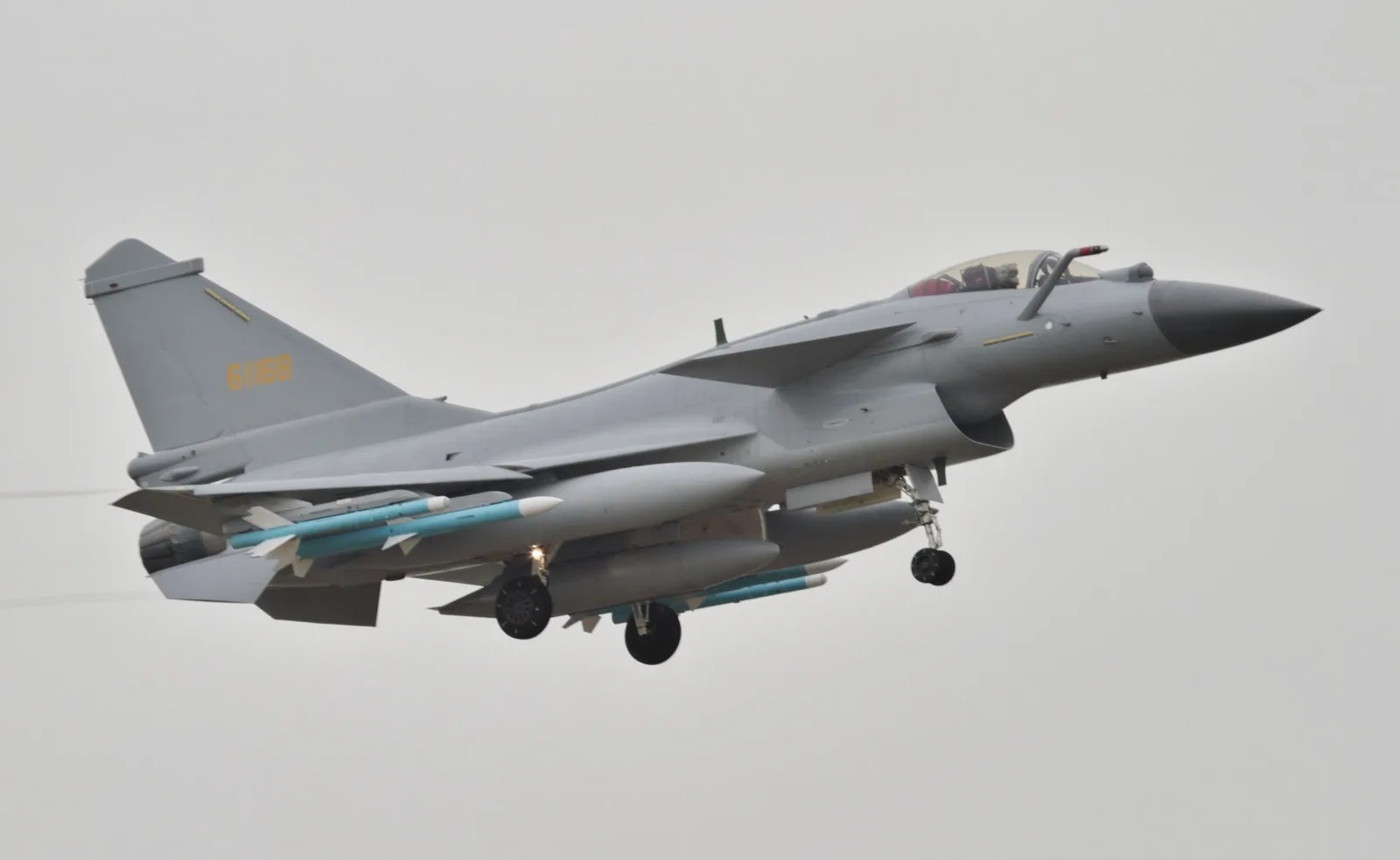
| 17 | J-10C | 1 | 1 | China | 2018 |
| 18 | J-20 | 1 | 2 | China | 2017 |
| 19 | KF-21 Boramae | 1 | 2 | South Korea | 2026 |
| 20 | Su-30SM | 1 | 2 | Russia | 2012 |
| 21 | J-16 | 1 | 2 | China | 2015 |
| 22 | Rafale C | 1 | 2 | France | 2006 |
| 23 | Rafale F4 | 1 | 2 | France | 2023 |
| 24 | J-15 | 1 | 2 | China | 2013 |
| 25 | J-35 | 1 | 2 | China | 2024 |
| 26 | Rafale M | 1 | 2 | France | 2001 |
| 27 | Tejas Mk1A | 1 | 1 | India | 2024 |
| 28 | JAS 39C Gripen | 1 | 1 | Sweden | 2003 |
| 29 | F/A-18C Hornet | 1 | 2 | United States | 1987 |
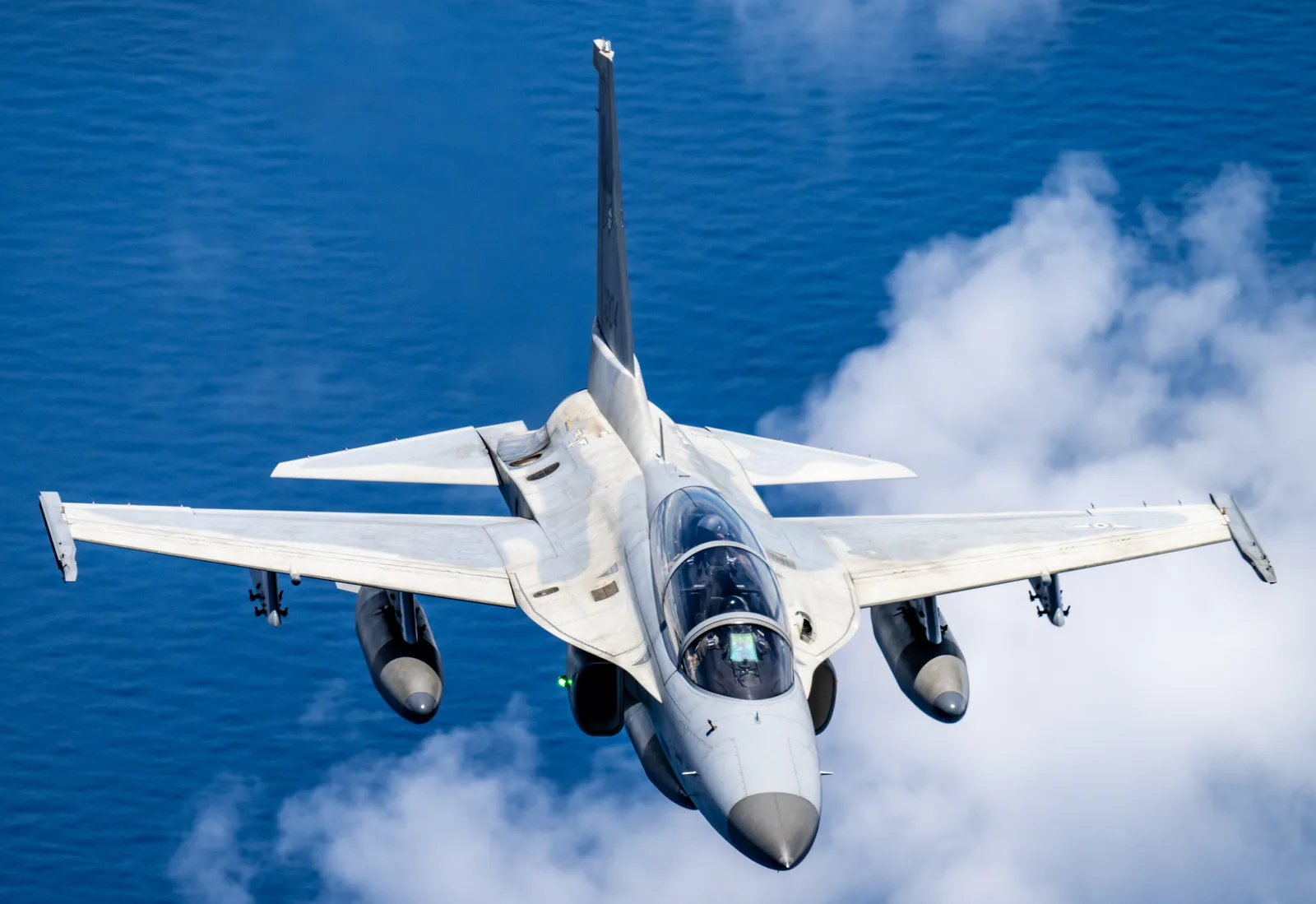
| 30 | FA-50 Golden Eagle | 1 | 1 | South Korea | 2013 |
| 31 | JF-17 Block 3 | 1 | 1 | Pakistan | 2020 |
| 32 | F-35B Lightning II | 1 | 1 | United States | 2015 |
| 33 | EA-18G Growler | 1 | 2 | United States | 2009 |
| 34 | F-15E Strike Eagle | 1 | 2 | United States | 1989 |
| 35 | F/A-18E/F Super Hornet | 1 | 2 | United States | 1999 |
| 36 | Mirage 2000-5 | 1 | 1 | France | 1996 |
| 37 | Mitsubishi F-2 | 1 | 1 | Japan | 2000 |
| 38 | JF-17 Thunder | 1 | 1 | Pakistan | 2007 |
| 39 | F-14 Tomcat | 1 | 2 | United States | 1974 |
| 40 | F-35A Lightning II | 1 | 1 | United States | 2016 |
| 41 | F-4E Phantom II | 1 | 2 | United States | 1967 |
| 42 | MiG-31 | 1 | 2 | Russia | 1981 |
| 43 | F-35C Lightning II | 1 | 1 | United States | 2019 |
| 44 | Su-34 | 1 | 2 | Russia | 2014 |
*Su-57 (rank 12): the published figure most plausibly reflects the Izdeliye 30 engine standard, not the AL-41F1 that equips most Su-57s in service today, treat it as provisional pending confirmed deliveries. Russian and Chinese entries throughout this table (Su-27, Su-35S, J-11, MiG-29, Su-57, MiG-35, J-10C, J-20, Su-30SM, J-16, J-15, J-35, MiG-31, Su-34) are manufacturer or state figures, not independently verified. KAAN, Tejas Mk2, and KF-21 Boramae are pre-production or low-rate-production programs; their figures describe developmental targets rather than established in-service data.
The bottom line
Eurofighter Typhoon leads this ranking not because it is the most advanced fighter flying, but because it pairs a genuinely powerful twin-engine setup with a comparatively light combat weight. The F-35 trails not because Lockheed Martin under-built it, but because thrust-to-weight was never the number its BVR-and-sensor-fusion doctrine was designed to maximize. The two other stealth jets near the top of this list, Su-57 and F-22A, confirm it: stealth and a high ratio are not mutually exclusive, the F-35 just made a different bet, and one caveat still applies to the Su-57’s own number before anyone leans on it.
Reading a single spec sheet number as a verdict on which jet “wins” misses what actually decides an air force’s procurement choice: mission profile, doctrine, interoperability, and the full sensor and weapons package, not one ratio in isolation. See a deeper claimed-versus-verified look at these three jets in Su-57 vs F-35 vs J-20, browse the full specs for the Eurofighter Typhoon, F-35A Lightning II, Su-57, F-22A Raptor, and J-20 directly, and run your own mission profile through the Advisor to see which airframe’s tradeoffs actually fit your requirement.
Systems in this comparison
Every system covered above, with its photo and, where available, a video. Tap a card to open the full spec sheet.
Compare these side by side →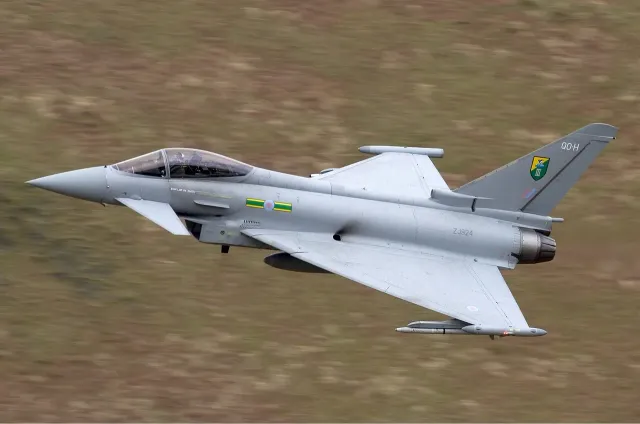
Fighter aircraft
Eurofighter Typhoon
Fighter aircraft
F-35A Lightning II
Fighter aircraft
F-22A Raptor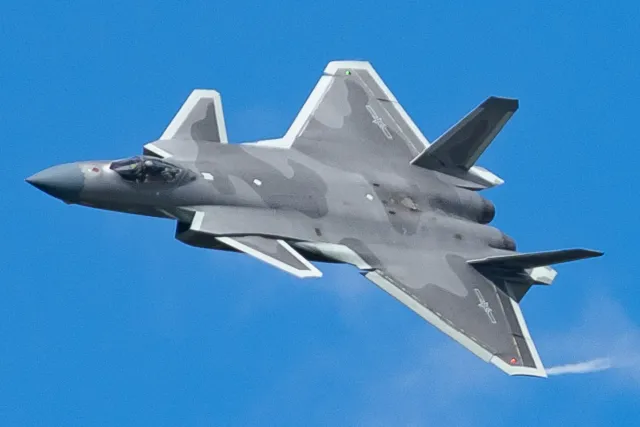
Frequently asked questions
What does thrust-to-weight ratio actually measure on a fighter jet? +
It is engine thrust at maximum power divided by the aircraft's weight, both expressed in comparable units. A ratio above 1.0 means the engines produce more force than the jet weighs, so the aircraft can theoretically accelerate straight up. It is a proxy for raw energy and climb/acceleration potential, not a measure of turn rate, sensors, weapons, or overall combat effectiveness.
Why does the F-35 have a lower thrust-to-weight ratio than jets like the F-16? +
The F-35 was designed around beyond-visual-range detection and sensor fusion rather than close-in dogfighting agility. Its single F135 engine is powerful in absolute terms, but the airframe's stealth shaping, internal weapons bays, and multirole weight carry a combat weight that keeps the ratio under 1.0 across all three variants. It is a documented design tradeoff, not an engineering shortfall.
Is the Eurofighter Typhoon's engine more powerful than the F-22 Raptor's? +
No. The F-22A's twin F119 engines publish 156 kN of thrust versus the Eurofighter's twin EJ200s at 90 kN, a wide margin in raw power. The Eurofighter still posts a higher thrust-to-weight ratio because its combat weight is far lower, around 23,500 kg against the F-22's roughly 29,410 kg. Thrust-to-weight rewards a light airframe as much as a strong engine.
Can the Su-57's published thrust-to-weight figure be trusted given its engine status? +
Treat it as provisional. The database's Su-57 thrust figure most plausibly reflects the definitive Izdeliye 30 second-stage engine, but independent reporting has not confirmed that engine is standard on the jets Russia has actually delivered to squadron service, most of which have flown on the earlier AL-41F1. A further-evolved engine only began flight testing in December 2025. The Su-57's ranking should be read as a claim about an eventual engine standard, not a verified figure for today's operational fleet.
Does a higher thrust-to-weight ratio mean a fighter wins more dogfights? +
Not by itself. Doctrine, sensor fusion, weapons range, pilot training, and whether the engagement happens beyond visual range at all matter far more in modern air combat than raw acceleration. Thrust-to-weight is one input among many, and a jet built to avoid the dogfight in the first place does not need to win one.
Related reading