Documents
 Russia
 Russian Helicopters
Mi-24P
A gun-armed Mi-24 Hind variant that replaced the earlier four-barrel Gatling gun with a fixed twin-barrel 30 mm GSh-30K autocannon for stronger anti-armor strafing capability, while retaining the type's troop cabin and anti-tank missile hardpoints. It remains in active Russian and export service.
In service since 1981 · 30 operator countries
Compiled from public sources ·primary reference ↗ ·last verified 2026-07-02
320
km/h
450
km range
4,500
m ceiling
1,500
kg payload
Pricing: Unit cost not consistently publicly disclosed
Procurement snapshot
Availability & export
Russian state channel
Rosoboronexport monopoly; Western sanctions exposure and payment/logistics risk for many buyers.
Channel: Rosoboronexport (state)
Fielded & proven
Widely fielded · 30 operators
In service since 1981. Status: active.
Lifecycle cost (est.)
No public unit price to model from. Why so few systems publish one →
Interoperability
No standardised NATO calibre / datalink detected in public specs.
Derived guidance from public data, export regime by country of origin, lifecycle from the GAO ~30% acquisition rule. Verify eligibility, pricing and offsets with the manufacturer and your acquisition authority.
Compatible munitions & weapons
Publicly reported weapons the Mi-24P can carry. Linked items have a full spec page.


Full specifications
Performance
Speed, range, altitude and engagement capability.
| Max speed Maximum level speed. For aircraft this is at optimal altitude; for ground vehicles, top road speed. Higher means faster response and better kinematic performance. | 320 km/h |
|---|---|
| Cruise speed Sustained economical speed. Determines transit time to station. | 270 km/h |
| Range Maximum distance: ferry range for aircraft, operational range for vehicles, maximum engagement distance for missiles. Higher means more standoff or persistence. | 450 km |
| Service ceiling Maximum operating altitude. Higher gives energy advantage and sensor horizon. | 4,500 m |
| Rate of climb How fast the aircraft gains altitude. Higher means better energy recovery in combat. | 12 m/s |
Firepower
Armament, payload and guidance.
| Main armament Primary weapon: main gun, cannon or missile type. | 30 mm twin-barrel GSh-30K autocannon |
|---|---|
| Hardpoints External stations for weapons and pods. More means bigger and more flexible loadouts. | 6 |
| Weapons payload Maximum ordnance weight the platform can carry. Higher means more strike capacity per sortie. | 1,500 kg |
Protection
Armor, countermeasures and survivability.
| Armor Armor technology: composite, modular, ERA-fitted, uranium-ceramic. Exact compositions are classified. | Titanium rotor blade spar and armored cockpit tub |
|---|---|
| Countermeasures Self-protection: chaff, flares, DIRCM, towed decoys, smoke dischargers, jammers. | ASO-2V chaff/flare dispenser, exhaust IR suppressors |
Physical
Dimensions, weight and crew.
| Length Overall length including gun/probe where applicable. | 17.5 m |
|---|---|
| Height Overall height. Lower profile is harder to spot and hit for ground vehicles. | 4.25 m |
| Empty weight Weight without fuel, ammunition or crew. | 8,500 kg |
| Combat weight Fully loaded weight. Lighter eases transport and bridging limits; heavier often means more armor. | 11,500 kg |
| Crew Personnel required to operate. Fewer reduces exposure; autoloaders trade a loader for mechanical complexity. | 2 |
Propulsion
Engine, power and fuel.
| Engine Powerplant model and type. | 2x Isotov TV3-117 turboshaft, 2200 hp each |
|---|---|
| Engines Number of engines. Twin-engine gives redundancy at higher cost. | 2 |
| Engine power Engine output power. Higher moves more weight faster. | 2,200 hp |
| Propulsion type Turbofan, turboshaft, diesel, gas turbine, solid-fuel rocket, ramjet… | Turboshaft |
Sensors & avionics
Radar, sensor suite and datalinks.
| Sensors IRST, EO/IR turrets, laser designators, sniper pods, thermal sights. | Raduga-Sh sighting system |
|---|---|
| Thermal imaging Thermal sights for night and obscured-visibility operations. | No |
Program
Cost, production scale and operators.
| Operator countries Number of countries operating the system. More operators means broader support ecosystem. | 30 |
|---|
Specifications compiled from public Russian Helicopters and reference sources ↗. Published defense figures are approximations, treat comparisons as directional. Last verified 2026-07-02.
Compare with rivals
See how it stacks up
 Boeing AH-64D Apache Longbow
 Frequently asked questions
What is the top speed of the Russian Helicopters Mi-24P? +
The Russian Helicopters Mi-24P has a maximum speed of 320 km/h.
What is the range of the Russian Helicopters Mi-24P? +
The Russian Helicopters Mi-24P has a maximum range of 450 km.
What is the weapons payload of the Russian Helicopters Mi-24P? +
The Russian Helicopters Mi-24P can carry up to 1,500 kg of weapons payload.
How much does the Russian Helicopters Mi-24P weigh? +
The Russian Helicopters Mi-24P has a combat weight of 11,500 kg.
How many crew does the Russian Helicopters Mi-24P require? +
The Russian Helicopters Mi-24P requires a crew of 2.
What is the main armament of the Russian Helicopters Mi-24P? +
The Russian Helicopters Mi-24P's primary weapon is the 30 mm twin-barrel GSh-30K autocannon.
What engine does the Russian Helicopters Mi-24P use? +
The Russian Helicopters Mi-24P is powered by the 2x Isotov TV3-117 turboshaft, 2200 hp each.
What is the Russian Helicopters Mi-24P used for? +
The Russian Helicopters Mi-24P is a helicopter typically used for close air support, anti armor.
How many countries operate the Russian Helicopters Mi-24P? +
The Russian Helicopters Mi-24P is operated by 30 countries.
How much does the Russian Helicopters Mi-24P cost? +
Russian Helicopters Mi-24P: Unit cost not consistently publicly disclosed. Defense program costs are rarely fully public and vary by contract and configuration.
Similar systems
Russian Helicopters
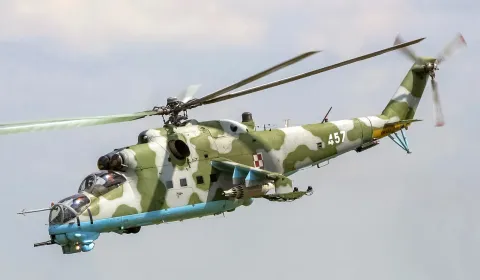
Mi-24 Hind
Russian Helicopters
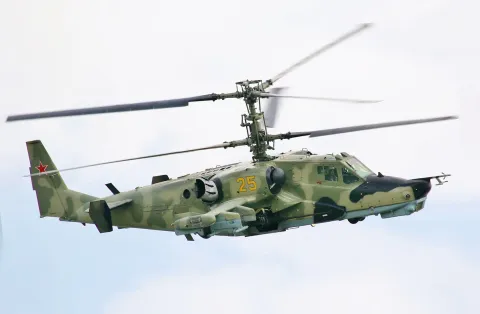
Ka-50 Black Shark
Russian Helicopters
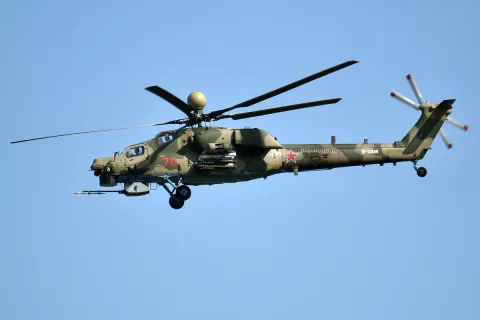
Ka-52 Alligator
Russian Helicopters