Golden Dome's 12 Interceptor Bidders Clear First Design Gate
All 12 contractors racing to build Golden Dome's $3.2 billion space-based interceptor layer passed Gate 1 design review, moving toward orbital prototypes.
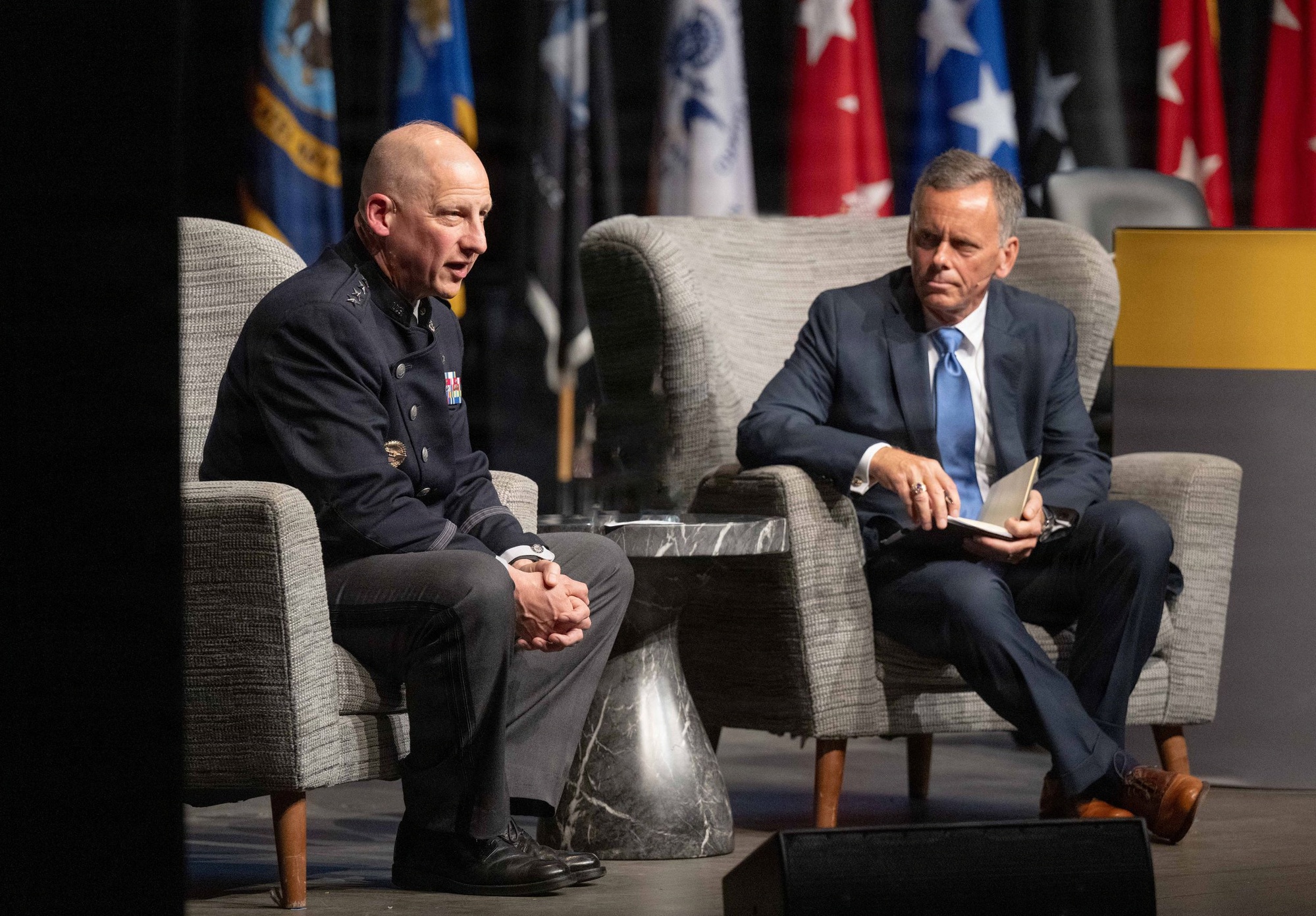
DVIDS/DoD public domain, VIRIN 260811-D-D0500-1004.
All 12 companies competing to build the space-based interceptor layer of the Golden Dome missile shield have passed the program’s first design review, Space Force Lt. Gen. Michael Guetlein said Aug. 11, clearing a $3.2 billion field of contractors toward building space-capable hardware rather than paper designs.
A four-gate ladder built to avoid a familiar acquisition mistake
Golden Dome for America, the space-based missile shield effort Guetlein directs, structured the space-based interceptor (SBI) competition around four sequential gates rather than picking a winner up front. Gate 1, the one all 12 companies just cleared, requires a finalized design plus component-level testing on the ground: motors, sensors, guidance electronics and the like proven individually, not yet assembled into a flight-ready interceptor. Gate 2 requires building an actual space-capable prototype. Gate 3 requires demonstrating that prototype’s functionality in orbit. Gate 4 requires validating how the winning design integrates into Golden Dome’s wider architecture of sensors, ground systems and other interceptor layers. No company receives production money until all four gates close, a sequencing meant to keep the Pentagon from repeating a mistake that has dogged missile defense and other major weapons programs for decades: locking in an expensive design years before anyone can prove it is affordable to build at scale.
“All of the providers that are part of the competition are progressing exceptionally well,” Guetlein told reporters at the Space and Missile Defense Symposium in Huntsville, Alabama, according to Breaking Defense.
Twelve companies, three ways to kill a missile from orbit
The Space Force selected the 12 companies in April across 20 separate Other Transaction Authority awards worth $3.2 billion combined, according to DefenseScoop: Anduril, Booz Allen Hamilton, General Dynamics Mission Systems, GITAI USA, Lockheed Martin, Northrop Grumman, Quindar, Raytheon, Sci-Tec, SpaceX, True Anomaly and Turion Space Corp. The roster mixes legacy primes like Lockheed Martin and Northrop Grumman with newer entrants such as Anduril, True Anomaly and Turion, reflecting the Pentagon’s broader push to pull commercial space and software companies into a competition that would once have gone almost automatically to the same handful of established contractors.
The 20 awards split across three distinct interceptor concepts, per Payload Space: boost-phase endo-atmospheric interceptors meant to hit a missile in its earliest, slowest climb through the atmosphere; exo-atmospheric interceptors that operate in the vacuum of space during a missile’s mid-course coast; and dedicated mid-course interceptors covering that same phase with a different engineering approach. Running three concepts in parallel lets the Space Force compare real hardware against real hardware at Gate 2 rather than betting the whole layer on a single design’s untested assumptions.

Guetlein’s travel schedule underlines how much of Golden Dome sits outside the space-based layer entirely. His July visit to the Vertical Launching System site under construction at Andersen Air Force Base, Guam, is part of the same program’s ground and sea-based defenses, a reminder that the space-based interceptors making headlines this week are one piece of an architecture widely estimated at $175 billion to $185 billion in total.
Money is already flowing well ahead of any orbital proof
Capital is moving into this field faster than the program itself has proven anything works. True Anomaly, one of the 12 SBI awardees, separately raised $650 million in a funding round reported by CNBC and TheNextWeb, a figure the company itself has not confirmed, pushing its total outside funding past $1 billion. That kind of investor bet on a company whose interceptor design has cleared only a ground-testing checkpoint says less about the technology’s maturity than about how much private capital sees Golden Dome’s outyear production contracts as worth positioning for now, well before Gate 2 hardware exists.
Two years of harder gates stand between now and a fielded interceptor
The Pentagon is targeting interceptor-related testing before the end of 2026, with the first orbital flight demonstrations, Gate 3 territory, aimed at 2027. That leaves a roughly 18-month gap between this week’s milestone and the point where any of the 12 designs actually has to prove it can hit something in space. Nothing in Gate 1’s requirements tests intercept performance, cost per unit, or manufacturability at the volumes Golden Dome would eventually need to field a real orbital shield, which is precisely why the Space Force built three more gates before committing production dollars.
Sources
- Space-based interceptor contractors passed first Golden Dome milestone: Guetlein — Breaking Defense, Aug 12, 2026
- Golden Dome takes first step as US companies pass key missile-defence tests — Caliber.Az, Aug 12, 2026
- Space Force names 12 companies to develop Golden Dome's space-based interceptors — DefenseScoop, Apr 24, 2026
- Pentagon Taps 12 Companies for Golden Dome SBI Tech — Payload Space, Apr 27, 2026
Frequently asked questions
What did the 12 companies actually pass? +
Gate 1, the first of four checkpoints in Golden Dome's space-based interceptor program. It confirms a design is finalized and its components have been tested individually on the ground. It does not mean any interceptor has flown, reached orbit, or intercepted a target.
Which companies are competing? +
Anduril, Booz Allen Hamilton, General Dynamics Mission Systems, GITAI USA, Lockheed Martin, Northrop Grumman, Quindar, Raytheon, Sci-Tec, SpaceX, True Anomaly and Turion Space Corp, splitting $3.2 billion across 20 Other Transaction Authority awards.
When will an actual intercept be demonstrated? +
The Pentagon is targeting interceptor-related tests before the end of 2026, with orbital flight demonstrations, Gate 3 on the program's own ladder, targeted for 2027. Full integration into the wider Golden Dome architecture is Gate 4 and has no public date yet.
How much does the space-based interceptor layer cost compared to the full Golden Dome program? +
The interceptor competition itself is running on $3.2 billion in early-stage awards. The overall Golden Dome missile defense architecture, of which space-based interceptors are one layer among several, is widely cited in the $175 billion to $185 billion range.
More news


