Rocket Lab Wins $266M Space Force Missile-Defense Deal
Rocket Lab's largest-ever contract buys up to 18 suborbital launches from a new Alaska site, flying surrogate targets to test US missile defenses.

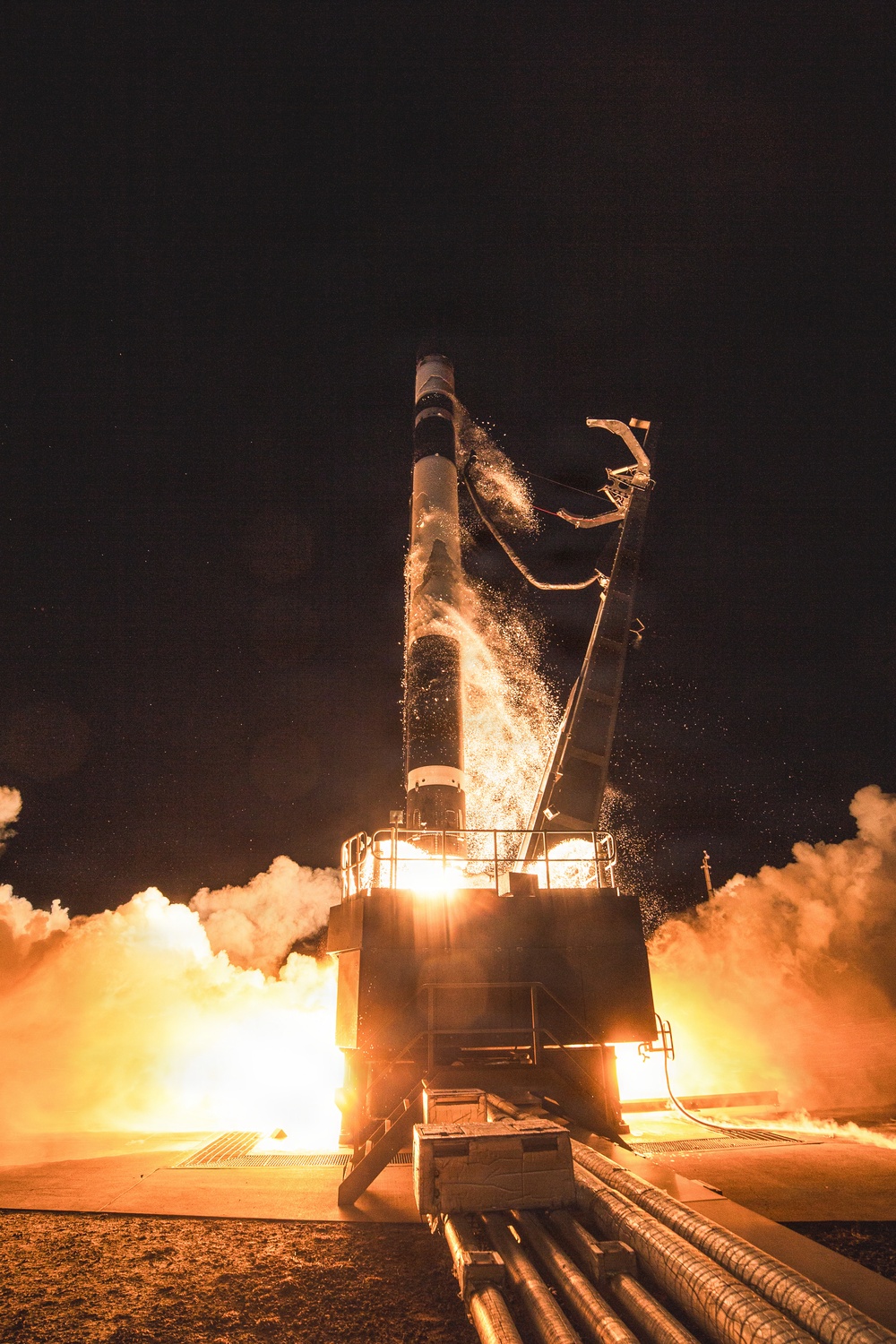
Photo courtesy of Rocket Lab, via U.S. Space Systems Command, DVIDS, public domain
Rocket Lab Corporation (Nasdaq: RKLB) will build a new launch site in Alaska under a $266 million US Space Force contract covering up to 18 suborbital missions, the company’s largest launch award to date. The deal, run through Space Systems Command’s Rocket Systems Launch Program, buys 12 firm launches with an option for 6 more, flying realistic surrogate-threat target vehicles that let missile-defense radars and interceptors practice against something that actually behaves like an incoming weapon, not a combat missile sale of its own.
What the Space Force is actually buying
The contract, announced by the Space Force on July 21 and confirmed by Rocket Lab on July 27, covers 12 core suborbital launches with an option for up to 6 additional missions, an 18-launch ceiling. Rocket Lab will fly the majority of them from a new site it is establishing at the Pacific Spaceport Complex-Alaska on Kodiak Island, giving the company a fourth launch location alongside its existing pads in New Zealand and Virginia. The first launch under the contract is scheduled no earlier than the end of 2026.
The purpose is range support, not weapons procurement. The Rocket Systems Launch Program exists to provide responsive suborbital launch services for research, development, and operational test missions across the Defense Department, and this award specifically supports missile-defense programs that need realistic target and sensor-test flight profiles: vehicles that fly trajectories mimicking an actual incoming threat so that radars, sensors, and interceptors under test have something real to track and engage. Rocket Lab has not disclosed which vehicle will fly these specific missions, but the company has increasingly positioned its Electron-derived HASTE suborbital vehicle, which shares its airframe with the orbital Electron rocket but flies a suborbital profile, as its platform for hypersonic and missile-defense target work, having already flown several such missions for Pentagon customers.
“Cadence, iteration, and relentless execution are essential to maturing America’s missile defense capabilities, and that’s exactly what we bring with launch leadership,” said Peter Beck, Rocket Lab founder and chief executive (StockTitan, July 27, 2026).
Why Alaska, and why this builds on Rocket Lab’s other Space Force work
A Kodiak launch site gives the Space Force a set of trajectories and range geometries that its existing Pacific- and Atlantic-facing sites in New Zealand and Virginia don’t offer, useful for a program built around varied, realistic target profiles rather than a single fixed flight path. It also expands Rocket Lab’s national-security launch footprint well beyond its original commercial small-satellite business, a shift the company has been building toward for several years.
The most direct precedent is Rocket Lab’s own June 19, 2026, VICTUS HAZE mission, in which an Electron rocket lifted off from the company’s Mahia, New Zealand site as part of the Space Force’s Tactically Responsive Space program, demonstrating the same kind of rapid, on-demand launch capability the new Alaska contract is designed to exercise at higher volume. That track record, not just the new site, is what the Space Force is paying to scale up: the Rocket Systems Launch Program has said its own mandate is to get more frequent, realistic test flights into the pipeline for missile-defense programs that officials say have been slowed by limited test infrastructure, a scarcity this contract is aimed directly at addressing (a shortage adjacent to, but distinct from, the space-based tracking-satellite contracts already flowing under the Golden Dome missile-defense buildout that WeaponSpecs has covered separately).
Simple arithmetic on the contract value gives a sense of scale: $266 million across 12 firm launches works out to roughly $22.2 million per launch, falling to about $14.8 million per launch if the Space Force exercises all 6 optional missions for a full 18-flight run. Both figures sit well below the cost of a typical orbital launch, consistent with a program built around lower-cost suborbital hops rather than satellite delivery, and cheap enough that the Pentagon can afford to fly many of them in the volume a real testing campaign requires rather than treating each shot as a rare, expensive event.
No Electron or Neutron in the interceptor business
It’s worth being precise about what this contract is not. Rocket Lab is not selling the Space Force a missile, an interceptor, or any weapon capable of striking a target; it is selling launch services that put a realistic-behaving test article into the sky so that separate missile-defense hardware, built by other companies, has something honest to detect and intercept during testing. That distinction matters because “missile defense contract” headlines can blur into “missile contract” in a reader’s mind, and this is squarely the former: range infrastructure, not a weapons sale.
Sources
- Rocket Lab to open Alaska launch site under $266 million Space Force deal — SpaceNews, Jul 27, 2026
- Rocket Lab Awarded Record $266M Missile Defense Contract with U.S. Space Force for Suborbital Launches — The Manila Times (GlobeNewswire wire), Jul 27, 2026
- Rocket Lab Awarded Record $266M Missile Defense Contract with U.S. Space Force — StockTitan, Jul 27, 2026
Frequently asked questions
Is this a weapons contract or a launch-services contract? +
Launch services. Rocket Lab is not selling a missile or interceptor here. The Space Force is paying to fly suborbital target and sensor-test vehicles that mimic incoming threats, the kind of realistic flight profile missile-defense radars and interceptors need to be tested against, not a combat weapon itself.
How much does each launch cost under this contract? +
Roughly $22.2 million per launch if only the 12 firm core launches fly, or as low as about $14.8 million per launch if the Space Force exercises all 6 optional missions for a full 18-launch run, both simple divisions of the $266 million total against the confirmed launch counts.
Where will the launches happen, and why does that matter? +
Primarily from a new Rocket Lab launch site at Pacific Spaceport Complex-Alaska on Kodiak Island, the company's fourth launch site after New Zealand, Virginia, and (pending) Alaska. A high-latitude Alaska site gives the Space Force a different set of trajectories and geometries for target and sensor testing than its Pacific and Atlantic-coast options.
What rocket will actually fly these missions? +
Rocket Lab has not specified the vehicle in the contract announcement itself, but the company has increasingly positioned its Electron-derived HASTE suborbital vehicle, built on the same airframe as the orbital Electron rocket, for hypersonic and missile-defense target flights, and has already flown multiple such missions for Pentagon customers.
More news


