Germany adds second Arrow-3 exo-atmospheric battery in Bavaria
The Bundeswehr will build a radar site at Kaufbeuren and launchers at Fliegerhorst Lechfeld, its second Arrow-3 site after Holzdorf went operational in December 2025.
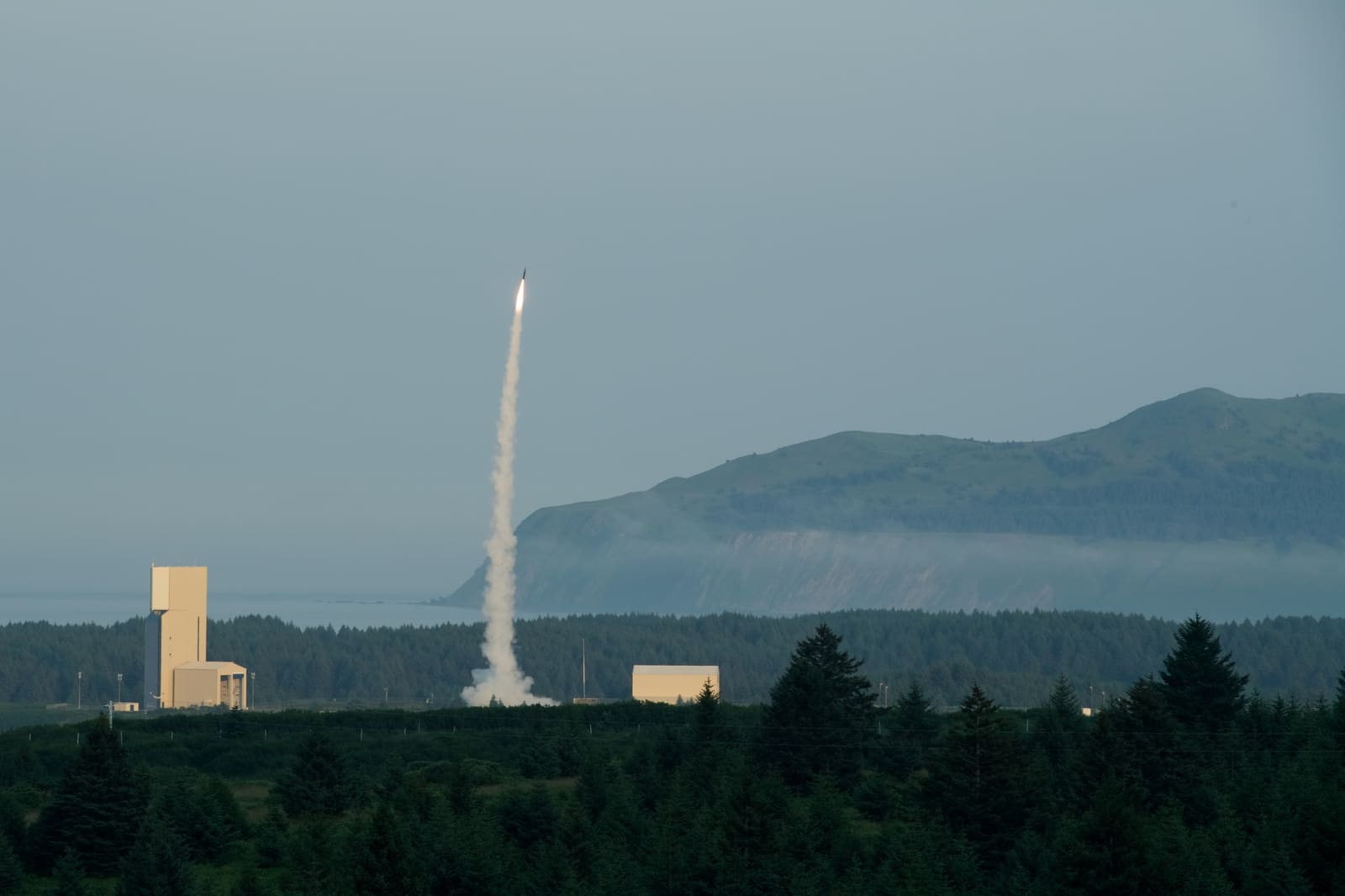
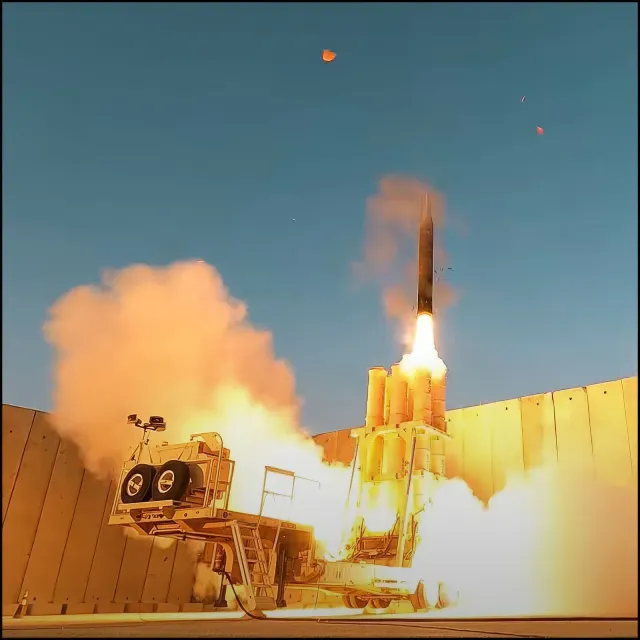
U.S. Missile Defense Agency / Israel Missile Defense Organization photo, DVIDS, public domain
By the numbers
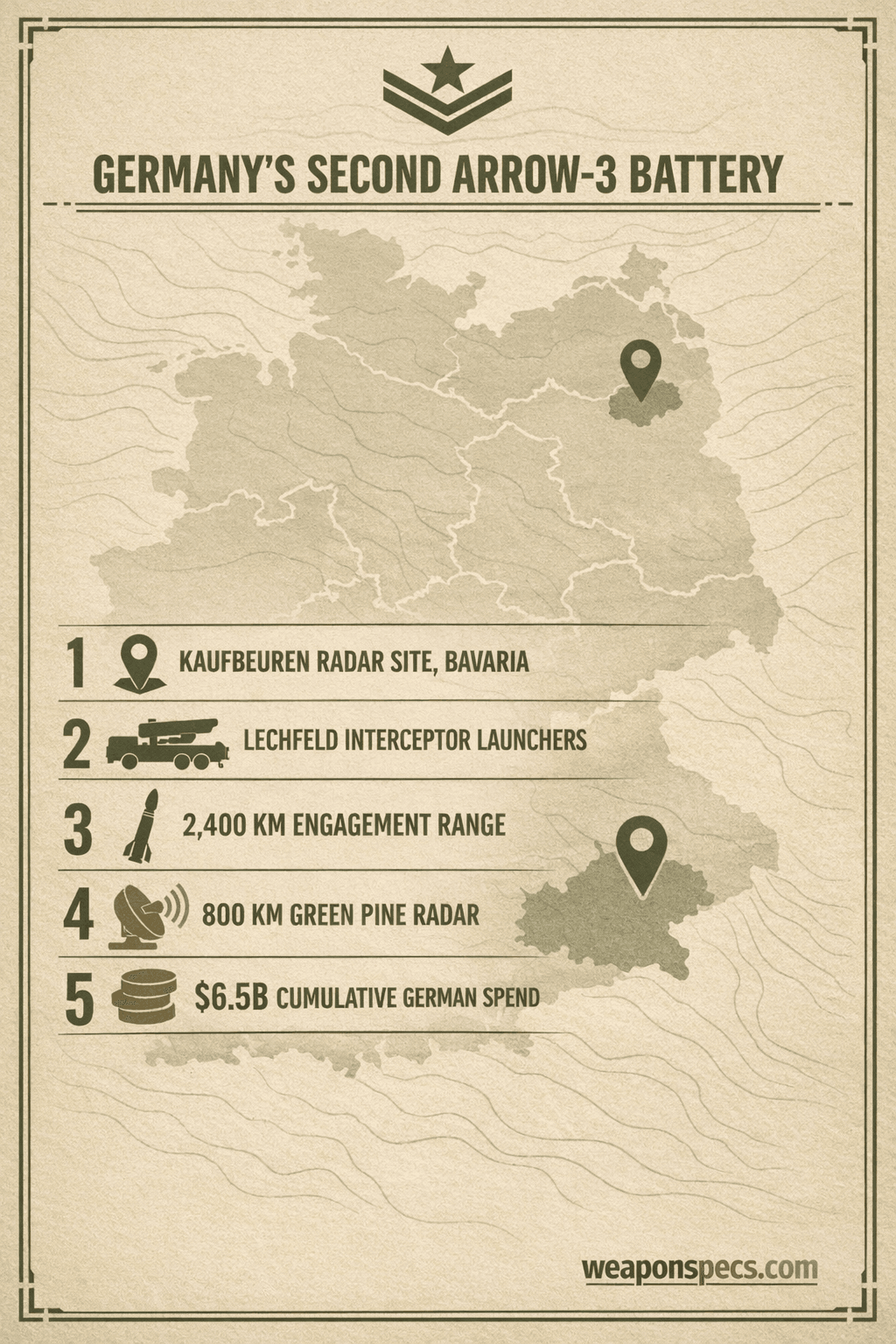
Infographic: WeaponSpecs News Desk
Germany’s Bundeswehr announced it will build its second Arrow-3 exo-atmospheric missile-defense site in Bavaria, splitting a new radar installation at Kaufbeuren from interceptor launchers at nearby Fliegerhorst Lechfeld, according to Interesting Engineering and Defence Industry Europe. It is the second of three planned Arrow-3 batteries for Germany, following a first site in Brandenburg that reached initial operational capability in December 2025, and comes as several European militaries race to close air and missile-defense gaps exposed by Russia’s war against Ukraine.
A split-site battery, again
The Kaufbeuren-Lechfeld pairing follows the same architecture Germany used for its first Arrow-3 battery: a radar site separated from the actual interceptor launchers by a short distance, connected by the system’s own battle-management network. Kaufbeuren will host the ELM-2080 Green Pine Block C radar, the sensor variant Israel Aerospace Industries builds specifically for Arrow-3’s exo-atmospheric detection and tracking, while Lechfeld, an existing Luftwaffe air base in the same corner of Bavaria, will hold the launchers themselves. Local officials framed the announcement in economic as much as strategic terms. Kaufbeuren Mayor Stefan Bosse called the deployment a source of “long-term certainty for the local military installation,” while Bavarian state lawmaker Bernhard Pohl described it as “a long-term guarantee for the future” of the site, according to Interesting Engineering’s reporting. The radar installation alone is projected to bring more than $94 million in investment and roughly 40 new jobs to the Kaufbeuren area, figures that do not include the cost of the launchers or interceptors themselves.
Germany’s first Arrow-3 battery, activated December 3, 2025 at Fliegerhorst Holzdorf/Schönewalde on the Brandenburg-Saxony-Anhalt border, gave the Bundeswehr its first-ever capability to detect and destroy ballistic missiles outside the atmosphere, a capability gap NATO’s eastern members in particular have pushed to close since 2022. That first deployment also marked the first time an Arrow-3 battery has operated outside Israel. A third site is planned for Schleswig-Holstein in northern Germany, though no construction timeline or location within the state has been announced yet, leaving the Bavaria battery as the more concrete near-term milestone.
What Arrow-3 actually does
Arrow-3 sits at the top tier of Israel’s layered missile-defense architecture, above the shorter-range Iron Dome and David’s Sling systems, and is designed to intercept ballistic missiles in space rather than waiting for them to reenter the atmosphere. Destroying a warhead exo-atmospherically, above roughly 100 kilometers altitude by IAI’s own published figures, reduces the risk that intercept debris, or an undetonated chemical, biological or nuclear payload, falls on populated ground below, a meaningful distinction from lower-tier interceptors that engage inside the atmosphere. Published performance data puts Arrow-3’s engagement range at approximately 2,400 kilometers, its interceptor speed near Mach 9, and its ability to track roughly 14 simultaneous targets, cued by the Green Pine and Super Green Pine radar family at detection ranges up to 800 kilometers. Unit cost for the interceptor itself is widely reported in the $2 to 3 million range based on 2025 and 2026 Israeli procurement disclosures, with some export-context figures running higher.
Germany’s cumulative commitment to the program now totals roughly $6.5 billion, built on a $3.1 billion follow-on contract signed around the first battery’s activation, making the country’s Arrow-3 purchase one of Israel Aerospace Industries’ largest single foreign weapons deals. That scale reflects a broader shift: Arrow-3 was purpose-built for Israel’s specific threat environment, principally Iranian and proxy ballistic-missile arsenals, and Germany’s adoption of the same architecture for its own homeland defense marks one of the more direct technology transfers from an Israeli missile-defense program into a NATO member’s territorial shield, distinct from the U.S.-sourced Patriot systems that have anchored European ground-based air defense for decades.
What is not yet settled
Neither Interesting Engineering nor Defence Industry Europe reported a construction completion date for the Kaufbeuren-Lechfeld site, an operational-capability target, or a specific interceptor and launcher count for the Bavaria battery, details that were likewise absent from initial coverage of the first Holzdorf/Schönewalde site before its actual activation in December 2025. The Schleswig-Holstein third site remains even less defined, with no site selection, contract or timeline reported anywhere in the sources reviewed for this story.
Sources
- Germany boosts missile shield buildout with additional Arrow-3 battery — Interesting Engineering, Jul 5, 2026
- Germany to build additional Arrow 3 missile defence site in Bavaria as part of expanding ballistic missile shield — Defence Industry Europe, Jul 2, 2026
Systems mentioned
Every system named in this story, with its photo and, where available, a video. Tap a card to open the full spec sheet.
Frequently asked questions
Where exactly is Germany's second Arrow-3 battery going? +
The battery splits across two nearby Bavarian sites: the ELM-2080 Green Pine Block C radar will be installed at Kaufbeuren, while the actual Arrow-3 interceptor launchers are planned for Fliegerhorst Lechfeld, a separate air base a short distance away. This mirrors the split-site pattern of Germany's first battery.
Is this Germany's first Arrow-3 site? +
No. Germany's first Arrow-3 battery reached initial operational capability on December 3, 2025 at Fliegerhorst Holzdorf/Schönewalde, on the Brandenburg-Saxony-Anhalt border, giving the Bundeswehr its first-ever capability to intercept ballistic missiles outside the atmosphere. The Bavaria site announced this month is the second of a planned three.
What can Arrow-3 actually intercept? +
Arrow-3 is an exo-atmospheric, hit-to-kill interceptor built by Israel Aerospace Industries with the United States, designed to destroy ballistic missiles above the atmosphere, at altitudes around 100 kilometers, before they reenter and before any warhead debris could fall on populated areas. Published performance figures put its engagement range at roughly 2,400 kilometers and its top speed near Mach 9, cued by the Green Pine radar family at up to 800 kilometers detection range.
How much has Germany spent on Arrow-3? +
Germany's cumulative Arrow-3 purchases total roughly $6.5 billion, including a $3.1 billion follow-on contract signed around the first battery's December 2025 activation. The new Bavarian radar site alone represents a reported investment of more than $94 million and about 40 new jobs in Kaufbeuren, separate from the interceptor and launcher costs.
More news