Documents
 Spain
Spain Navantia
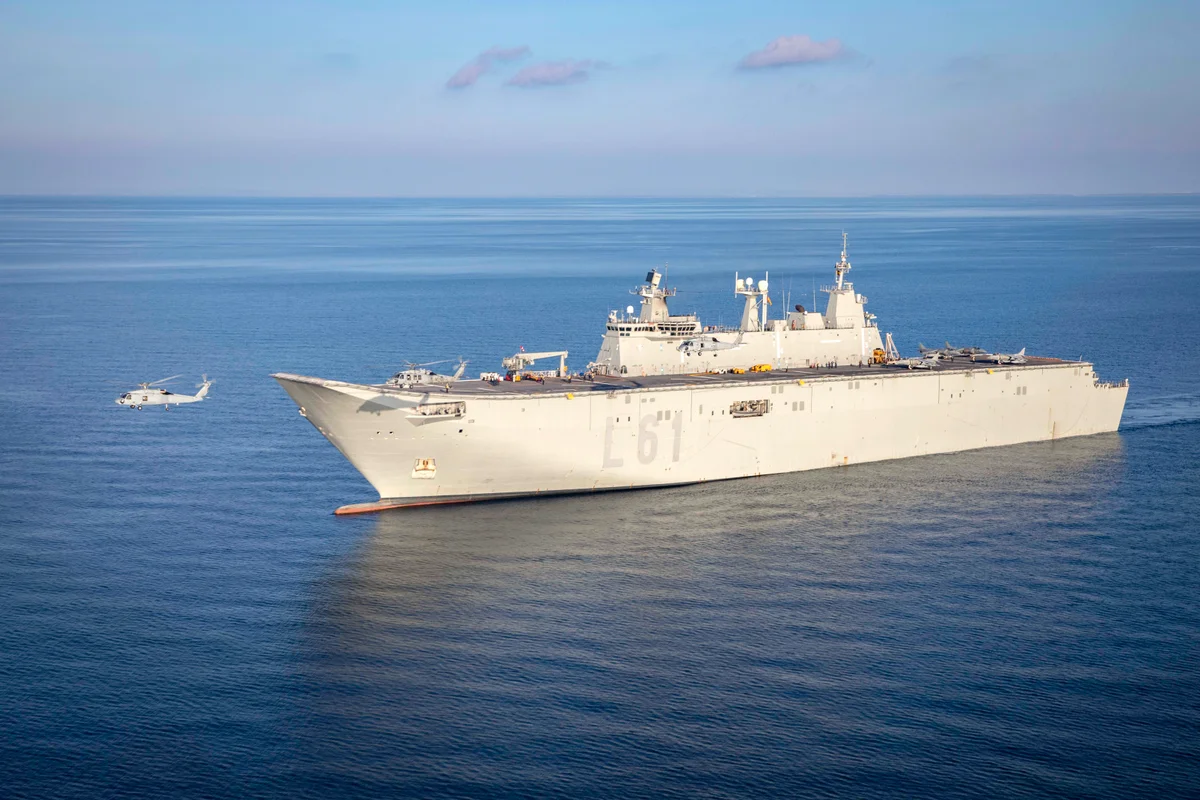
Juan Carlos I
Spanish Navy's flagship strategic projection ship, a landing helicopter dock with a ski-jump flight deck able to operate AV-8B Harriers and F-35Bs alongside a full amphibious well deck. Built by Navantia, its design was scaled up and exported to Australia as the two Canberra-class LHDs.
In service since 2010 · 1 operator countries
Compiled from public sources ·primary reference ↗ ·last verified 2026-07-02
25,000
t
21
kn
9,000
nmi
243
crew
💲 ≈ $500,000,000, Approximate build cost
Procurement snapshot
Availability & export
National export licensing
Subject to Spain export-control approval; verify eligibility with the manufacturer.
Channel: Direct commercial / G2G
Fielded & proven
Limited · 1 operator
In service since 2010. Status: active · ~1 built.
Lifecycle cost (est.)
$1.3B – $1.8B
Acquisition is only ~30% of lifecycle cost, operating & support dominate over ~35 yrs. Rough 2.5–3.5× the unit price. How we estimate this →
Interoperability
No standardised NATO calibre / datalink detected in public specs.
Derived guidance from public data, export regime by country of origin, lifecycle from the GAO ~30% acquisition rule. Verify eligibility, pricing and offsets with the manufacturer and your acquisition authority.
Compatible munitions & weapons
Publicly reported weapons the Juan Carlos I can carry. Linked items have a full spec page.
Full specifications
Physical
Dimensions, weight and crew.
| Length Overall length including gun/probe where applicable. | 231 m |
|---|
Sensors & avionics
Radar, sensor suite and datalinks.
| Radar Primary radar. AESA (active electronically scanned array) is the current state of the art. | SPS-55 surface search radar |
|---|
Program
Cost, production scale and operators.
| Unit cost Approximate flyaway/unit cost where public. Defense pricing varies hugely by contract, offsets and configuration. Lower is cheaper. | $500,000,000 |
|---|---|
| Units built Total production run. Higher means proven manufacturing, mature logistics and spares availability. | 1 |
| Operator countries Number of countries operating the system. More operators means broader support ecosystem. | 1 |
Specifications compiled from public Navantia and reference sources ↗. Published defense figures are approximations, treat comparisons as directional. Last verified 2026-07-02.
Compare with rivals
See how it stacks up
 Naval Group Amiral Ronarc'h-class Frigate (FDI)
 Head-to-head comparisons
Juan Carlos I vs
 Arleigh Burke-class Destroyer
 Frequently asked questions
How many countries operate the Navantia Juan Carlos I? +
The Navantia Juan Carlos I is operated by 1 countries.
How much does the Navantia Juan Carlos I cost? +
The Navantia Juan Carlos I has an approximate unit cost of 500,000,000 USD. Defense pricing varies by contract, offsets and configuration, treat this as directional.
Similar systems
Related coverage