Documents
 Russia
 Kurganmashzavod
BMP-2
A tracked Soviet-era infantry fighting vehicle armed with a rapid-fire autocannon and an anti-tank guided missile launcher, developed to address the BMP-1's weak anti-armor firepower. It remains one of the most numerous IFVs in Russian and export service.
In service since 1980 · 30 operator countries
Compiled from public sources ·primary reference ↗ ·last verified 2026-07-02
65
km/h
600
km range
19.8
hp/t
30
mm gun
14,300
kg
Pricing: No public modern unit cost; legacy production run
Procurement snapshot
Availability & export
Russian state channel
Rosoboronexport monopoly; Western sanctions exposure and payment/logistics risk for many buyers.
Channel: Rosoboronexport (state)
Fielded & proven
Widely fielded · 30 operators
In service since 1980. Status: active · ~20,000 built.
Lifecycle cost (est.)
No public unit price to model from. Why so few systems publish one →
Interoperability
No standardised NATO calibre / datalink detected in public specs.
Derived guidance from public data, export regime by country of origin, lifecycle from the GAO ~30% acquisition rule. Verify eligibility, pricing and offsets with the manufacturer and your acquisition authority.
Full specifications
Performance
Speed, range, altitude and engagement capability.
| Max speed Maximum level speed. For aircraft this is at optimal altitude; for ground vehicles, top road speed. Higher means faster response and better kinematic performance. | 65 km/h |
|---|---|
| Range Maximum distance: ferry range for aircraft, operational range for vehicles, maximum engagement distance for missiles. Higher means more standoff or persistence. | 600 km |
| Power-to-weight Engine power per tonne of vehicle weight. Higher means better acceleration and cross-country mobility. | 19.8 hp/t |
Firepower
Armament, payload and guidance.
| Main armament Primary weapon: main gun, cannon or missile type. | 30 mm 2A42 autocannon |
|---|---|
| Secondary armament Additional weapons: coaxial MG, remote weapon station, gun pods. | 9M111/9M113 ATGM launcher + 7.62 mm PKT |
| Caliber Bore diameter of the main gun or rifle. Larger throws heavier projectiles; not simply better, ammunition commonality matters. | 30 mm |
| Ammunition Rounds carried (main gun) or standard magazine capacity. | 500 |
Protection
Armor, countermeasures and survivability.
| Armor Armor technology: composite, modular, ERA-fitted, uranium-ceramic. Exact compositions are classified. | Welded steel |
|---|---|
| NBC protection Sealed crew compartment with overpressure filtration for nuclear/biological/chemical environments. | Yes |
Physical
Dimensions, weight and crew.
| Length Overall length including gun/probe where applicable. | 6.72 m |
|---|---|
| Width Overall width, matters for rail/road transport of vehicles. | 3.15 m |
| Height Overall height. Lower profile is harder to spot and hit for ground vehicles. | 2.45 m |
| Combat weight Fully loaded weight. Lighter eases transport and bridging limits; heavier often means more armor. | 14,300 kg |
| Crew Personnel required to operate. Fewer reduces exposure; autoloaders trade a loader for mechanical complexity. | 3 |
| Troop capacity Number of embarked troops/passengers (IFV, APC, transport). Higher carries more. | 7 |
Propulsion
Engine, power and fuel.
| Engine Powerplant model and type. | UTD-20S1 diesel |
|---|---|
| Engine power Engine output power. Higher moves more weight faster. | 300 hp |
| Propulsion type Turbofan, turboshaft, diesel, gas turbine, solid-fuel rocket, ramjet… | Diesel |
Program
Cost, production scale and operators.
| Units built Total production run. Higher means proven manufacturing, mature logistics and spares availability. | 20,000 |
|---|---|
| Operator countries Number of countries operating the system. More operators means broader support ecosystem. | 30 |
Specifications compiled from public Kurganmashzavod and reference sources ↗. Published defense figures are approximations, treat comparisons as directional. Last verified 2026-07-02.
Compare with rivals
See how it stacks up
 Rheinmetall Puma
  BAE Systems Inc. (US Land Systems) M2A3 Bradley
  General Dynamics Land Systems Ajax
 Head-to-head comparisons
BMP-2 vs
 Ratel
Ratel  CV90
CV90  Arma
Arma  Bushmaster
 Frequently asked questions
What is the top speed of the Kurganmashzavod BMP-2? +
The Kurganmashzavod BMP-2 has a maximum speed of 65 km/h.
What is the range of the Kurganmashzavod BMP-2? +
The Kurganmashzavod BMP-2 has a maximum range of 600 km.
How much does the Kurganmashzavod BMP-2 weigh? +
The Kurganmashzavod BMP-2 has a combat weight of 14,300 kg.
How many crew does the Kurganmashzavod BMP-2 require? +
The Kurganmashzavod BMP-2 requires a crew of 3.
What is the main armament of the Kurganmashzavod BMP-2? +
The Kurganmashzavod BMP-2's primary weapon is the 30 mm 2A42 autocannon.
What engine does the Kurganmashzavod BMP-2 use? +
The Kurganmashzavod BMP-2 is powered by the UTD-20S1 diesel.
What is the Kurganmashzavod BMP-2 used for? +
The Kurganmashzavod BMP-2 is a ifv / apc typically used for infantry combat, anti armor.
How many countries operate the Kurganmashzavod BMP-2? +
The Kurganmashzavod BMP-2 is operated by 30 countries.
How much does the Kurganmashzavod BMP-2 cost? +
Kurganmashzavod BMP-2: No public modern unit cost; legacy production run. Defense program costs are rarely fully public and vary by contract and configuration.
Similar systems
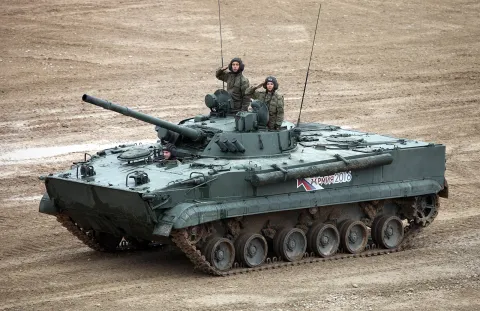
Kurganmashzavod
BMP-3
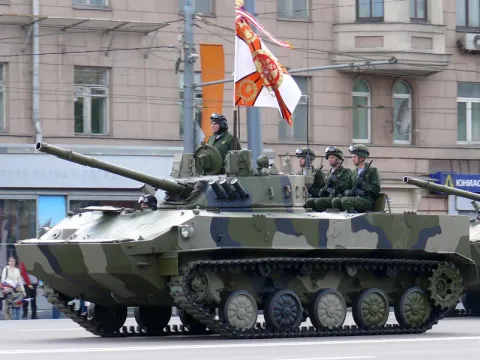
Kurganmashzavod
BMD-4M
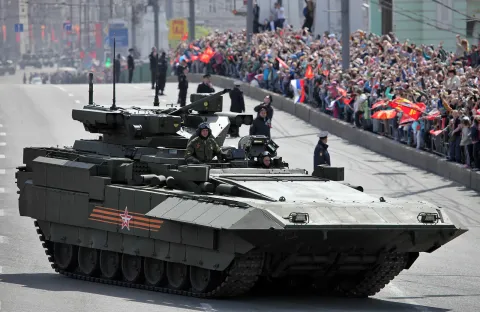
Uralvagonzavod
T-15
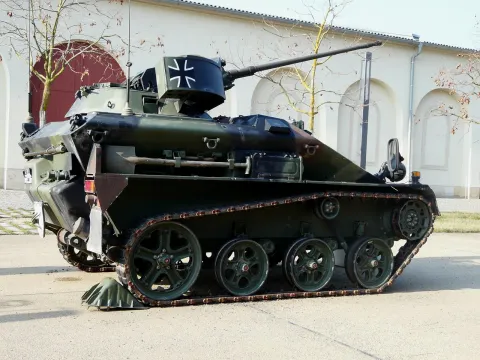
Rheinmetall
Wiesel
Related coverage