What 'Range' Really Means on a Drone Spec Sheet
Across 36 UAVs in our database, published range spans a 33x gap, from a figure that matches true flight distance to one that is a control-link limit.

Bayhaluk, CC BY-SA 4.0
Two drones from the same company, with almost the same endurance, publish ranges twenty times apart. Baykar’s Bayraktar TB2 flies for roughly 27 hours and cruises at 130 km/h, an implied flight distance of about 3,510 km, yet its published range is 150 km, a ratio of 23.4x. Baykar’s Bayraktar Akinci flies for about 24 hours at 278 km/h, an implied distance of 6,672 km, and its published range is 6,000 km, a ratio of 1.1x. Same manufacturer, similar endurance class, and one number is a fuel figure while the other is closer to a leash length.
That gap is not a TB2-specific quirk. Pulling every UAV in the WeaponSpecs database that discloses endurance, cruise speed, and published range at once turns up 36 of our 73 tracked UAV systems, and across them the ratio of implied flight distance to published range spans 33-fold, from 0.8x up to 26.6x. Some of that variance is genuine mission design. Most of it, for the widest-gap systems, is a control link doing the capping, not a fuel tank.
What is “implied flight distance,” and why does it expose the gap?
Implied flight distance is endurance in hours multiplied by cruise speed in km/h, a rough estimate of how far a drone’s airframe could physically travel if it flew for its full stated endurance at its stated cruise speed. Dividing that number by the published range produces a ratio. A ratio near 1x says the published range already reflects something close to the airframe’s real flight capability. A ratio well above 1x says the published number is capped by something else well before the fuel runs out, and for most tactical drones that something else is the ground-control datalink: the radio connection between the aircraft and its operator.
This method only works where a drone discloses all three figures on the record, which is why the analysis covers 36 of the 73 UAV systems in the WeaponSpecs database rather than the full set. The other 37 are missing at least one of endurance, cruise speed, or range, and no ratio can be computed without all three.
Which UAVs publish a range that is really a control-link limit, not a fuel limit?
Baykar builds both ends of this chart. The TB2, line-of-sight only, control link under 300 km, sits near the top of the wide-gap group at 23.4x. The Akinci, which adds a satellite BLOS link, sits at the top of the narrow-gap group at 1.1x, despite similar endurance. The datalink, not the airframe, decided which side of this chart each drone landed on.
The TB2’s number is not a mystery once you check what “range” is describing. Wikipedia’s entry on the Bayraktar TB2 confirms the base aircraft is line-of-sight only, with a ground-control datalink cited at under 300 kilometres, and that the published 150 km range figure sits inside that ceiling, not anywhere near the roughly 3,510 km its 27-hour endurance and 130 km/h cruise speed could otherwise cover. The satcom-equipped TB2S variant removes that ceiling entirely, which is itself confirmation that the base TB2’s number was a communications limit rather than a fuel limit. Baykar’s own product page for the Akinci states the aircraft carries a “SATCOM BLOS” link alongside a triple-redundant line-of-sight system, which is exactly the difference that lets its published range close to within 1.1x of its physical flight envelope.
ScanEagle is the cleanest second case in the dataset, and arguably the clearest smoking gun of the whole exercise. Boeing subsidiary Insitu’s own ScanEagle product page and a November 2025 report from NextGen Defense both put the platform’s baseline line-of-sight control range at roughly 60 nautical miles, or about 100 km. ScanEagle’s published database range is also 100 km. Those two numbers do not just correlate, they match almost exactly, because for most of ScanEagle’s service life its “range” spec was never describing how far the airframe could fly, it was describing how far its operator’s radio could reach. The same reporting notes Insitu has only recently begun adding low-earth-orbit satellite comms specifically to remove that ceiling, an upgrade that would not be necessary if the old number had ever been a fuel limit.
“The integration of PLEO SATCOM provides operators unparalleled BLOS capability, enabling real-time decision-making capability and operational success for land and maritime missions,” said Diane Rose, CEO of Insitu, a Boeing company, announcing the ScanEagle upgrade in November 2025.
The rest of the top-8, wide-gap group tells a consistent story: Super Heron, ANKA-S, Heron 1, Gray Eagle, Orion, and Orlan-10 are all medium-altitude tactical ISR or strike drones built for continuous operator control over line-of-sight radio rather than autonomous or satellite-relayed flight. That is the category, more than any single manufacturer or country, that dominates the top of this chart.
Which platforms publish a range that matches their real flight envelope?
At the narrow-gap end of the chart, the mechanism generally flips from “control link limited” to “closer to a true fuel-limited figure,” though not for identical reasons. Iran’s Shahed-136 sits at 0.8x, the lowest ratio in the set, because it is a one-way loitering munition. It does not fly home, and it needs no continuous operator link after launch, so its published range describes essentially its full one-way fuel-limited flight, confirmed by Wikipedia’s entry on the HESA Shahed 136. Heron TP, MQ-4C Triton, and RQ-4 Global Hawk each sit at 0.9x, and all three are well-documented Ku-band satcom-linked high-altitude, long-endurance ISR aircraft; Wikipedia’s RQ-4 Global Hawk entry documents exactly that satcom-relay design. Wing Loong I also lands at 0.9x, and Akinci, discussed above, sits at 1.1x thanks to its own satcom BLOS link.
That said, this is a useful diagnostic, not an infallible rule, and the dataset itself supplies the exception. MQ-9A Reaper is satcom-capable, the same category of control link as Global Hawk or Akinci, yet it still shows a real gap: 4.6x. The likely explanation is not a hidden control-link ceiling but a difference in what the published figure is measuring. Reaper’s 1,850 km range most plausibly describes a realistic transit-plus-loiter operational mission profile, flying out, loitering on station, and flying home, rather than a maximum one-way ferry flight at cruise speed. So satcom presence alone does not guarantee a ratio near 1x. The ratio flags where something other than fuel might be setting the number; it does not, by itself, prove what that something is, and this whole exercise is Cole’s cross-check of the database’s own disclosed figures against each other, not a claim about any manufacturer’s undisclosed design intent.
All 36 UAVs, ranked by the size of the gap
| UAV | Origin | Endurance (h) | Cruise (km/h) | Published Range (km) | Implied Distance (km) | Ratio |
|---|---|---|---|---|---|---|
| Super Heron | Israel | 45 | 207 | 350 | 9,315 | 26.6x |
| Bayraktar TB2 | Turkey | 27 | 130 | 150 | 3,510 | 23.4x |
| ScanEagle | United States | 24 | 92 | 100 | 2,208 | 22.1x |
| ANKA-S | Turkey | 24 | 150 | 200 | 3,600 | 18x |
| Heron 1 | Israel | 45 | 130 | 350 | 5,850 | 16.7x |
| MQ-1C Gray Eagle | United States | 25 | 230 | 400 | 5,750 | 14.4x |
| Orion (Inokhodets) | Russia | 24 | 150 | 250 | 3,600 | 14.4x |
| Orlan-10 | Russia | 16 | 110 | 140 | 1,760 | 12.6x |
| Searcher Mk III | Israel | 18 | 200 | 300 | 3,600 | 12x |
| Mohajer-6 | Iran | 12 | 150 | 200 | 1,800 | 9x |
| Hermes 450 | Israel | 20 | 130 | 300 | 2,600 | 8.7x |
| Warmate | Poland | 1.17 | 80 | 15 | 94 | 6.2x |
| RQ-11 Raven | United States | 1.25 | 45 | 10 | 56 | 5.6x |
| Hermes 900 | Israel | 36 | 130 | 1,000 | 4,680 | 4.7x |
| MQ-9A Reaper | United States | 27 | 313 | 1,850 | 8,451 | 4.6x |
| RQ-20 Puma | United States | 2.5 | 37 | 20 | 93 | 4.6x |
| MQ-1 Predator | United States | 24 | 130 | 1,100 | 3,120 | 2.8x |
| Switchblade 300 | United States | 0.25 | 101 | 10 | 25 | 2.5x |
| Alpagu | Turkey | 0.25 | 72 | 8 | 18 | 2.3x |
| MQ-9B SkyGuardian | United States | 40 | 313 | 6,000 | 12,520 | 2.1x |
| Switchblade 600 | United States | 0.67 | 113 | 40 | 76 | 1.9x |
| CH-5 (Caihong-5) | China | 60 | 180 | 6,000 | 10,800 | 1.8x |
| Harop | Israel | 9 | 185 | 1,000 | 1,665 | 1.7x |
| Aksungur | Turkey | 49 | 200 | 6,000 | 9,800 | 1.6x |
| Bayraktar TB3 | Turkey | 24 | 130 | 2,000 | 3,120 | 1.6x |
| CH-4 (Caihong-4) | China | 30 | 180 | 3,500 | 5,400 | 1.5x |
| Bayraktar Akinci | Turkey | 24 | 278 | 6,000 | 6,672 | 1.1x |
| UJ-22 Airborne | Ukraine | 7 | 120 | 800 | 840 | 1.1x |
| Wing Loong II | China | 20 | 220 | 4,000 | 4,400 | 1.1x |
| Shahed-131 | Iran | 6 | 150 | 900 | 900 | 1x |
| WZ-7 | China | 10 | 700 | 7,000 | 7,000 | 1x |
| Heron TP | Israel | 30 | 213 | 7,400 | 6,390 | 0.9x |
| MQ-4C Triton | United States | 24 | 574 | 15,186 | 13,776 | 0.9x |
| RQ-4 Global Hawk | United States | 34 | 575 | 22,780 | 19,550 | 0.9x |
| Wing Loong I | China | 20 | 180 | 4,000 | 3,600 | 0.9x |
| Shahed-136 | Iran | 12 | 160 | 2,500 | 1,920 | 0.8x |
Every figure in this table is a manufacturer or state disclosure, not an independently measured result, and that caveat matters most where the only public source is a state entity. Russia’s Orion and Orlan-10 come from Kronshtadt and Zala Aero, both operating inside Russia’s defense-industrial system with no independent flight-test data available to us. Iran’s Shahed-131, Shahed-136, and Mohajer-6 figures trace back to HESA and Iranian state media, sources with an obvious interest in favorable numbers. China’s CH-4, CH-5, Wing Loong I, Wing Loong II, and WZ-7 figures come from AVIC and CASC export literature aimed at foreign buyers. None of that changes the internal logic of the ratio itself: endurance and range for each of these drones come from the same manufacturer, so the comparison stays apples-to-apples within each one’s own claims. But the absolute numbers, the 6,000 km on Akinci, the 22,780 km on Global Hawk, the 2,500 km on Shahed-136, should be read as what a manufacturer or state says its system can do, not as independently verified facts.
What should a buyer or analyst take from this?
Don’t compare “range” across UAV spec sheets at face value; check first what kind of range each figure is describing. A published range on a line-of-sight tactical drone is very often a communications-link ceiling dressed up as a flight-performance spec, while the same word on a satcom-linked HALE aircraft or a one-way loitering munition tends to mean something closer to true fuel-limited distance. Before assuming a number means what it appears to mean, check whether the platform is LOS-only or satcom/BLOS-capable, and whether the published figure looks like a maximum ferry flight or a realistic mission profile, because either factor alone can move the ratio without the airframe changing at all.
Treat “range” the way this column treats every manufacturer and state figure: a claim describing one specific measurement convention, not a universal yardstick that means the same thing on every spec sheet. Run your own comparison across the full UAV category in WeaponSpecs’ compare tool, browse the complete UAV type page, or get a tailored recommendation through the WeaponSpecs Advisor before treating any single “range” number as the whole story.
Sources
Systems in this comparison
Every system covered above, with its photo and, where available, a video. Tap a card to open the full spec sheet.
Compare these side by side →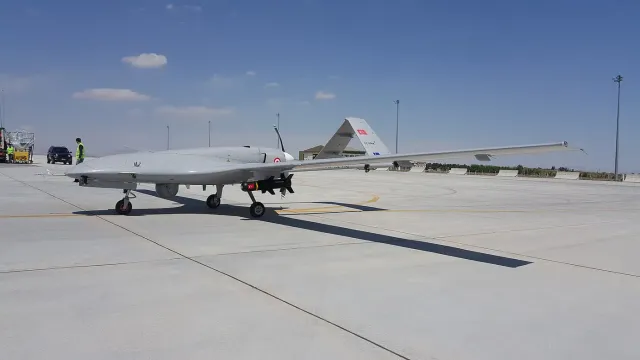
UAV / drone
Bayraktar TB2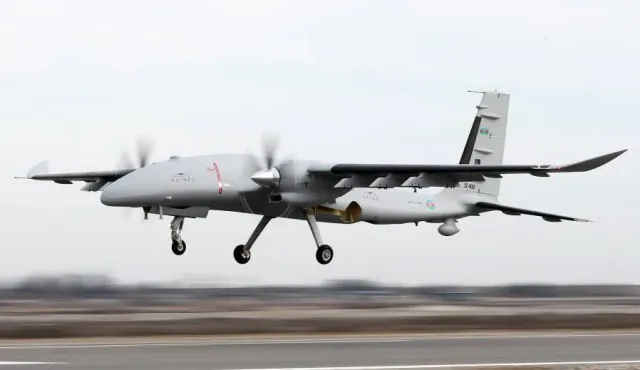
UAV / drone
Bayraktar Akinci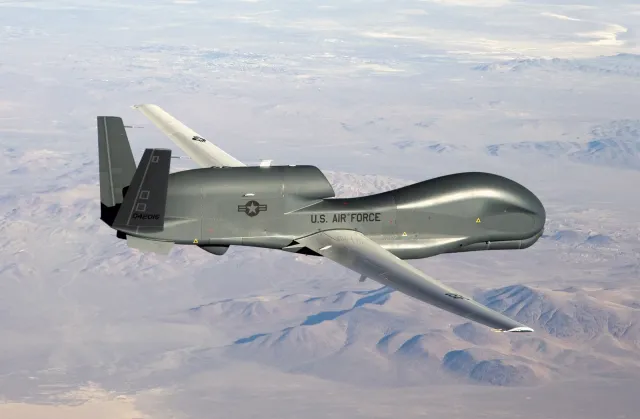
UAV / drone
RQ-4 Global Hawk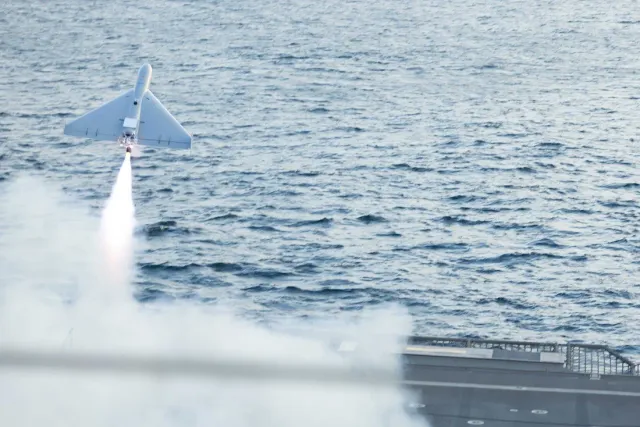
UAV / drone
Shahed-136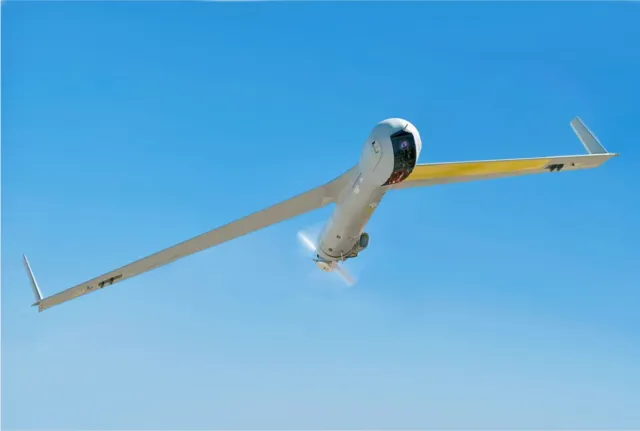
Frequently asked questions
Why do two drones with similar endurance publish ranges dozens of times apart? +
Because "range" on a UAV spec sheet is not always fuel range. For line-of-sight-only drones, the published figure is usually the operator's ground-control datalink limit, a communications ceiling, not how far the airframe could physically fly. Endurance and cruise speed still describe the airframe's real capability; multiplying them gives a rough physical flight distance that can run many times past the published "range."
How is the "implied flight distance" in this analysis calculated? +
Endurance in hours multiplied by cruise speed in km/h, using each system's own published figures in the WeaponSpecs database. Dividing that implied distance by the published range gives a ratio: close to 1x means the range figure matches what the airframe could physically fly, far above 1x means something else, usually the control link, is capping the number instead.
Which UAVs in the database show the widest gap between implied and published range? +
The Super Heron (26.6x), Bayraktar TB2 (23.4x), ScanEagle (22.1x), ANKA-S (18x), and Heron 1 (16.7x) top the list of 36 UAVs with all three figures disclosed. All five are tactical, line-of-sight-controlled platforms whose published range tracks known ground-control link limits far more closely than their fuel capacity.
Does satellite (BLOS) control change this? +
Often, and the clearest case sits inside one manufacturer's own lineup. Baykar's TB2, line-of-sight only in its base configuration, with a control link under 300 km, posts a 23.4x gap. Baykar's own Akinci, which adds a SATCOM beyond-line-of-sight link, posts 1.1x, essentially matching its physical flight envelope despite similar endurance. It is not a perfect rule though: the satcom-capable MQ-9A Reaper still posts a 4.6x gap, likely because its published figure describes a realistic transit-plus-loiter mission rather than a maximum ferry flight.
How reliable are the Russian, Chinese, and Iranian drone figures in this dataset? +
They are manufacturer or state disclosures, not independently measured results, the same caveat that applies to every figure in this analysis regardless of origin. Russia's Orion and Orlan-10, Iran's Shahed-131, Shahed-136, and Mohajer-6, and China's CH-4, CH-5, Wing Loong, and WZ-7 figures all come from state-linked manufacturer or export literature. The ratio itself stays valid because endurance and range come from the same source for each drone, but the absolute numbers should be read as claims, not verified facts.
Related reading


