Documents
 United States Legacy
 General Atomics Aeronautical Systems
MQ-1 Predator
The pioneering medium-altitude long-endurance armed reconnaissance drone that established the modern US hunter-killer UAV concept. Retired from US Air Force service in 2018 and succeeded by the larger MQ-9 Reaper.
In service since 1995 · 3 operator countries
Compiled from public sources ·primary reference ↗ ·last verified 2026-07-02
217
km/h
1,100
km range
7,620
m ceiling
204
kg payload
💲 ≈ $4,000,000, Publicly cited program unit cost estimate
Procurement snapshot
Availability & export
US ITAR-controlled
Export needs U.S. State Dept (DDTC) approval; end-use & re-transfer restrictions apply.
Channel: Foreign Military Sales (FMS) or Direct Commercial Sale
Fielded & proven
Limited · 3 operators
In service since 1995. Status: legacy · ~360 built.
Lifecycle cost (est.)
$10M – $14M
Acquisition is only ~30% of lifecycle cost, operating & support dominate over ~20 yrs. Rough 2.5–3.5× the unit price. How we estimate this →
Interoperability
No standardised NATO calibre / datalink detected in public specs.
Derived guidance from public data, export regime by country of origin, lifecycle from the GAO ~30% acquisition rule. Verify eligibility, pricing and offsets with the manufacturer and your acquisition authority.
Compatible munitions & weapons
Publicly reported weapons the MQ-1 Predator can carry. Linked items have a full spec page.

Full specifications
Performance
Speed, range, altitude and engagement capability.
| Max speed Maximum level speed. For aircraft this is at optimal altitude; for ground vehicles, top road speed. Higher means faster response and better kinematic performance. | 217 km/h |
|---|---|
| Cruise speed Sustained economical speed. Determines transit time to station. | 130 km/h |
| Range Maximum distance: ferry range for aircraft, operational range for vehicles, maximum engagement distance for missiles. Higher means more standoff or persistence. | 1,100 km |
| Service ceiling Maximum operating altitude. Higher gives energy advantage and sensor horizon. | 7,620 m |
| Endurance Time on station. Critical for UAVs and patrol platforms, higher means longer persistent coverage. | 24 h |
Firepower
Armament, payload and guidance.
| Hardpoints External stations for weapons and pods. More means bigger and more flexible loadouts. | 2 |
|---|---|
| Weapons payload Maximum ordnance weight the platform can carry. Higher means more strike capacity per sortie. | 204 kg |
Physical
Dimensions, weight and crew.
| Length Overall length including gun/probe where applicable. | 8.2 m |
|---|---|
| Wingspan Wingtip-to-wingtip span. | 14.8 m |
| Empty weight Weight without fuel, ammunition or crew. | 512 kg |
| Combat weight Fully loaded weight. Lighter eases transport and bridging limits; heavier often means more armor. | 1,020 kg |
| Crew Personnel required to operate. Fewer reduces exposure; autoloaders trade a loader for mechanical complexity. | 0 |
Propulsion
Engine, power and fuel.
| Engine Powerplant model and type. | Rotax 914 turbocharged piston engine |
|---|---|
| Propulsion type Turbofan, turboshaft, diesel, gas turbine, solid-fuel rocket, ramjet… | Piston, pusher propeller |
Sensors & avionics
Radar, sensor suite and datalinks.
| Sensors IRST, EO/IR turrets, laser designators, sniper pods, thermal sights. | AN/AAS-52 multi-spectral targeting system, Synthetic aperture radar |
|---|---|
| Datalink Network connectivity: Link 16, MADL, national datalinks. Enables cooperative engagement. | LOS datalink, Ku-band SATCOM |
Program
Cost, production scale and operators.
| Unit cost Approximate flyaway/unit cost where public. Defense pricing varies hugely by contract, offsets and configuration. Lower is cheaper. | $4,000,000 |
|---|---|
| Units built Total production run. Higher means proven manufacturing, mature logistics and spares availability. | 360 |
| Operator countries Number of countries operating the system. More operators means broader support ecosystem. | 3 |
Specifications compiled from public General Atomics Aeronautical Systems and reference sources ↗. Published defense figures are approximations, treat comparisons as directional. Last verified 2026-07-02.
Compare with rivals
See how it stacks up
 Turkish Aerospace Industries ANKA-S
 Frequently asked questions
What is the top speed of the General Atomics Aeronautical Systems MQ-1 Predator? +
The General Atomics Aeronautical Systems MQ-1 Predator has a maximum speed of 217 km/h.
What is the range of the General Atomics Aeronautical Systems MQ-1 Predator? +
The General Atomics Aeronautical Systems MQ-1 Predator has a maximum range of 1,100 km.
What is the weapons payload of the General Atomics Aeronautical Systems MQ-1 Predator? +
The General Atomics Aeronautical Systems MQ-1 Predator can carry up to 204 kg of weapons payload.
How much does the General Atomics Aeronautical Systems MQ-1 Predator weigh? +
The General Atomics Aeronautical Systems MQ-1 Predator has a combat weight of 1,020 kg.
How many crew does the General Atomics Aeronautical Systems MQ-1 Predator require? +
The General Atomics Aeronautical Systems MQ-1 Predator requires a crew of 0.
What engine does the General Atomics Aeronautical Systems MQ-1 Predator use? +
The General Atomics Aeronautical Systems MQ-1 Predator is powered by the Rotax 914 turbocharged piston engine.
What is the General Atomics Aeronautical Systems MQ-1 Predator used for? +
The General Atomics Aeronautical Systems MQ-1 Predator is a uav / drone typically used for isr, close air support.
How many countries operate the General Atomics Aeronautical Systems MQ-1 Predator? +
The General Atomics Aeronautical Systems MQ-1 Predator is operated by 3 countries.
How much does the General Atomics Aeronautical Systems MQ-1 Predator cost? +
The General Atomics Aeronautical Systems MQ-1 Predator has an approximate unit cost of 4,000,000 USD. Defense pricing varies by contract, offsets and configuration, treat this as directional.
Similar systems
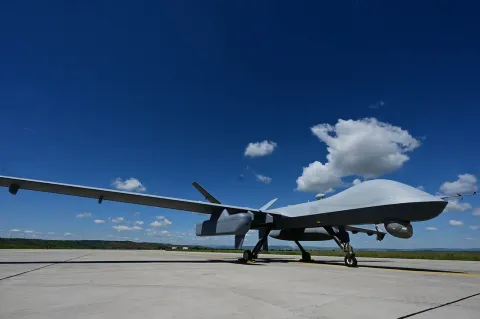
General Atomics Aeronautical Systems
MQ-9A Reaper
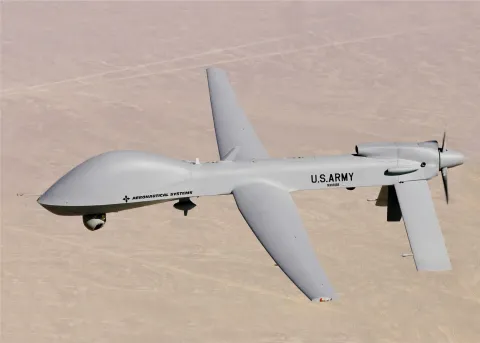
General Atomics Aeronautical Systems
MQ-1C Gray Eagle
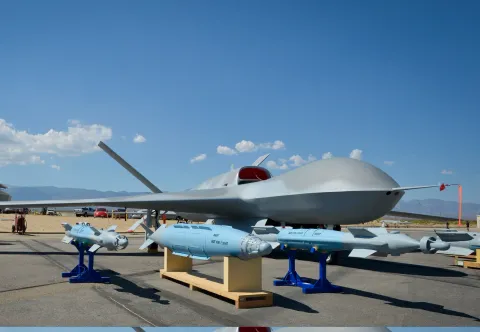
General Atomics Aeronautical Systems
Avenger (Predator C)
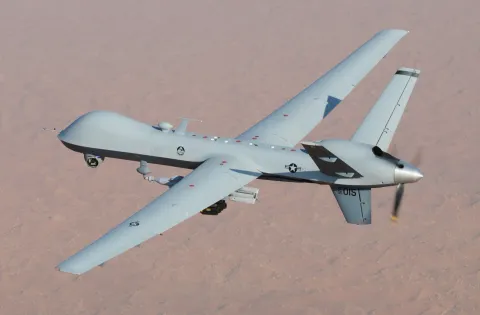
General Atomics Aeronautical Systems