Documents
 Israel
 Israel Aerospace Industries
Searcher Mk III
The latest-generation member of IAI's medium-altitude, long-endurance Searcher family of tactical ISR UAVs, providing reconnaissance, surveillance and target acquisition for army and border-security operators. Predecessor of the larger Heron series.
In service since 2007 · 12 operator countries
Compiled from public sources ·primary reference ↗ ·last verified 2026-07-02
300
km range
6,100
m ceiling
Pricing: Unit cost not publicly disclosed
Procurement snapshot
Availability & export
Israeli export-licensed
Israeli MoD (DECA/SIBAT) licensing; active export programme.
Channel: Direct commercial / G2G
Fielded & proven
Established · 12 operators
In service since 2007. Status: active.
Lifecycle cost (est.)
No public unit price to model from. Why so few systems publish one →
Interoperability
No standardised NATO calibre / datalink detected in public specs.
Derived guidance from public data, export regime by country of origin, lifecycle from the GAO ~30% acquisition rule. Verify eligibility, pricing and offsets with the manufacturer and your acquisition authority.
Full specifications
Performance
Speed, range, altitude and engagement capability.
| Cruise speed Sustained economical speed. Determines transit time to station. | 200 km/h |
|---|---|
| Range Maximum distance: ferry range for aircraft, operational range for vehicles, maximum engagement distance for missiles. Higher means more standoff or persistence. | 300 km |
| Service ceiling Maximum operating altitude. Higher gives energy advantage and sensor horizon. | 6,100 m |
| Endurance Time on station. Critical for UAVs and patrol platforms, higher means longer persistent coverage. | 18 h |
Physical
Dimensions, weight and crew.
| Length Overall length including gun/probe where applicable. | 5.85 m |
|---|---|
| Wingspan Wingtip-to-wingtip span. | 8.55 m |
| Combat weight Fully loaded weight. Lighter eases transport and bridging limits; heavier often means more armor. | 436 kg |
| Crew Personnel required to operate. Fewer reduces exposure; autoloaders trade a loader for mechanical complexity. | 0 |
Propulsion
Engine, power and fuel.
| Propulsion type Turbofan, turboshaft, diesel, gas turbine, solid-fuel rocket, ramjet… | Piston engine, pusher propeller |
|---|
Sensors & avionics
Radar, sensor suite and datalinks.
| Sensors IRST, EO/IR turrets, laser designators, sniper pods, thermal sights. | Electro-optical/infrared payload, Synthetic aperture radar (variant) |
|---|---|
| Datalink Network connectivity: Link 16, MADL, national datalinks. Enables cooperative engagement. | LOS datalink |
Program
Cost, production scale and operators.
| Operator countries Number of countries operating the system. More operators means broader support ecosystem. | 12 |
|---|
Specifications compiled from public Israel Aerospace Industries and reference sources ↗. Published defense figures are approximations, treat comparisons as directional. Last verified 2026-07-02.
Compare with rivals
See how it stacks up
 Turkish Aerospace Industries ANKA-S
  General Atomics Aeronautical Systems MQ-9A Reaper
 Frequently asked questions
What is the range of the Israel Aerospace Industries Searcher Mk III? +
The Israel Aerospace Industries Searcher Mk III has a maximum range of 300 km.
How much does the Israel Aerospace Industries Searcher Mk III weigh? +
The Israel Aerospace Industries Searcher Mk III has a combat weight of 436 kg.
How many crew does the Israel Aerospace Industries Searcher Mk III require? +
The Israel Aerospace Industries Searcher Mk III requires a crew of 0.
What is the Israel Aerospace Industries Searcher Mk III used for? +
The Israel Aerospace Industries Searcher Mk III is a uav / drone typically used for isr.
How many countries operate the Israel Aerospace Industries Searcher Mk III? +
The Israel Aerospace Industries Searcher Mk III is operated by 12 countries.
How much does the Israel Aerospace Industries Searcher Mk III cost? +
Israel Aerospace Industries Searcher Mk III: Unit cost not publicly disclosed. Defense program costs are rarely fully public and vary by contract and configuration.
Similar systems
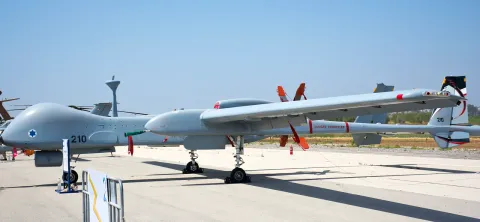
Israel Aerospace Industries
Heron TP
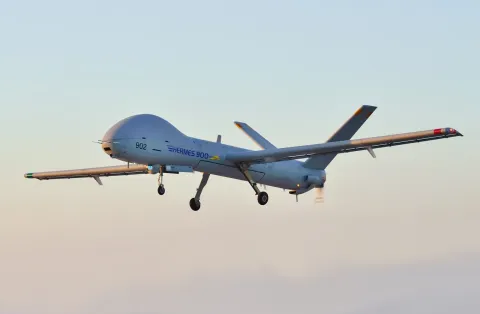
Elbit Systems
Hermes 900
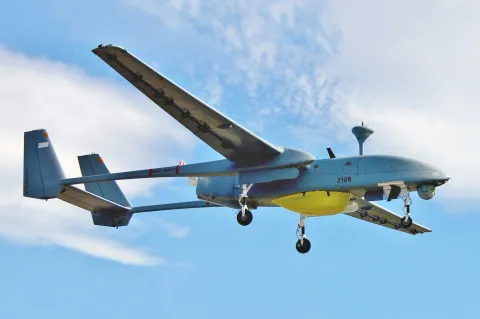
Israel Aerospace Industries
Super Heron
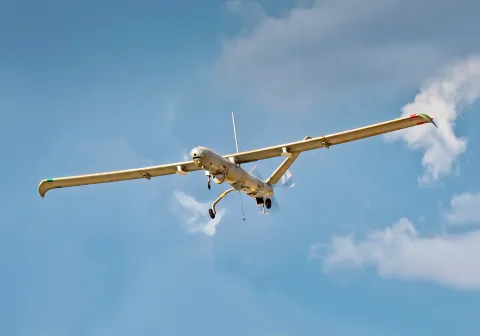
Elbit Systems