Documents
 United States
 GE Aerospace
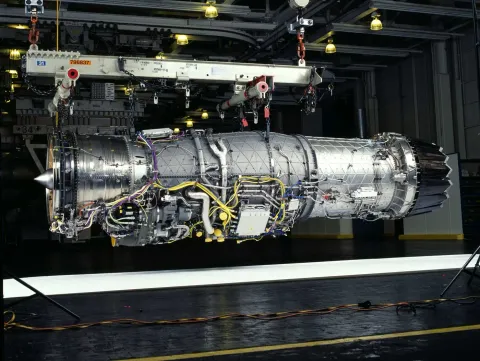
General Electric F404
Derived from GE's YJ101 demonstrator, the F404 became the original F/A-18 Hornet's engine and, in its non-afterburning and export variants, went on to power a wide spread of light fighters and trainers including South Korea's FA-50/T-50 and India's Tejas Mk1A.
In service since 1978
Compiled from public sources ·primary reference ↗ ·last verified 2026-08-10
79
kN thrust
989
kg
8.12
T/W
Procurement snapshot
Availability & export
US ITAR-controlled
Export needs U.S. State Dept (DDTC) approval; end-use & re-transfer restrictions apply.
Channel: Foreign Military Sales (FMS) or Direct Commercial Sale
Fielded & proven
Operator data not public
In service since 1978. Status: active.
Lifecycle cost (est.)
No public unit price to model from. Why so few systems publish one →
Interoperability
No standardised NATO calibre / datalink detected in public specs.
Derived guidance from public data, export regime by country of origin, lifecycle from the GAO ~30% acquisition rule. Verify eligibility, pricing and offsets with the manufacturer and your acquisition authority.
Overview
Figures above are for the F404-GE-402 afterburning variant used in the F/A-18C/D Hornet. The non-afterburning F404-GE-102 rates lower and powers South Korea's FA-50/T-50 Golden Eagle family. GE scaled the F404's core up into the higher-thrust F414 for the Super Hornet generation, and the two engine families are still marketed and sustained together.
Powers these platforms
Systems in the WeaponSpecs database that list the General Electric F404 as their engine.


Full specifications
Performance
Speed, range, altitude and engagement capability.
| Thrust-to-weight Engine thrust divided by loaded weight. Above 1.0 the aircraft can accelerate going straight up. On a standalone engine record, this is the engine's own thrust divided by its dry weight, the standard figure of merit for jet engines. | 8.12 |
|---|
Physical
Dimensions, weight and crew.
| Length Overall length including gun/probe where applicable. | 3.91 m |
|---|---|
| Width Overall width, matters for rail/road transport of vehicles. | 0.89 m |
| Empty weight Weight without fuel, ammunition or crew. | 989 kg |
Propulsion
Engine, power and fuel.
| Thrust Total engine thrust (with afterburner where applicable). | 79 kN |
|---|---|
| Propulsion type Turbofan, turboshaft, diesel, gas turbine, solid-fuel rocket, ramjet… | Afterburning turbofan |
| Bypass ratio Ratio of air bypassing the engine core to air passing through it. Low ratios suit combat engines built for thrust and speed; high ratios suit transport engines built for fuel efficiency, so neither direction is simply better. | 0.34 |
Specifications compiled from public GE Aerospace and reference sources ↗. Published defense figures are approximations, treat comparisons as directional. Last verified 2026-08-10.
Compare with rivals
 Eurojet Turbo GmbH Eurojet EJ200