Documents
 Russia
 JSC Klimov
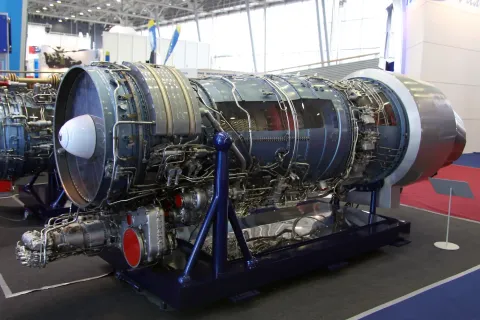
Klimov RD-33
Twin-shaft afterburning turbofan (two per aircraft) developed under S.P. Izotov for the MiG-29, and license-built in Russia and China as the RD-93 variant with a shifted gearbox for single-engine airframes like the JF-17 Thunder. Manufacturer and state-sourced figures below carry limited independent verification.
In service since 1982
Compiled from public sources ·primary reference ↗ ·last verified 2026-08-10
81
kN thrust
1,055
kg
7.87
T/W
Procurement snapshot
Availability & export
Russian state channel
Rosoboronexport monopoly; Western sanctions exposure and payment/logistics risk for many buyers.
Channel: Rosoboronexport (state)
Fielded & proven
Operator data not public
In service since 1982. Status: active.
Lifecycle cost (est.)
No public unit price to model from. Why so few systems publish one →
Interoperability
No standardised NATO calibre / datalink detected in public specs.
Derived guidance from public data, export regime by country of origin, lifecycle from the GAO ~30% acquisition rule. Verify eligibility, pricing and offsets with the manufacturer and your acquisition authority.
Overview
The upgraded RD-33MK fitted to the MiG-35 raises afterburning thrust to a reported 88 kN (9,000 kgf), adds FADEC digital control and eliminates the visible smoke trail of earlier RD-33 production, at a slightly higher dry weight of roughly 1,145 kg. Treat all figures as Russian manufacturer/state claims given the Russia origin caveat applied sitewide.
Powers these platforms
Systems in the WeaponSpecs database that list the Klimov RD-33 as their engine.


Full specifications
Performance
Speed, range, altitude and engagement capability.
| Thrust-to-weight Engine thrust divided by loaded weight. Above 1.0 the aircraft can accelerate going straight up. On a standalone engine record, this is the engine's own thrust divided by its dry weight, the standard figure of merit for jet engines. | 7.87 |
|---|
Physical
Dimensions, weight and crew.
| Length Overall length including gun/probe where applicable. | 4.23 m |
|---|---|
| Width Overall width, matters for rail/road transport of vehicles. | 1.04 m |
| Empty weight Weight without fuel, ammunition or crew. | 1,055 kg |
Propulsion
Engine, power and fuel.
| Thrust Total engine thrust (with afterburner where applicable). | 81 kN |
|---|---|
| Propulsion type Turbofan, turboshaft, diesel, gas turbine, solid-fuel rocket, ramjet… | Afterburning turbofan |
Specifications compiled from public JSC Klimov and reference sources ↗. Published defense figures are approximations, treat comparisons as directional. Last verified 2026-08-10.
Compare with rivals
 Eurojet Turbo GmbH Eurojet EJ200
  Pratt & Whitney Pratt & Whitney F135