F/A-XX and the Range Gap No Carrier Jet Has Closed
The Navy picks an F/A-XX builder this month citing 'longer range.' WeaponSpecs data shows why: no carrier jet in the world clears China's DF-21D threat radius.

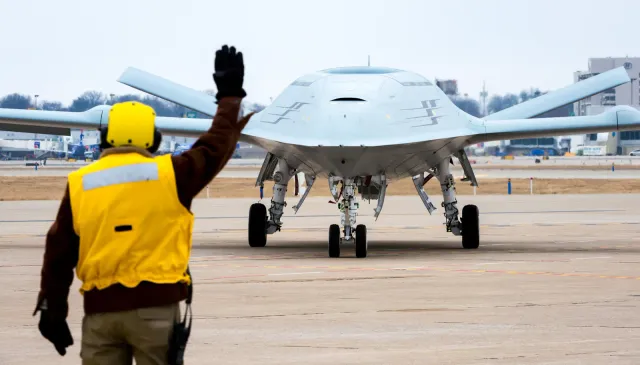
U.S. Navy photo by Mass Communication Specialist 2nd Class Antonio Turretto Ramos, via Wikimedia Commons, public domain
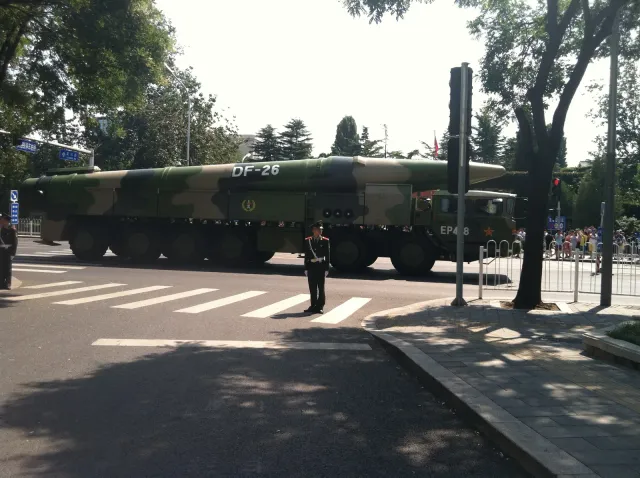
Of the 56 fighters in the WeaponSpecs database that publish a combat radius figure, only 8 are carrier-capable designs, and every single one falls short of China’s own claimed 1,500 km range for the DF-21D anti-ship ballistic missile. The best of them, China’s own J-35, still comes up 250 km short of its own country’s missile. Zero of the 56 fighters, carrier or land-based, reach even half of the DF-26’s claimed 4,000 km range. The closest is China’s land-based J-20 at 2,000 km, exactly 50 percent.
Why is the Navy’s F/A-XX decision coming down to range?
Chief of Naval Operations Adm. Daryl Caudle has framed the sixth-generation F/A-XX requirement around one capability above the rest: reach. The Navy wants a carrier-launched fighter that can operate deep inside an adversary’s missile envelope without requiring the carrier itself to sail inside that envelope first.
“In no world will what flies off of [a carrier] shouldn’t be the highest-end platform possible to penetrate deep into a weapon engagement zone and have confidence with longer-range munitions that it can close that kill chain,” said Adm. Daryl Caudle, Chief of Naval Operations (Breaking Defense, Dec. 6, 2025).
That framing is the whole procurement logic in one sentence: the further a carrier fighter can strike from the deck, the further offshore the carrier itself can stay. Caudle said in April 2026 that “we expect a down-select in August of this year” between Boeing and Northrop Grumman, per DefenseScoop. As of today, no winner has been named. Caudle has also explained why the call took longer than the Navy originally wanted, pointing to a shared industrial base with the Air Force’s own next-generation fighter program: “one of the contractors who would make this plane for us is in a place where they really can’t deliver in the timeframe we need it,” he said, describing a check-twice-cut-once approach to balancing F/A-XX against the Air Force’s F-47 NGAD program for the same limited pool of manufacturing capacity. F/A-XX itself has no public unit cost yet, the same opacity problem that dogs next-generation fighter programs more broadly.
How big is the gap, really?
WeaponSpecs tracks 56 fighters that publish a combat radius figure. Eight of them are real carrier or amphib-capable designs: the US F/A-18E/F Super Hornet and F-35C, France’s Rafale M, China’s J-15 and J-35, the F-35B, the legacy F/A-18C Hornet, and India’s HAL Tejas Navy. None of them reach China’s own stated 1,500 km range for the DF-21D anti-ship ballistic missile, and that missile’s range is itself a Chinese state and manufacturer claim, never independently verified against a moving target and never used in actual anti-ship combat, the same caveat WeaponSpecs applied in our prior look at anti-ship missile range versus combat record.
The best US carrier fighter, the F-35C, comes up 360 km short of the DF-21D’s claimed reach, a 24 percent shortfall. The Navy’s current frontline strike fighter, the Super Hornet, comes up 778 km short, 52 percent. Against the longer-legged DF-26, which China claims reaches 4,000 km, the F-35C falls short by 2,860 km, over 71 percent of the missile’s stated range. Only 13 of the 56 fighters in the database, 23.2 percent, meet or exceed 1,500 km combat radius at all, and every one of them is a land-based design. Not a single carrier-capable jet makes that list.
Every tan bar, the carrier-capable fighters, sits below the DF-21D line. Only two land-based jets on this list clear it at all, and neither one can land on a flight deck.
Does aerial refueling already fix this?
The Navy’s actual answer to the range problem, at least for the next several years, is not F/A-XX. It’s the MQ-25A Stingray, an unmanned carrier-based tanker built specifically to extend strike fighter reach without adding a manned aircraft to the tanking mission. The Pentagon’s requirement calls for delivering at least 14,000 lbs of fuel at 500 nautical miles (926 km) from the carrier, and the drone has already demonstrated refueling the F/A-18E/F, F-35C, and E-2D. USS Theodore Roosevelt became the first fully MQ-25-capable carrier in March 2026, per Army Recognition.
That milestone sounds like the range gap closing. It isn’t, not soon. The MQ-25’s first actual carrier flight isn’t projected until February 2027, and per Military Times, its Initial Operational Capability has slipped to February 2029. A mid-flight refuel does not simply add its transfer distance onto a fighter’s published combat radius the way a back-of-envelope sum implies, tanking geometry, fuel burn on the outbound leg, and where the tanker itself can safely operate all complicate that math. What the IOC date does tell you cleanly: the interim fix for the carrier air wing’s range problem is arriving on roughly the same calendar as F/A-XX itself. There is no near-term shortcut here. Both paths run through the end of this decade.
Is this only an American problem?
No, and that’s the part worth sitting with rather than treating as a scoring opportunity. China’s own newest carrier fighter, the J-35, built for the carrier Fujian, publishes a 1,250 km combat radius figure. Its own country’s claimed DF-21D range is 1,500 km. That’s a 250 km shortfall, 16.7 percent, against a missile China itself fields and describes as an anti-ship weapon. The J-15, China’s older carrier fighter flying off Liaoning and Shandong, comes up even shorter at 1,200 km.
Physics doesn’t take sides. A carrier air wing’s realistic combat radius is bounded by fuel, engine efficiency, and airframe weight in ways that don’t care whose flag is on the tailhook. China’s own military planners are working the same problem the US Navy is working, and its own newest fighter hasn’t solved it any more than the Super Hornet has. That symmetry is a useful check on the framing here: this is a story about the physical limits of carrier aviation against modern stand-off missiles, not a story about one country’s jets being inadequate while another’s are adequate.
What the caveats mean for reading these numbers
Two things need to stay attached to every figure in this piece. First, the DF-21D and DF-26 ranges are Chinese state and manufacturer claims, not independently verified performance data and not figures either missile has demonstrated in actual anti-ship combat against a moving target. Treat them as the outer edge of a stated threat envelope, not a confirmed one. Second, “combat radius” and “range” are not the same measurement, and mixing them produces false comparisons; every fighter figure cited here is a published combat radius, the practical one-way strike distance a jet can fly and still return, not its one-way ferry range.
None of that changes the shape of the finding. Even granting every benefit of the doubt on the Chinese figures, the best carrier fighter flying today, by combat radius, doesn’t reach the medium end of China’s own stated anti-ship envelope. That’s the gap the Navy says F/A-XX exists to close, and it’s why the August contractor decision matters more than which company’s name ends up on the airframe. Compare these and other fighters directly, or model a threat envelope against your own assumptions, with the WeaponSpecs Advisor, or browse the full fighter aircraft category for the rest of the 56-system dataset behind this piece.
| System | Country | Combat radius / range (km) | Carrier-capable |
|---|---|---|---|
| DF-26 (“Guam Killer”) | China | 4,000 (claimed) | N/A (missile) |
| DF-21D | China | 1,500 (claimed) | N/A (missile) |
| J-35 | China | 1,250 | Yes |
| J-15 | China | 1,200 | Yes |
| F-35C Lightning II | United States | 1,140 | Yes |
| Rafale M | France | 1,055 | Yes |
| F-35B Lightning II | US/UK/Japan/Italy | 900 | Yes (STOVL/amphib) |
| F/A-18C Hornet | Multiple (legacy) | 740 | Yes |
| F/A-18E/F Super Hornet | United States | 722 | Yes |
| HAL Tejas Navy | India | 400 | Yes |
Not one carrier row on that table clears either missile row above it, which is the entire reason the Navy frames F/A-XX around reach rather than speed, stealth, or payload alone.
Sources
- Navy's Caudle: F/A-XX fighter decision needs to come 'quickly' (Breaking Defense)
- Navy F/A-XX contract award planned August: Adm. Caudle (DefenseScoop)
- USS Theodore Roosevelt becomes first U.S. carrier ready to command MQ-25 Stingray operations (Army Recognition)
- MQ-25A Stingray cleared for deployment, says Cao (Military Times)
- DF-21 (missile family), Wikipedia
- DF-26, Wikipedia
Systems in this comparison
Every system covered above, with its photo and, where available, a video. Tap a card to open the full spec sheet.
Compare these side by side →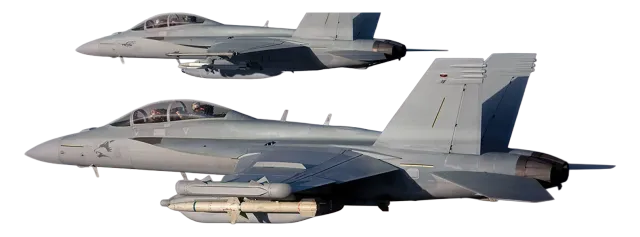
Fighter aircraft
F/A-18E/F Super Hornet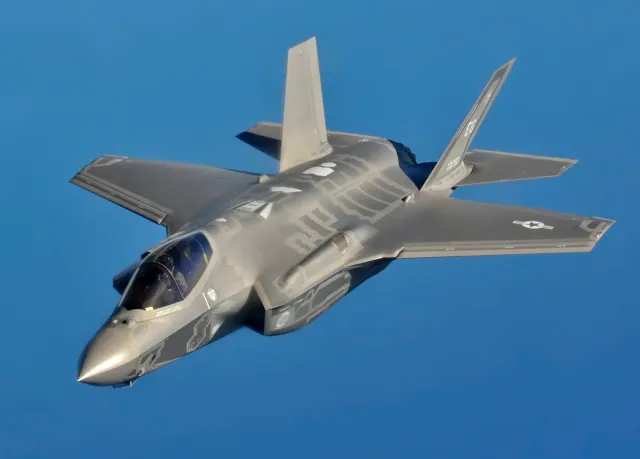
Fighter aircraft
F-35C Lightning II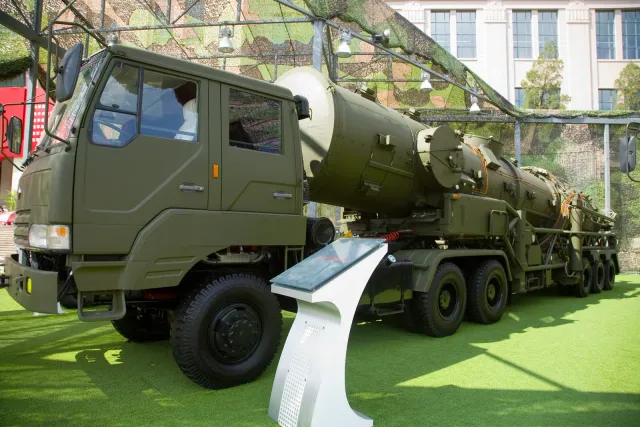
UAV / drone
MQ-25 Stingray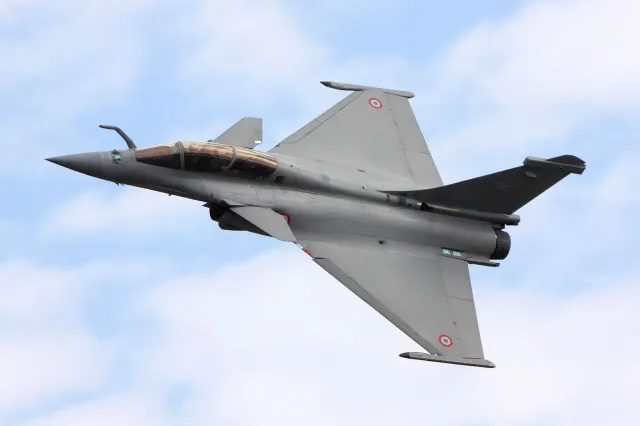
Frequently asked questions
Why is the Navy's F/A-XX decision coming down to range? +
Chief of Naval Operations Adm. Daryl Caudle has said the sixth-generation carrier fighter needs to penetrate deep into a weapon engagement zone without forcing the carrier itself inside a threat missile's reach. WeaponSpecs' own database shows why that matters: every carrier-capable fighter it tracks, US and Chinese alike, falls short of even China's stated medium-range anti-ship missile radius.
How much combat radius do today's carrier fighters have? +
Among the eight carrier-capable fighters in the WeaponSpecs database, the longest published combat radius figure is China's J-35 at 1,250 km, followed by the F-35C at 1,140 km. The US Navy's current frontline strike fighter, the F/A-18E/F Super Hornet, publishes 722 km.
Does the MQ-25 Stingray solve the Navy's range problem? +
Not on the current timeline. The MQ-25A is a carrier-based tanker drone built to extend strike fighter reach, and USS Theodore Roosevelt became the first fully MQ-25-capable carrier in March 2026, but the drone's first carrier flight isn't projected until February 2027 and its Initial Operational Capability has slipped to February 2029, roughly the same window F/A-XX itself is aiming for.
Is the range gap only an American problem? +
No. China's newest carrier fighter, the J-35, publishes a 1,250 km combat radius figure against its own country's claimed 1,500 km DF-21D anti-ship missile range, a 250 km shortfall. The physics of the range gap does not distinguish between fleets.
When will the Navy announce the F/A-XX contractor? +
Adm. Caudle said in April 2026 that the Navy expected a down-select between Boeing and Northrop Grumman in August 2026. As of this writing no winner has been announced. Caudle has attributed the slower timeline partly to limited industrial capacity shared with the Air Force's F-47 NGAD program.
Related reading


