Soviet Artillery Production Still Dwarfs NATO's
Ten Soviet-era artillery platforms in our database total 29,238 units built, more than double the 11,207 built across 22 modern systems from 15 countries.

Via Wikipedia, BM-21 Grad (shown for identification)
Ten Soviet or Russian-origin artillery platforms in WeaponSpecs’ database total 29,238 units built between them. Twenty-two non-Russian platforms from 15 other countries, everything from the American M777 to South Korea’s K9 Thunder, total 11,207 units combined. That is not a close race: the Soviet total runs roughly 2.6 times higher, and one single Cold War design, the BM-21 Grad, was built in almost as many copies on its own as all 22 non-Russian systems put together.
How many artillery systems in the database actually publish a production number?
WeaponSpecs tracks 58 systems tagged as artillery, spanning towed and self-propelled howitzers, multiple-launch rocket systems, and mortars. Of those, 33 publish a units-built figure, the rest simply don’t disclose one, which is itself worth noting: a production total is one of the more basic facts a manufacturer or state can release, and roughly 43% of artillery systems in our database don’t.
One of those 33, Lockheed’s 70,000-unit GMLRS, gets pulled out before any comparison starts, and the reason matters more than a footnote. GMLRS is a guided rocket fired from HIMARS and M270 launchers, not a gun or launcher platform in its own right. Its units-built figure counts rockets fired, not vehicles produced. Stacking that number against a howitzer’s production run would be comparing ammunition to hardware, the same “same field, different meaning” trap that shows up whenever a units-built column mixes munitions with the platforms that fire them. Strip GMLRS out and the real comparison set is 32 platforms: howitzers, MLRS launchers, and mortars, each counted the same way.
Which single Cold War-era design nearly outbuilt every rival combined?
The BM-21 Grad, first fielded in 1,963, alone accounts for 10,000 units. That is almost as many as all 22 non-Russian platforms in our database combined, 11,207. A single 40-tube rocket truck, designed while Khrushchev was still in power, came within a few thousand units of matching the entire modern non-Russian world’s artillery production added together.
Add a second Soviet design and the comparison stops being close at all. The 2S1 Gvozdika self-propelled howitzer, also built to a total of 10,000 units, brings the two-system Soviet total to 20,000, nearly double the 11,207 built across every non-Russian artillery platform we track. Two truck-and-turret designs from the early 1970s outbuilt fifteen countries’ worth of modern artillery programs by a factor of almost two. That is the scale gap this post is about: not that Soviet artillery was numerous, every analyst already knows that, but that the gap it opened has never actually closed. Even the newest Soviet-era design in the comparison, the 2S19 Msta-S introduced in 1989, still reached 1,000 units on its own, more than most single Western programs manage today.
Why doesn’t the highest number in the dataset belong in this comparison?
GMLRS’s 70,000-unit figure would dwarf every number in either table above if it were left in, and that is exactly why leaving it in would mislead rather than inform. A HIMARS battery firing GMLRS pods is a launcher platform with a production run in the hundreds; the rockets it fires are consumable munitions with a production run in the tens of thousands, the same relationship as a rifle and its ammunition. Counting rounds fired as if they were vehicles built would make the American side of this comparison look far larger than it is, while telling the reader nothing true about how many actual gun or launcher platforms the United States has fielded. The compare tool lets you check this distinction yourself against any pair of systems in the database.
Is South Korea’s K9 Thunder proof the mass-production gap can be closed?
It’s the closest thing to a counterexample in the dataset, and worth taking seriously as one. K9 Thunder, built by Hanwha and first fielded in 1,999, has reached 1,900 units, the highest production total of any non-Russian system in our database. It alone outbuilds every individual Western howitzer we track, including the American M777 at 1,500 units, the next-highest non-Russian figure. South Korea has also exported the design widely, a genuine modern mass-production success story, and evidence that sustained peacetime output at real scale is still achievable outside a Soviet-style industrial base.
But scale matters here, not just leadership within a smaller field. K9 Thunder’s 1,900 units is roughly a fifth of what the BM-21 Grad managed alone, and less than a tenth of the combined Soviet total. K9 Thunder shows the gap can be narrowed by one determined manufacturer. It does not show the gap has closed, and nothing else in the non-Russian column comes close to Soviet-era volumes either: 21 of the 22 non-Russian systems in our comparison entered service in 1976 or later, built under the steadier, lower-volume procurement rhythm that has defined Western and allied artillery programs since the Cold War wound down. France’s CAESAR, at 350 units since 2008, sits closer to that Western norm, a real, actively-exported program that simply operates at a different order of magnitude than either K9 Thunder or the Soviet designs above it.
Why does 1960s-era production still matter in a 2026 war?
Because it is a wartime resource, not a museum inventory. Every Soviet-era platform in our comparison table is still classified active in WeaponSpecs’ own database except one, the 1,975-vintage 2S7 Pion, which is the single legacy-status system in either table. Nine of the ten Soviet designs are still formally in front-line service somewhere more than 50 years after the oldest of them entered production, and Russia’s current war has made that fact operationally real rather than theoretical.
Russia has been reactivating M-46 130mm towed guns, a design dating to the 1940s and 50s, older than any system in the two tables above, pulling roughly 300 of about 600 stored units out of Cold War depots because current production cannot fully replace battlefield losses, with reported help sourcing ammunition and components from North Korea and Iran (ArmyRecognition, July 16, 2024). The M-46 isn’t one of the 32 systems in our comparison, its production figures aren’t tracked in our database the same way, but it is the same phenomenon in sharper relief: Soviet-era industrial mass built decades ago is being drawn down as an active strategic reserve today, not studied as history.
What should this mean for a modern procurement planner?
Two things, and neither is “match the Soviet number.” First, the production gap is real and durable, not an artifact of one outlier system: it holds up whether you compare the single biggest Soviet design to the entire rest of the world, or the top two Soviet systems to everything non-Russian combined. A planner sizing a wartime attrition reserve should treat that gap as the baseline reality of what a peer or near-peer adversary can draw on when a conflict runs longer than expected, not an exaggeration to discount.
Second, K9 Thunder’s example is the more useful model going forward than trying to out-produce Cold War Soviet industry unit-for-unit. It shows that a modern, exportable, still-in-production design can reach meaningful scale within a normal procurement cycle, which is a more realistic target than replicating 1960s-70s mass mobilization. Readers building out their own attrition or reserve-capacity assumptions can browse the full artillery category for every system’s individual production and service-entry data, or run a side-by-side breakdown of specific platforms through the compare tool. For a broader threat-profile assessment that accounts for what an adversary can field and resupply, start with the Advisor.
The data: Soviet/Russian-origin vs. everyone else
Soviet-era production totals below, especially for systems built inside the USSR decades ago, are widely-cited open-source and historical estimates, typically sourced via Wikipedia and Western military historians, not figures independently audited or released by the Russian government. Read every number in the first table with that uncertainty in mind.
Soviet/Russian-origin platforms (10 systems, 29,238 units)
| System | Country | Entered Service | Status | Units Built |
|---|---|---|---|---|
| 2S1 Gvozdika | Russia | 1,971 | active | 10,000 |
| BM-21 Grad | Russia | 1,963 | active | 10,000 |
| 2S3 Akatsiya | Russia | 1,971 | active | 4,000 |
| 2S5 Giatsint-S | Russia | 1,976 | active | 2,000 |
| 2S19 Msta-S | Russia | 1,989 | active | 1,000 |
| BM-27 Uragan | Russia | 1,975 | active | 750 |
| 2S4 Tyulpan | Russia | 1,972 | active | 588 |
| 2S7 Pion | Russia | 1,975 | legacy | 500 |
| BM-30 Smerch | Russia | 1,989 | active | 300 |
| TOS-1A Solntsepyok | Russia | 2,001 | active | 100 |
Everyone else (22 systems, 15 countries, 11,207 units)
| System | Country | Entered Service | Status | Units Built |
|---|---|---|---|---|
| K9 Thunder | South Korea | 1,999 | active | 1,900 |
| M777 Howitzer | United States | 2,005 | active | 1,500 |
| M270A2 MLRS | United States | 2,018 | active | 1,300 |
| L118 Light Gun | United Kingdom | 1,976 | active | 1,100 |
| PLZ-05 | China | 2,007 | active | 900 |
| DANA | Czech Republic | 1,981 | active | 750 |
| M109A7 Paladin | United States | 2,015 | active | 600 |
| M142 HIMARS | United States | 2,005 | active | 540 |
| PzH 2000 | Germany | 1,998 | active | 400 |
| K239 Chunmoo | South Korea | 2,014 | active | 356 |
| CAESAR | France | 2,008 | active | 350 |
| T-155 Fırtına | Turkey | 2,001 | active | 350 |
| Pinaka | India | 1,999 | active | 200 |
| AS-90 | United Kingdom | 1,993 | active | 179 |
| G6 Rhino | South Africa | 1,988 | active | 150 |
| Type 99 155mm SPH | Japan | 1,999 | active | 150 |
| AHS Krab | Poland | 2,013 | active | 120 |
| Dhanush | India | 2,018 | active | 114 |
| Vilkha-M | Ukraine | n/a | active | 100 |
| M120 Rak | Poland | 2,017 | active | 70 |
| Archer Artillery System | Sweden | 2,016 | active | 60 |
| Primus SSPH 1 | Singapore | 2,004 | active | 18 |
Bars are drawn to a linear scale, so the drop-off after the top four Soviet designs is real, not a scaling artifact. K9 Thunder is the only non-Russian system to crack the top four, and even it sits at roughly a fifth of the BM-21 Grad's total.
Run the numbers on any of these platforms yourself, including releaseYear and units-built figures that stay current as WeaponSpecs’ database is corrected, through the artillery category or the compare tool.
Sources
Systems in this comparison
Every system covered above, with its photo and, where available, a video. Tap a card to open the full spec sheet.
Compare these side by side →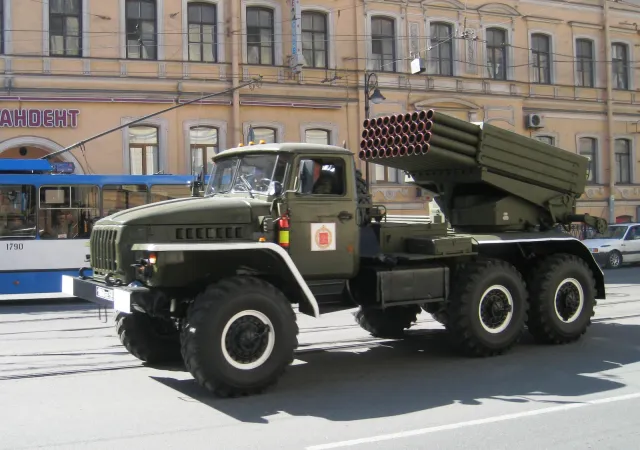
Artillery & MLRS
BM-21 Grad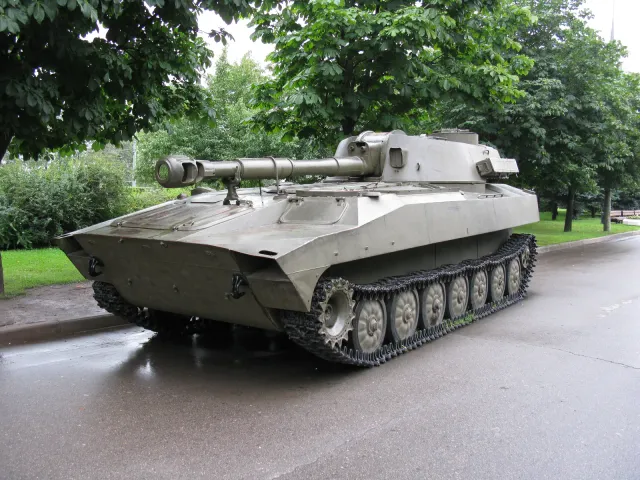
Artillery & MLRS
2S1 Gvozdika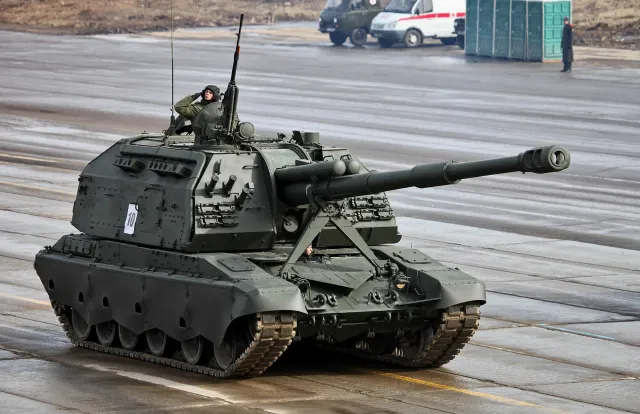
Artillery & MLRS
2S19 Msta-S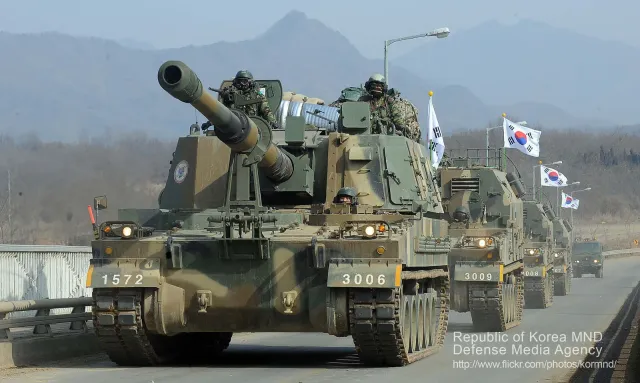
Artillery & MLRS
K9 Thunder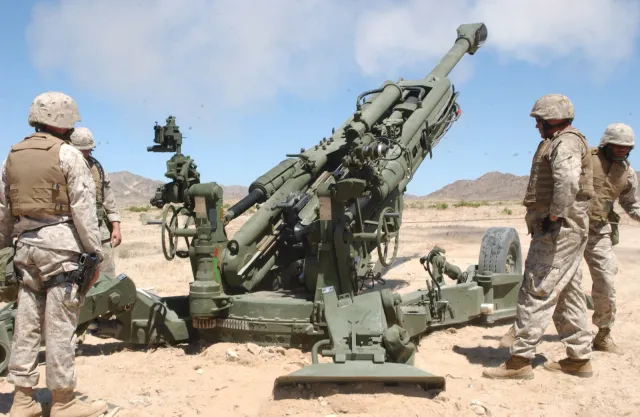
Artillery & MLRS
M777 Howitzer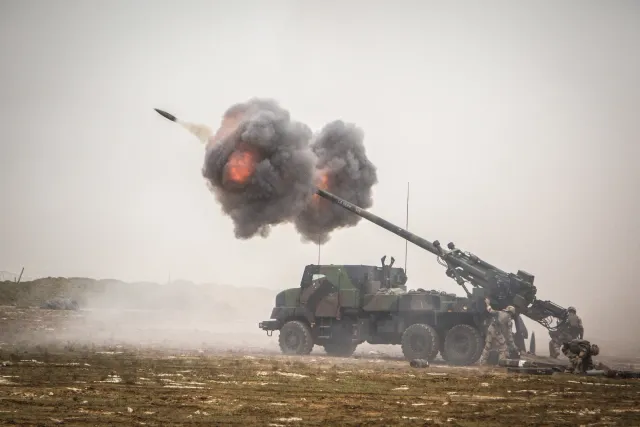
Frequently asked questions
How many artillery systems in the WeaponSpecs database publish a units-built figure? +
33 of the 58 artillery-category systems we track publish a production total. One of those, Lockheed's GMLRS at 70,000 units, counts rockets fired from launchers rather than gun or launcher platforms, so it is excluded from platform-to-platform comparisons, leaving 32 real howitzers, MLRS launchers, and mortars with a usable figure.
What is the actual split between Soviet-era and everyone else's artillery production? +
Ten Soviet or Russian-origin platforms in our database total 29,238 units built. Twenty-two platforms from 15 other countries total 11,207 units combined. The Soviet total is roughly 2.6 times larger, and two Soviet systems alone, the 2S1 Gvozdika and BM-21 Grad, already outbuild all 22 non-Russian platforms combined.
Why is Lockheed's GMLRS excluded from this artillery comparison? +
GMLRS is a guided rocket fired from HIMARS and M270 launchers, not a gun or launcher platform in its own right. Its 70,000-unit total counts rounds fired, not vehicles built, so putting it next to a howitzer or launcher production number would compare a munition count to a platform count, two different things that happen to share a units-built field.
How reliable are the Soviet-era production totals? +
Treat them as estimates, not audited figures. Systems like the BM-21 Grad and 2S1 Gvozdika were built decades ago inside a closed Soviet industrial system that never published verified production data, so the numbers in circulation today, including the ones in our database, trace back to Western military historians and open-source compilations rather than any Russian government release.
Does high historical production mean these Soviet systems are still relevant today? +
Yes, in the sense that matters for a war, not a museum. Every Soviet-era system in our comparison except the 2S7 Pion is still classified active, and Russia has gone as far as pulling 1940s-designed M-46 towed guns out of storage to sustain the war in Ukraine, evidence that Cold War-era mass production is a wartime resource being actively drawn down, not a historical footnote.
Related reading


