Second Ford-Class Carrier Kennedy Passes Acceptance Trials
The $13B USS John F. Kennedy, 98% complete, finished a 4-day acceptance sea trial off the Atlantic coast ahead of a spring 2027 Navy delivery.

U.S. Navy photo by Seaman Jayden Howard, via DVIDS, public domain.
The future USS John F. Kennedy (CVN 79), the US Navy’s second Gerald R. Ford-class supercarrier, completed a four-day acceptance sea trial off the Atlantic coast on Aug. 15, with the ship reported 98% complete and on track for delivery to the Navy in spring 2027.
What acceptance trials actually test
Acceptance trials are a formal Navy evaluation, run by the Board of Inspection and Survey, that checks a newly built ship against its contract specifications before the government agrees to accept it. Over the four days at sea, Kennedy’s crew and inspectors put the carrier’s propulsion, navigation, combat systems, aviation infrastructure, safety systems, habitability, and general operational reliability through their paces. This is a different, more advanced milestone than Kennedy’s first-ever underway period: the carrier’s builder’s sea trials, essentially the shipbuilder’s own internal shakedown before handing the ship to the Navy for formal evaluation, wrapped in February 2026 after the ship first got underway on Jan. 28.
Passing acceptance trials does not mean Kennedy is done. The next step is Preliminary Acceptance, which allows the Navy to begin its own underway test-and-evaluation period, followed by final delivery, still targeted for spring 2027. Construction on Kennedy actually began back in February 2011, and the program has already absorbed delays tied to the same advanced arresting gear and advanced weapons elevator problems that troubled the lead ship, pushing the current delivery target out to March 2027. The Navy has extended the service life of USS Nimitz specifically to bridge the gap created by those delays.

Why the second hull of a class is where the real test happens
Lead ships in a new carrier class routinely absorb a disproportionate share of a program’s technical risk, and Ford was no exception: its electromagnetic launch system, advanced arresting gear, and advanced weapons elevators all generated well-documented cost growth and schedule delays before the Navy accepted it. Kennedy’s smoother path through builder’s trials and now acceptance trials is being read industry-wide as evidence that the class’s early technical risk is being retired rather than repeating hull after hull, the actual purpose of building a class of ships in the first place rather than one-off designs.
That reading comes with a real caveat, not just a rhetorical one: four advanced weapons elevators, systems used to move munitions from below-deck magazines up to the flight deck, remain under construction by the prime contractor even after acceptance trials concluded. That is the same category of problem, not the same problem solved, that dogged Ford’s own delivery, and it is worth tracking whether those elevators are finished well before spring 2027 or become a late complication the way they did on the lead ship.
The F-35C difference that actually changes deployed capability
One concrete way Kennedy improves on Ford rather than just repeating it: Kennedy will be delivered ready to operate the F-35C Lightning II from day one. Ford, by contrast, was delivered without full F-35C integration and had that capability added afterward, a costly retrofit that delayed the carrier’s ability to actually deploy with the Navy’s newest carrier-based fighter. Building F-35C readiness into Kennedy’s construction rather than bolting it on later is a direct, applied lesson from Ford’s own program history, and it means Kennedy should be able to deploy with a more capable air wing sooner after commissioning than its sister ship did.
The cost is real, and it is not unusual for this class
The Navy’s latest procurement estimate puts Kennedy’s cost at roughly $13.2 billion against an $11.4 billion cost cap, a real and substantial overrun of more than $1.8 billion. Context matters here: lead ship USS Gerald R. Ford closed out at approximately $13.3 billion, so Kennedy’s overrun, while still large in absolute dollars, sits below what the first-in-class ship ultimately cost. A cost cap breach of this size on a single ship is roughly equivalent to the annual defense budget of a mid-sized NATO member, a useful way to grasp the scale of a single carrier program even as it remains, in Navy budget terms, one line item among many.
What people directly involved are saying
The Navy’s own program manager framed the trials as evidence the crew, not just the ship, is ready.
“Over the last few days, the crew of the future USS John F. Kennedy performed incredibly well and have demonstrated that they are ready to put this ship to work,” said Capt. Mark Johnson, Program Manager for Aircraft Carrier New Construction, U.S. Navy (DVIDS, Aug. 17, 2026).
The shipbuilder’s side struck a similar note about the work behind the ship rather than the ship alone.
“It is an honor to take Kennedy to sea to demonstrate the quality work and commitment by our shipbuilders,” said Derek Murphy, Vice President of New Construction Aircraft Carrier Programs, Newport News Shipbuilding (HII, Aug. 15, 2026).
What to watch through delivery
Two threads are worth following between now and spring 2027: whether the four remaining advanced weapons elevators finish without becoming the kind of late-program complication that hit Ford, and whether Preliminary Acceptance and the Navy’s own test-and-evaluation period surface anything acceptance trials did not. Kennedy clearing this stage cleanly is a genuinely good sign for the Ford class’s maturity, not a guarantee the rest of the process goes as smoothly.
Sources
- HII's Newport News Shipbuilding Completes Successful Acceptance Sea Trials of John F. Kennedy (CVN 79) — Huntington Ingalls Industries (HII), Aug 15, 2026
- HII Completes Successful Acceptance Sea Trials of John F. Kennedy (CVN 79) — Naval News, Aug 16, 2026
- Kennedy Carrier Completes Acceptance Sea Trials Ahead of 2027 Delivery — The Defense Post, Aug 17, 2026
- Future USS John F. Kennedy Completes Acceptance Trials — DVIDS / U.S. Navy, Aug 17, 2026
Systems mentioned
Every system named in this story, with its photo and, where available, a video. Tap a card to open the full spec sheet.
Compare these side by side →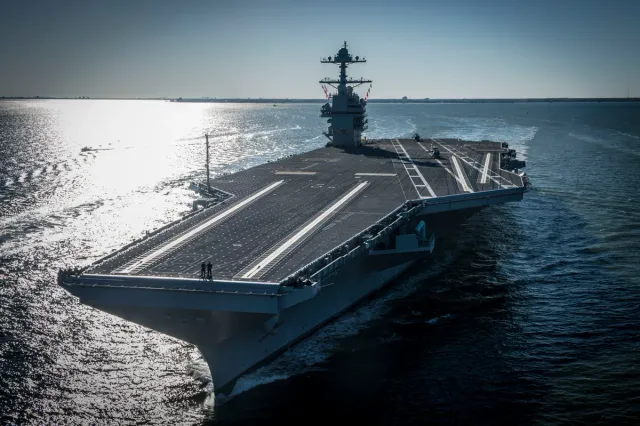
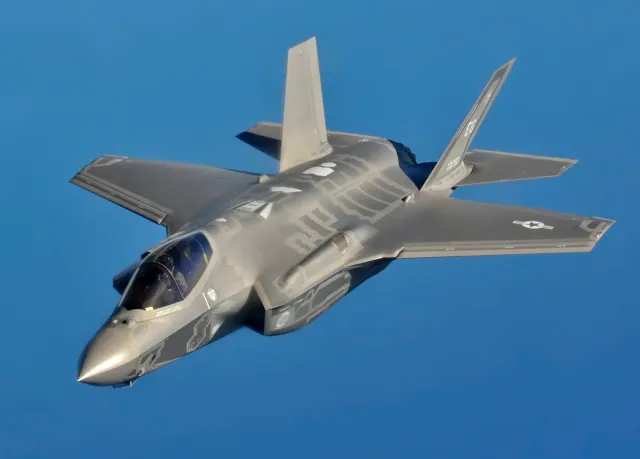
Fighter aircraft
F-35C Lightning IIFrequently asked questions
What's the difference between acceptance trials and the ship actually joining the fleet? +
Acceptance trials are a Navy Board of Inspection and Survey evaluation confirming the ship meets its contract specifications. Kennedy still has to go through Preliminary Acceptance and further Navy test and evaluation before final delivery, which is targeted for spring 2027.
Why does it matter that Kennedy will be F-35C-ready at delivery, unlike lead ship Ford? +
USS Gerald R. Ford was delivered without full F-35C Lightning II integration and had that capability added later, an expensive retrofit. Kennedy having F-35C readiness built in from day one reflects lessons learned on the lead ship and avoids repeating that cost.
How much has this carrier cost, and is it over budget? +
The Navy's latest procurement estimate is roughly $13.2 billion against an $11.4 billion cost cap, a significant overrun, though it's still smaller in relative terms than lead ship USS Gerald R. Ford's final out-turn cost of about $13.3 billion.
What's still unfinished at 98% complete? +
Four advanced weapons elevators remain under construction by the prime contractor even after acceptance trials wrapped, a lingering technical issue that has dogged the Ford class since USS Gerald R. Ford's own delivery.
More news


