UGV Control Range: Why the Biggest Claims Are Untested
Only 15 of 47 combat robots in the WeaponSpecs database publish a control range, and the longest claim, 15 km, has never been fielded in combat.

U.S. Marine Corps photo by Eve A. Baker, public domain, via Wikimedia Commons
Only 15 of the 47 unmanned ground vehicles (UGVs) in the WeaponSpecs database publish a maximum control range, the distance a human operator can stay from the robot and still run it, and among those 15 the median is a modest 2 km. The longest claim in the sample, 15 km from Ukraine’s Ukrainian Armor Protector, has never been fielded in combat: it was unveiled at a 2024 trade show. The only system in the sample independently reported as fielded in ongoing combat, Ukraine’s Roboneers Ironclad, claims a comparatively unremarkable 5 km.
How far can a combat robot actually operate from its handler?
WeaponSpecs added a dedicated ugv systemType today, covering 47 unmanned ground vehicles and combat robots spanning wheeled, tracked, and, in two cases, legged platforms built to fight, breach, resupply, or evacuate casualties without a crew aboard. Browse the full UGV category for spec sheets on every entry.
Of those 47, only 15 (31.9%) publish a unmanned.controlRangeKm figure at all, the maximum radio- or fiber-optic-link distance between the operator’s control station and the robot before the link degrades past usable command. Locomotion splits 25 tracked to 20 wheeled to 2 legged across the full 47, but that’s a footnote here, not the story; every locomotion type shows up on both sides of the disclosure line.
Among the 15 that do publish a number, the median is 2 km and the spread runs from 0.2 km (GD MUTT) to 15 km (Ukrainian Armor Protector), a 75x gap between the shortest and longest published claim. That’s wide enough that “control range” on a UGV spec sheet is close to meaningless as a single number until you know who’s claiming it and under what conditions it was claimed.
Which control-range claims are combat-tested, and which are trade-show numbers?
Combat exposure is the variable the raw ranking hides. Of the 15 systems with a published control range, exactly one has been independently reported as fielded in ongoing active combat: Ukraine’s Roboneers Ironclad, used by the 5th Assault Brigade for logistics and casualty evacuation under fire. Its published range is 5 km, mid-pack in this sample, not the leader.
The system with the longest claim sits at the opposite end of that exposure spectrum. Ukrainian Armor Protector claims 15 km, but that number comes from its 2024 unveiling at MSPO, a Polish defense trade show, with no reported combat deployment behind it. Treat it as a manufacturer claim made in a controlled demonstration setting, not a figure any unit has had to rely on against an adversary jamming the link.
The clearest reality check in the sample comes from a system that isn’t even in the top half of the ranking: Russia’s Uran-9. The WeaponSpecs database records its control range at 3 km, itself a Russian state figure and flagged as such; the manufacturer’s own datasheet separately claims “not less than 4 km.” Neither number is independently verified, and both should be read as claims. What makes Uran-9 different is that Russia’s own military tested it in the one setting these numbers are supposed to describe: a 2018 combat deployment to Syria. The Russian Ministry of Defence’s 3rd Central Scientific Research Institute assessed that deployment afterward, and the result undercuts every claimed figure at once.
“Not capable of performing the tasks assigned to it,” concluded Andrei P. Anisimov, senior research officer at the Russian Ministry of Defence’s 3rd Central Scientific Research Institute, after the Uran-9’s 2018 Syria combat trial found its control range collapsed to 300-500 meters among low-rise buildings (Task & Purpose, June 27, 2018).
That 300-500 meter figure, corroborated by the US Army’s own Mad Scientist Laboratory analysis, is roughly a tenth of the several-kilometer range Uran-9 was supposed to deliver, and it came with 17 short-term and 2 long-term losses of control during the trial. This is Russian state reporting, worth flagging the same way any Russian figure on this page is flagged, but it’s a different kind of state reporting than a marketing claim: it’s Russia’s own military research institute reporting adversely on Russia’s own system, an admission against interest rather than a number designed to sell the platform. That combination, a state source with every incentive to inflate the result instead admitting it failed, is about as credible a data point as this category produces.
The pattern across all three cases runs the same direction. The less combat exposure a system has, the more inflated its range claim tends to look, and the one case with an actual independent trial found the claimed range collapsed by roughly 90%.
Does more autonomy mean a longer leash?
No, and this is a mistake worth heading off before it shapes a requirement. Autonomy level and control range measure two different things. Autonomy describes how much decision-making the robot handles onboard, whether a human drives every wheel input or the robot navigates a route on its own and waits for a fire-authorization tap. Control range describes how far the physical link, radio or fiber, reaches before it degrades. Nothing about a UGV making more decisions on its own requires its radio to reach further, and the dataset bears that out cleanly.
GD MUTT, the S-MET, is classified “Semi-autonomous,” a step up from simple teleoperation, and it has the shortest published control range in the entire sample: 0.2 km. Several “Supervised autonomy” and even flatly “Teleoperated” systems publish longer ranges than MUTT despite requiring more constant human input, not less: QinetiQ MAARS, fully teleoperated, reaches 0.9 km, and Milrem THeMIS, a “Supervised autonomy” platform, sits at 1.5 km.
If a requirement writer assumes a more autonomous platform automatically buys a longer standoff distance, this sample says otherwise. Range is a radio-engineering and terrain question. Autonomy is a software and doctrine question. They happen to sit on the same spec sheet, but one doesn’t predict the other.
What a 2 km leash means for the buyer
The entire pitch behind an unmanned ground vehicle is keeping a person further from the threat than a manned crew would be. A 2 km median control range sounds like it delivers that, until you remember it’s a brochure figure from a set of systems that, in this sample, has mostly never been tested against real terrain, urban clutter, or deliberate jamming. The one system that has been tested that way lost roughly 90% of its claimed range in a built-up environment. Scale that discount across the rest of the sample and a “2 km” leash could easily mean an operator effectively within a few hundred meters once buildings, foliage, or an adversary’s electronic warfare enter the picture, close enough to sit inside the same artillery fan, drone strike radius, or direct-fire arc that would threaten a manned vehicle’s crew.
That doesn’t make UGVs a bad buy. It means the control-range figure on the spec sheet needs the same skepticism as any claimed engagement range or armor rating: treat it as an upper bound established under ideal conditions, verify it against any available field or trial reporting, and size the actual standoff distance a mission plan can rely on well below the published number. Run a platform’s full spec profile, including whether it publishes a range figure at all, through the Advisor before writing a control-range requirement into a procurement document.
The full 15-system ranking
| System | Country | Control range | Autonomy | Locomotion | Status |
|---|---|---|---|---|---|
| GD MUTT (S-MET) | United States | 0 km | Semi-autonomous | Wheeled | Active |
| QinetiQ MAARS | United States | 1 km | Teleoperated | Tracked | Legacy |
| Elektroland Hançer | Turkey | 1 km | Not published | Tracked | Active |
| ASELSAN Aslan | Turkey | 1 km | Semi-autonomous | Tracked | Active |
| QinetiQ TALON SWORDS | United States | 1 km | Teleoperated | Tracked | Discontinued |
| Milrem THeMIS | Estonia | 2 km | Supervised autonomy | Tracked | Active |
| Roboteam ProBot | Israel | 2 km | Semi-autonomous | Wheeled | Active |
| HAVELSAN Barkan-3 | Turkey | 2 km | Supervised autonomy | Tracked | Announced |
| Uran-9 | Russia | 3 km* | Teleoperated | Tracked | Active |
| ARX Gereon RCS | Germany | 4 km | Semi-autonomous | Tracked | Active |
| HAVELSAN Kapgan | Turkey | 5 km | Supervised autonomy | Tracked | Announced |
| Otokar ALPAR | Turkey | 5 km | Semi-autonomous | Tracked | Announced |
| Roboneers Ironclad | Ukraine | 5 km | Semi-autonomous | Wheeled | Active, combat-fielded |
| ZM Tarnów Perun | Poland | 5 km | Semi-autonomous | Wheeled | Announced |
| Ukrainian Armor Protector | Ukraine | 15 km | Semi-autonomous | Wheeled | Announced, unfielded |
*Uran-9’s range is disputed even among Russian sources: the WeaponSpecs database records the commonly-reported 3 km figure, but Kalashnikov’s own datasheet separately claims “not less than 4 km.” Both are manufacturer/state claims, neither independently verified, and per the Syria trial above, both likely overstate real-world performance by close to an order of magnitude.
The only bar in accent color, Roboneers Ironclad's 5 km, sits in the middle of the pack rather than at either extreme, while the two most attention-grabbing bars, the shortest and the longest, both belong to systems with no combat record behind their number.
Sources
- Russia's Uran-9 Robot Tank Had a Bad Time in Syria (Task & Purpose)
- 63. Russian Ground Battlefield Robots: A Candid Evaluation and Ways Forward (Mad Scientist Laboratory / US Army TRADOC)
- Soldiers of the 5th Assault Brigade Used the Ironclad Multifunctional Unmanned Ground Vehicle (Militarnyi)
- Specifications of the Protector, New Multirole UGV From Ukrainian Armor (Defence Express)
Systems in this comparison
Every system covered above, with its photo and, where available, a video. Tap a card to open the full spec sheet.
Compare these side by side →UGV / combat robot
Roboneers IroncladUGV / combat robot
Ukrainian Armor ProtectorUGV / combat robot
Milrem THeMISUGV / combat robot
QinetiQ MAARS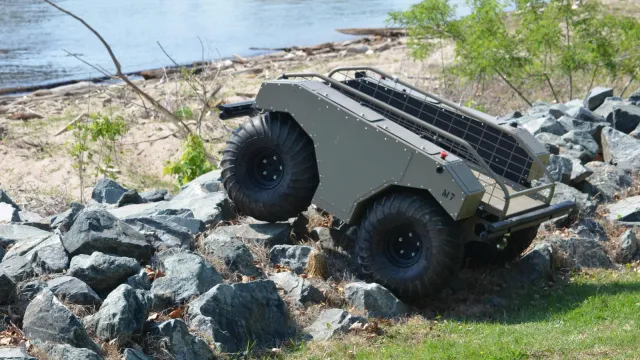
UGV / combat robot
MUTT (S-MET)Frequently asked questions
What does "control range" mean on a UGV spec sheet, and why does it matter? +
It's the maximum distance between the operator's control station and the robot at which the radio or fiber-optic link still reliably works, the practical leash length for teleoperation or supervised control. It matters because that distance is the actual measure of how far a human operator has to stay from wherever the robot is working, which is the entire point of fielding an unmanned platform in the first place.
Which combat robot has the longest published control range? +
Ukraine's Ukrainian Armor Protector claims 15 km, the longest figure among the 15 UGVs in the WeaponSpecs database that publish one. That number comes from the system's 2024 unveiling at the MSPO trade show in Poland, though, and it has no reported combat deployment behind it, so read it as an untested manufacturer claim rather than a battlefield-proven figure.
Has any UGV's claimed control range actually been tested in real combat? +
Yes, one, and the result is not flattering to the category. Russia's Uran-9 was deployed to Syria in 2018, and a post-deployment assessment by the Russian Ministry of Defence's own 3rd Central Scientific Research Institute found its claimed several-kilometer control range collapsed to 300-500 meters in built-up terrain, with repeated losses of control during the trial. It's a rare case of a Russian institution reporting adversely on a Russian system's own claims, which gives it more credibility than a typical marketing figure.
Does a more autonomous UGV operate at a longer range from its handler? +
Not necessarily. Autonomy level, how much decision-making the robot handles on its own, and control range, how far its physical link reaches, are separate variables. GD MUTT is classified "Semi-autonomous" and still has the shortest published control range in the WeaponSpecs database, 0.2 km, shorter than several teleoperated systems that require constant human input.
How many UGVs are in the WeaponSpecs database, and how many publish a control range? +
47, in a systemType added to the database in August 2026. Of those 47, only 15 (31.9%) publish a unmanned.controlRangeKm figure at all; the remaining 32 don't disclose it.
Related reading


