Russia Strikes Ukraine's Main Danube Port as Jet Drones Escalate
Russia struck Ukraine's largest Danube grain port and hit Odesa with a new turbojet Shahed-238 drone, as overnight barrages topped 128 drones.

Yuriy Kvach, Wikimedia Commons, CC BY-SA 4.0. This is a 2014 pre-war photo of the Port of Izmail itself, used here as an illustrative, contextual image of the port; it does not depict damage from this strike.
Russia struck port infrastructure at Izmail, Ukraine’s largest port on the Danube River, overnight into Aug. 17, hours after a jet-powered Shahed-238 drone hit a shopping center on Odesa’s outskirts, part of an overnight barrage of 128 drones that Ukrainian air defense says it downed 106 of.
The Izmail strike
Russian strikes hit port infrastructure in Izmail district, Odesa region, overnight into Aug. 17, according to Reuters reporting carried by Oman Observer and Aaj English. Izmail is Ukraine’s largest port on the Danube, sitting near the Romanian border. A Togo-flagged civilian vessel was damaged, four people were injured, fires broke out and were extinguished, and power was knocked out in the southeast part of the city.
Russia’s Defense Ministry said it had hit a “berthing terminal for military cargo,” hangars housing Western military equipment, and naval-drone storage depots. That is a state claim, not independently verified: Reuters explicitly said it could not confirm the Russian Defense Ministry’s assertions about what was actually hit, and no source reviewed for this story corroborates the military-cargo characterization independently.
Why the Danube keeps coming up as a target
Izmail is not a random target. After Russia’s early-war blockade and missile campaign against Ukraine’s Black Sea ports, the Izmail-Reni stretch of the Danube became Ukraine’s critical alternate export corridor for grain and other goods, routed near the Romanian border and out of range of the naval pressure Russia has applied further south. That history is why Danube port infrastructure keeps reappearing as a target: hitting it strikes at one of the few export routes Ukraine built specifically because its original ports were no longer reliably usable.
The national toll and the overnight barrage
Ukrainian authorities reported at least 9 people killed and 43 injured across the country over the 24 hours ending Aug. 17, according to Kyiv Independent: two killed and 11 injured in Kramatorsk, Donetsk region; two men, ages 58 and 66, killed by an FPV drone strike in Novokairy, Kherson region; two killed and three injured by guided bombs in Zaporizhzhia, a region that also absorbed 20 guided bombs and roughly 846 drone and 350 artillery strikes; two killed, ages 75 and 72, in Sumy region; one killed and six injured in Dnipropetrovsk region; and three injured in Izium, Kharkiv region. Overnight into Aug. 17 specifically, Russia launched 128 drones at Ukraine, Ukrainian air defense downed 106 of them, and strikes hit 14 locations with debris falling at two more.
The Odesa strike that preceded the Izmail hit came the evening of Aug. 16, when a jet-powered drone struck a post office inside a shopping center on the city’s outskirts, injuring seven people, including an 8-year-old child and their parents, per Kyiv Independent.
Why the jet-powered drone is the real story here
The Odesa strike is where this story’s most consequential detail sits: the drone involved was jet-powered, not the standard propeller-driven Shahed-136 that has defined Russia’s drone campaign since 2022. WeaponSpecs’ own systems database tracks this variant as the Geran-3, a turbojet-powered evolution of the Shahed-136/Geran-2 airframe first shown publicly in late 2023 and fielded by Russia in small numbers as the Geran-3 (based on Iran’s Shahed-238) from 2024 onward. Wreckage analysis by Defense Express points to an engine derived either from Iran’s Toloue turbojet family or from a Czech PBS TJ150-derived design recovered in earlier crash sites.
The reason this matters more than a routine spec upgrade: Ukraine’s own interceptor drones, built to run down the propeller-driven Shahed at a cost of roughly $2,000 each rather than firing a far more expensive missile-system interceptor at it, were designed against the older airframe’s speed. A jet engine pushes the Geran-3 meaningfully faster, though by how much is itself disputed. WeaponSpecs’ database lists a maximum speed of 600 km/h; Iranian sources have claimed closer to 500 km/h; Russian claims put it near 800 km/h in a dive. None of those three figures is independently confirmed, and Russian and Iranian figures specifically are state claims, not verified performance data. What is consistent across all three readings is the direction of the change: faster than the airframe it’s built on, which is exactly what makes a cheap interceptor drone’s job harder. That is the mechanism behind the escalation, not the specific top-speed number.

One open-source tracker, The Board, has published a figure claiming roughly 180 jet-powered drones were used in 2025 against approximately 1,400 in 2026 so far, a scale-up that would track the pattern described above. That specific comparison has not turned up in any other source reviewed for this story, so it is reported here only as one tracker’s estimate, not as an independently corroborated fact.
Sources
- Russian attacks kill 9, injure 43 across Ukraine over past day as jet-powered drone hits shopping center in Odesa Oblast — Kyiv Independent, Aug 17, 2026
- Russia hits Ukraine's Izmail port infrastructure — Reuters via Oman Observer, Aug 17, 2026
- Russian attack targets Ukraine's Izmail port, officials say — Reuters via Aaj English, Aug 17, 2026
- Ukraine and Russia intensify attacks, several killed in Belgorod border region — France 24, Aug 17, 2026
- Jet-powered Shahed drones: Russia's turbojet escalation — The Board
- Russian jet-powered drone hits Kyiv: avionics and engine point to Geran-3 based on Shahed-238 — Defense Express
Systems mentioned
Every system named in this story, with its photo and, where available, a video. Tap a card to open the full spec sheet.
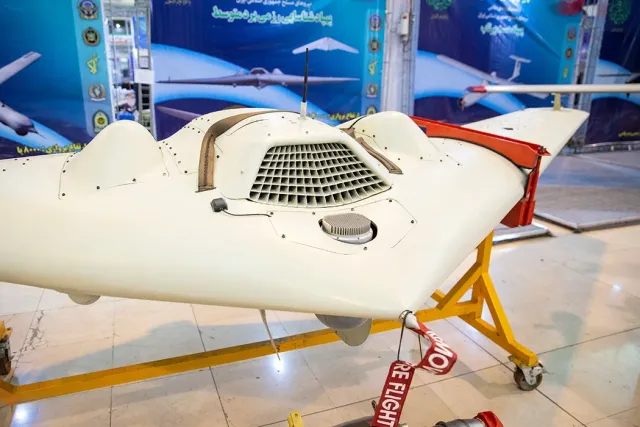
UAV / drone
Shahed-238 (Geran-3)Frequently asked questions
What did Russia hit this time? +
Overnight Aug. 17, Russian strikes hit port infrastructure in Izmail district on the Danube River, Ukraine's largest port on that river, damaging a Togo-flagged civilian vessel, injuring four people, and knocking out power in part of the city. Russia's Defense Ministry claimed it hit military cargo terminals and equipment depots; Reuters said it could not verify those claims.
What is the Shahed-238/Geran-3, and why does it matter? +
It is a turbojet-powered version of Russia's propeller-driven Shahed-136/Geran-2 attack drone, first shown publicly in late 2023. The jet engine trades fuel volume for speed, which matters because Ukraine's cheap interceptor drones, built to catch the slower Shahed-136, have a harder time running down a faster target.
How big was the overnight barrage? +
Russia launched 128 drones at Ukraine overnight into Aug. 17; Ukrainian air defense downed 106 of them, and strikes hit 14 locations with debris falling at two more. A separate national count over the prior 24 hours put the toll at least 9 killed and 43 injured across six regions.
Why does the Danube corridor matter strategically? +
After Russia's early-war disruption of Ukraine's Black Sea ports, the Izmail-Reni stretch of the Danube became Ukraine's critical alternate route for exporting grain and other goods near the Romanian border, which is why Russia keeps returning to Danube port infrastructure as a target.
More news


