Lockheed's Next Gen Interceptor Clears Two Motor Tests
Lockheed and L3Harris fired the NGI's second-stage motor in a vacuum chamber, closing in on a Critical Design Review after an 18-month delay.

U.S. Army/DVIDS photo by Fred W. Baker III, public domain. This image shows a legacy Ground-Based Interceptor component display, not the Next Generation Interceptor itself.
Lockheed Martin and L3Harris Technologies fired the Next Generation Interceptor’s second-stage motor inside a high-vacuum chamber on Aug. 10, the second successful test of that motor in less than a week, as the program moves toward a Critical Design Review expected before the end of 2026.
A different interceptor than the one already in headlines this month
It is worth being precise about what NGI is, because the name sits close enough to other missile defense programs that the distinction gets lost. The Next Generation Interceptor is a silo-launched, hit-to-kill interceptor designed to destroy a small number of incoming intercontinental ballistic missiles during the midcourse, or space, phase of their flight. It is meant to replace the aging Ground-Based Interceptor fleet at Fort Greely, Alaska, and Vandenberg Space Force Base, California, which together form the backbone of the United States’ homeland shield against a limited ICBM attack, the kind a country like North Korea could theoretically attempt.
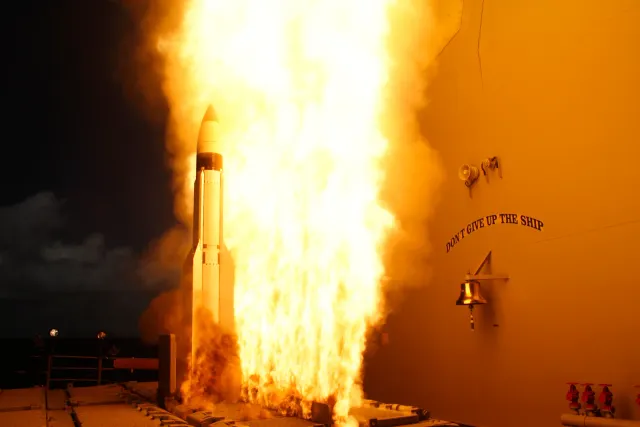
That makes NGI architecturally distinct from the space-based interceptor layer of the Golden Dome missile-defense initiative, a newer effort tracked separately by this desk, and from the SM-3 interceptor family that the Missile Defense Agency separately expanded production frameworks for earlier this month. NGI has been folded administratively under the Golden Dome umbrella since that program’s launch, but the hardware itself predates Golden Dome. Lockheed Martin won the $17 billion to $18 billion NGI development contract from the Missile Defense Agency in April 2024, beating a Boeing-led team, with L3Harris building the Stage 2 rocket motor as a major subcontractor. It is old hardware wearing a new administrative label, not a new program.
Two tests, two different questions
The reason NGI needed two separate tests in the same week is that structural integrity and propulsion performance are different engineering problems, and both had to clear before reviewers would sign off on the motor design. On Aug. 4, engineers ran a burst test: they filled the Stage 2 motor’s carbon-fiber-reinforced composite case with a water vessel and pressurized it well beyond expected launch pressures, checking whether the case’s strength-to-weight ratio would hold. Six days later, on Aug. 10, they ran a static-fire, or hot-fire, test, igniting the actual motor inside a chamber built to simulate low-Earth-orbit vacuum conditions, to validate thrust output, chamber pressure and combustion stability.

Passing a structural test says a component will not fail under pressure. Passing a hot-fire test says the motor actually produces the thrust and burn characteristics the design promises. A motor can pass one and fail the other, so clearing both in a single week is a meaningfully faster pace than the program’s recent track record suggested it could manage.
“This successful static fire test is a significant milestone on the path to the Critical Design Review and confirms our confidence that the NGI motor will meet the demanding performance envelope required for fielding by 2030,” said Christopher Jewell, vice president of Lockheed Martin’s Next Generation Interceptor program (Lockheed Martin, Aug. 10, 2026).
A program still working off an 18-month delay
The tests land against a backdrop of real schedule pressure. In April 2026, the Missile Defense Agency disclosed that NGI had slipped 18 months, attributing the delay to technical issues with the solid rocket motor, the inertial measurement unit and sensors. MDA Director Gen. Heath Collins said at the time the program remained “on track” despite the slip, language that read at the time as more reassurance than evidence. These August results are the first concrete, public sign that at least one piece of that named risk list, the solid rocket motor, is being retired rather than compounding.
That context matters for reading the Critical Design Review, the major go/no-go acquisition milestone now expected before the end of calendar 2026. A CDR does not certify that an interceptor works; it certifies that the design is mature enough to move into production-representative hardware and further testing. Two clean motor tests in one week make that review more likely to go smoothly, but they do not by themselves answer the harder questions still ahead: how the completed interceptor performs in an actual intercept test, and whether the 2030 fielding target holds once assembly and integration begin in earnest.
What a decade-old homeland shield replacement is actually racing against
The stakes behind NGI’s schedule are straightforward. The Ground-Based Interceptors it will replace at Fort Greely and Vandenberg have been in the ground for roughly two decades, and they are the only layer standing between a limited ICBM launch and impact on U.S. soil, since neither THAAD nor the SM-3 family, both built for shorter-range and different-phase intercepts, are designed to substitute for that midcourse role. Every year NGI’s schedule slips is another year the current fleet has to keep working past its intended service life. Two successful motor tests do not close that gap, but they are the first hard evidence in months that the gap is narrowing rather than widening.
Sources
- Lockheed Martin Announces Successful Static-Fire Test of Next Generation Interceptor's Stage 2 Motor — Lockheed Martin, Aug 10, 2026
- Lockheed Martin Announces Successful Burst Test of the Next Generation Interceptor's Second-Stage Motor — Lockheed Martin, Aug 4, 2026
- ICBM killer passes two key tests ahead of design review, Lockheed says — Defense One, Aug 10, 2026
- Lockheed Martin Says Test Of NGI Stage 2 Motor A Success; Wins MDA Modeling Contract — Huntsville Business Journal, Aug 11, 2026
Systems mentioned
Every system named in this story, with its photo and, where available, a video. Tap a card to open the full spec sheet.
Compare these side by side →
Missile
SM-3 Block IIA
Strategic missiles
LGM-30G Minuteman IIIFrequently asked questions
What does the Next Generation Interceptor actually do? +
NGI is a silo-launched, hit-to-kill interceptor meant to destroy a small number of incoming intercontinental ballistic missiles during their midcourse, or space, phase of flight, replacing the older Ground-Based Interceptor fleet at Fort Greely, Alaska, and Vandenberg Space Force Base, California.
Is NGI part of "Golden Dome"? +
It has been folded administratively into the Golden Dome missile-defense architecture, but it is a pre-existing, ground-based program awarded in 2024, distinct from Golden Dome's newer space-based interceptor layer.
Why did this program need two tests in one week? +
The Aug. 4 test validated the motor case's structural integrity under pressure. The Aug. 10 test fired the actual motor to confirm it produces the right thrust and burns stably, two separate engineering questions that both had to clear before the Critical Design Review.
Has the program had problems? +
Yes. The Missile Defense Agency disclosed an 18-month schedule delay in April 2026 tied to the solid rocket motor, inertial measurement unit and sensors. These August tests are the first major public sign of that specific motor risk being retired.
More news


