Army Seeks 133,000 GMLRS Rockets, Wants Output Up 36%
A Sources Sought notice asks industry for 19,002 GMLRS rockets a year from 2028-2034, a bet on the munition Ukraine has burned through fastest.

Sgt. Jamie Robinson, U.S. Army, DVIDS, public domain. A soldier assigned to Bravo Battery, 2nd Battalion, 300th Field Artillery Regiment, loads GMLRS rockets onto an M142 HIMARS in Northeast Syria, Oct. 31, 2024.
The U.S. Army has asked industry to be ready to build 133,014 Guided Multiple Launch Rocket System rockets by 2034, at a sustained pace of 19,002 rockets a year, about 36% above the production rate Lockheed Martin only finished ramping up to last year.
What the Army is actually asking for
The request, first reported by Defense News, takes the form of a Sources Sought notice rather than a contract. That distinction matters: a Sources Sought notice is the government asking industry whether it can do something, not committing money to have it done. The Army wants white papers from interested manufacturers by Sept. 1, 2026, laying out how they could deliver 133,014 GMLRS rockets between 2028 and 2034, with deliveries starting in February 2030 and holding at 19,002 rockets a year for the back half of that window. Common Defense’s independent reporting confirms the same figures.
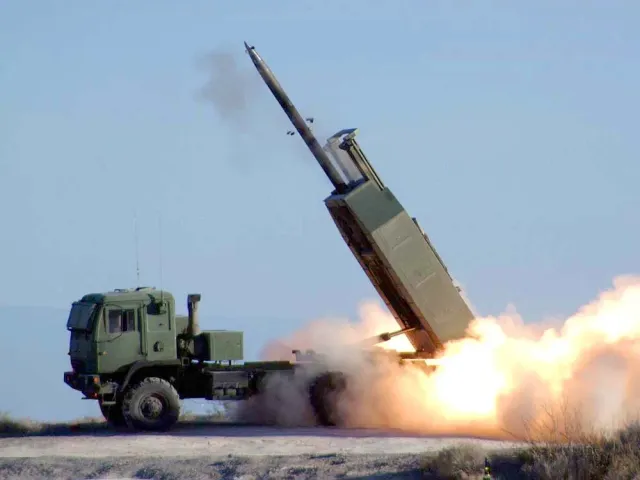
The notice covers all three variants currently in the GMLRS family: the M31 unitary rocket, which carries a single high-explosive warhead; the Alternative Warhead variant, designed to deliver fragmentation effects without the submunition dispersal patterns that older cluster-style warheads used; and the Extended Range, or ER, variant, which stretches the rocket’s reach from a baseline of roughly 70 kilometers out to about 150 kilometers. All three fire from the same family of launchers, the wheeled M142 HIMARS and the tracked M270A2 MLRS, both GPS/INS-guided so a rocket can hit a fixed set of coordinates without a human correcting its flight path after launch.
Why the math is the story
The significance here is less the headline total than what it implies about the gap between current capacity and what the Army now believes it needs. Lockheed Martin, GMLRS’s sole producer, announced in 2025 that it had ramped annual output to about 14,000 rockets a year, itself a major increase from where the line stood a few years earlier, according to Army Recognition’s coverage of that expansion (used here only for that baseline figure, not as same-day sourcing). The new request asks for roughly 36% more than that already-expanded rate, sustained for seven straight years. Put differently, the Army isn’t asking Lockheed to hold the line it just built, it’s asking for a second expansion on top of the first one, before the first one has even had time to prove itself against steady-state demand.

Lockheed Martin had delivered roughly 75,000 GMLRS rockets cumulatively by 2024. The new Sources Sought notice asks for nearly double that total, 133,014 rockets, inside a single seven-year production window.
The two wars behind the request
Neither Defense News nor Common Defense cites a single cause for the request, but both connect it to the same two pressures. The first is continued GMLRS transfers to Ukraine, where the rocket has become one of the most heavily used precision-strike weapons in the war, valued for its ability to hit a command post, ammunition depot, or troop concentration well behind the front line without putting a crewed aircraft over contested airspace. The second, flagged specifically by Common Defense, is munitions expenditure during the protracted conflict with Iran, a theater that has drawn on many of the same precision-strike stockpiles the Army maintains for other contingencies.
Both pressures are landing on an industrial base that was already strained before this request. Trade press covering the broader precision-fires and air-defense sector, including Breaking Defense’s reporting through the summer on solid rocket motor scarcity, has described the shortage of solid rocket motors, the propulsion component common to GMLRS, Patriot interceptors, and a range of other guided munitions, as one of the central bottlenecks constraining how fast the U.S. defense industrial base can expand output of almost any guided weapon at once. A request for 36% more GMLRS capacity does not sit in isolation; it competes for the same motor casings, propellant, and specialized manufacturing capacity that Patriot, THAAD, and other interceptor programs are also trying to scale up.
What a Sources Sought notice actually commits the Army to
It is worth being precise about what has and has not happened. The Army has not signed a production contract, has not committed to buy 133,014 rockets, and has not selected a manufacturer beyond the fact that Lockheed Martin remains the only qualified GMLRS producer today. What has happened is that the Army has put a specific number, a specific delivery schedule, and a specific ramp rate in writing and asked industry to respond by Sept. 1, 2026. That is a meaningful signal of the Army’s planning assumptions, and it is also the step that typically precedes a request for proposals and an eventual award, but it remains, for now, a question rather than an order.
The rockets in question fire from the M142 HIMARS, the wheeled launcher that became a household name in defense circles after its deployment to Ukraine, and the older, tracked M270A2 MLRS, which carries twice the rocket payload per launcher but is harder to move and conceal. Both launchers fire the same GMLRS family, tracked in WeaponSpecs’ own database as the Lockheed GMLRS system, meaning any production increase benefits both platforms simultaneously rather than requiring separate munitions lines.
Sources
- US Army requests 133,000 GMLRS rockets by 2034 — Defense News, Aug 18, 2026
- U.S. Army Calls for 133,000 GMLRS Rockets in Massive Arsenal Push — Common Defense, Aug 18, 2026
- Breaking news: U.S. seeks to mass produce GMLRS guided rockets to boost long-range firepower — Army Recognition, Jan 1, 2025
Systems mentioned
Every system named in this story, with its photo and, where available, a video. Tap a card to open the full spec sheet.
Compare these side by side →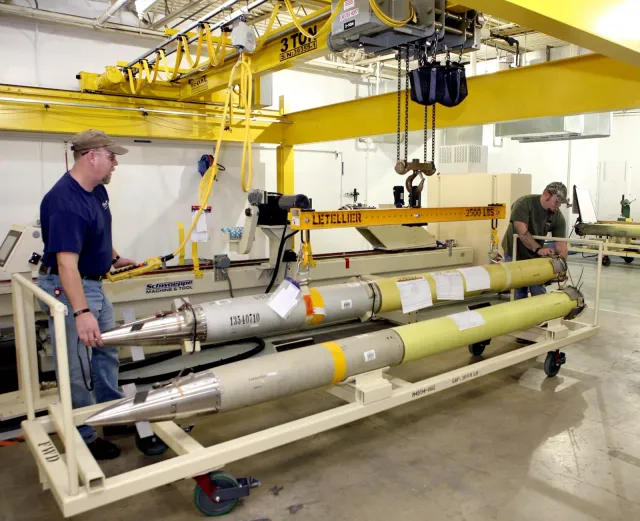
Artillery & MLRS
M142 HIMARS Artillery & MLRS
M270A2 MLRSFrequently asked questions
Is this a signed contract or just a request? +
It is a Sources Sought notice. The Army is asking industry to submit white papers by Sept. 1, 2026 describing their capacity to hit the target rate. No production contract has been awarded yet, and the notice itself is a step toward one, not a guarantee of one.
Why does the Army need so many more GMLRS rockets? +
Coverage ties the request to continued GMLRS transfers to Ukraine and to munitions expended during the ongoing conflict with Iran, layered on top of an existing solid-rocket-motor shortage across the broader precision-fires industrial base.
What is the difference between the GMLRS variants the Army wants? +
The request covers three: the M31 unitary rocket with a single high-explosive warhead, the Alternative Warhead variant built to avoid submunition-related restrictions, and the Extended Range (ER) variant, which roughly doubles the base rocket's range.
Who builds GMLRS today, and can they hit this rate? +
Lockheed Martin is the sole producer and announced in 2025 that it had ramped capacity to about 14,000 rockets a year. The Army's target of 19,002 rockets a year is roughly 36% above that already-expanded baseline.
More news


