Trump Threatens Oman as US-Iran 60-Day Deal Deadline Lapses
The June 17 US-Iran memorandum on reopening the Strait of Hormuz expired unresolved; Trump vowed to "bomb the s*** out of" Oman over its own traffic deal with Tehran.

U.S. Navy photo by MC2 Brandon Woods/USS San Diego, via DVIDS, public domain
A 60-day U.S.-Iran memorandum meant to reopen the Strait of Hormuz expired at midnight Monday with no permanent deal in place, and President Trump responded by threatening Oman over its own separate shipping arrangement with Tehran, telling Fox News he would “bomb the s*** out of them” if Muscat got in the way.
A 14-point framework that ran out the clock
The memorandum of understanding at the center of this story was signed June 17, 2026, a 14-point framework built around a straightforward trade: the United States would lift its naval blockade on Iranian ports, and Iran would clear the mines it had laid in the Strait of Hormuz, restoring shipping traffic through the waterway to something close to pre-war levels within 30 days. Attached to that core exchange were provisions easing some financial restrictions on Iran and a stated path toward resuming nuclear talks. It was, in other words, an attempt to de-escalate a maritime standoff that had already disrupted one of the world’s most important oil-transit chokepoints.
That 60-day window closed at midnight Monday, Aug. 17, with no successor agreement reached and, more tellingly, neither government publicly pursuing an extension (Al Jazeera, Aug. 17, 2026). A deadline that both sides let lapse without comment is a weaker signal of imminent crisis than a deadline either side fought to save, but it still leaves the underlying dispute, mined and heavily patrolled shipping lanes carrying a large share of the world’s seaborne oil, unresolved.
Oman’s side deal, and why it triggered Trump
Iran’s semi-official Mehr News Agency reported that Tehran had separately reached its own bilateral arrangement with Oman to manage Hormuz shipping traffic, a claim that comes from Iranian state media and has not been independently verified by any outlet cited in this story. True or not, the report was enough to draw a public threat from Trump, who told Fox News chief foreign correspondent Trey Yingst in a phone interview that Oman risked U.S. military action if it interfered with the stalled Hormuz negotiations.
“If Oman gets in the way, we’ll bomb the s*** out of them,” President Donald Trump told Fox News’ Trey Yingst by phone (NBC News, Aug. 18, 2026).

It is not an isolated outburst. This is the second time Trump has threatened Oman specifically, after a similar threat in late May 2026 tied to reports that Muscat and Tehran were discussing maritime transit fees. The pattern is consistent: whenever Oman appears to be negotiating around Washington rather than through it, Trump has responded with the same kind of public, military threat he has otherwise reserved for adversaries, not for a country that has hosted U.S. forces and mediated between Washington and Tehran for decades.
A blockade that stays up even as mines supposedly come down
Trump also used the same conversation to stake out a position that is internally difficult to square. He said the U.S. naval blockade on Iranian ports remains in “full force and effect,” even as he claimed that all water mines in the strait have already been cleared. If the mines are genuinely gone, the operational rationale for the blockade, restoring safe transit, has arguably already been achieved on Iran’s side of the original bargain, while the U.S. side of that same bargain, lifting the blockade, has not moved. No outlet covering the story has independently verified Trump’s mine-clearing claim, which rests entirely on his own account.
That gap between what Trump says has happened and what the U.S. is still doing matters because it is the exact trade the expired MOU was built around. If Iran’s side of the bargain is complete and the U.S. side is not, the memorandum did not so much expire as get abandoned mid-execution, with the U.S. holding the position that gives it leverage and no clear public commitment to eventually let it go.
A slowdown at the strait even without a formal crisis
CNBC reported that Hormuz Strait traffic has slowed as the ceasefire period tied to the broader conflict formally ends alongside the MOU deadline, a sign that shippers and insurers are treating the lapse as meaningful even without a new declared crisis (CNBC, Aug. 18, 2026). That is the practical stakes of this story: the Strait of Hormuz carries a large share of the world’s seaborne oil trade, and it does not need a new war to disrupt global shipping, it only needs enough uncertainty that vessel operators start routing around it or pausing transits altogether. U.S. Navy destroyers, including the Arleigh Burke-class ships that form the backbone of the American naval presence in and around the strait, remain the enforcement mechanism behind whatever the blockade actually is at any given moment, a role unchanged by the MOU’s expiration.
What actually changed this week, and what did not
Nothing about the underlying military posture shifted overnight. What changed is that the diplomatic clock that had been running since June ran out, publicly, with neither side extending it, and a third country not directly party to the original U.S.-Iran talks became the target of the administration’s most pointed threat of the week. Oman’s alleged side arrangement with Iran, unverified as it is, has become the flashpoint less because of what it changes on the water and more because it signals Muscat may be hedging its own position rather than waiting on a U.S.-Iran deal that keeps not materializing.
Sources
- Trump threatens to bomb Oman if it 'gets in the way' of Strait of Hormuz talks with Iran — NBC News, Aug 18, 2026
- US-Iran Memorandum of Understanding expires: How and why it fell apart — Al Jazeera, Aug 17, 2026
- Trump threatens Oman, Hormuz Strait traffic slows, Iran ceasefire ends — CNBC, Aug 18, 2026
- Trump threatens to bomb Oman with Iran war stuck in stalemate as 60-day negotiation period ends — CBS News, Aug 17, 2026
Systems mentioned
Every system named in this story, with its photo and, where available, a video. Tap a card to open the full spec sheet.
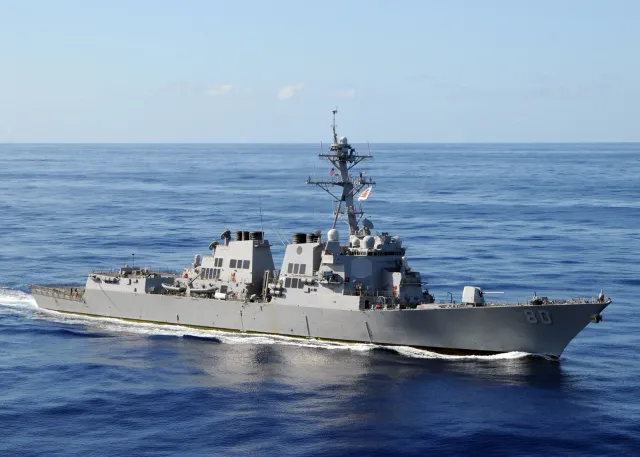
Warship
Arleigh Burke-class DestroyerFrequently asked questions
What was the US-Iran MOU that just expired? +
A June 17, 2026, 14-point framework under which the U.S. would lift its naval blockade and Iran would clear mines from the Strait of Hormuz to restore normal shipping traffic within 30 days, alongside easing some financial restrictions and opening a path to nuclear talks.
Is the US blockade of Iran still in effect? +
Yes. Trump said on Aug. 18 that the naval blockade on Iranian ports remains in "full force and effect," even while separately claiming that all water mines in the strait have been cleared, a claim no cited outlet has independently verified.
Why is Trump threatening Oman specifically? +
Because Oman is reportedly negotiating its own bilateral arrangement with Iran to manage Hormuz shipping traffic, which Trump sees as undercutting the leverage Washington was trying to hold onto in the now-expired talks.
Has Trump threatened Oman before? +
Yes. This is the second time, after a similar threat in late May 2026 over reported Oman-Iran discussions on maritime transit fees.
More news


