Trump Pledges Ukraine a License to Build Patriot Interceptors
At the NATO Ankara summit, Trump said the US will license Ukraine to manufacture Patriot interceptors, while acknowledging Lockheed Martin and RTX have not yet been notified.

Lupus in Saxonia, CC BY-SA 4.0 / Hunini, CC BY-SA 4.0, via Wikimedia Commons
By the numbers

Infographic: WeaponSpecs News Desk
President Trump said on July 8 that the United States will license Ukraine to manufacture its own Patriot air-defense interceptor missiles, a policy shift from Washington supplying finished missiles to helping Kyiv build them domestically. Trump made the pledge during a bilateral meeting with Ukrainian President Volodymyr Zelenskyy on the sidelines of the NATO leaders summit in Ankara, Turkey, according to Defense News’s reporting from the summit. In the same remarks, Trump acknowledged that neither Lockheed Martin nor RTX Corporation, the two companies that build the Patriot system, have been formally notified of the plan.
What Trump actually said
“We’re going to give a license to you to make Patriots. That’s pretty cool,” Trump told Zelenskyy, according to Defense News’s transcript of the exchange. He added that Patriot is “a defensive weapon, which I like better than an offensive weapon,” framing the pledge as consistent with a defense-only rationale rather than an escalation. Asked about the manufacturers, Trump said plainly: “We haven’t informed the company of that yet, but that’ll work out all right,” adding, “We have great power over the companies, those companies that make the Patriot,” per CBS News’s coverage, which separately confirmed that Lockheed Martin and RTX (formerly Raytheon) are the two firms in question and that they have not been briefed.
Trump also addressed why the pledge is a manufacturing license rather than a fresh shipment of interceptors: the US, he indicated, does not currently have “many” Patriot missiles available to hand over, because domestic stocks are needed while American production is being expanded. CBS News reported that the administration does not plan to send Ukraine additional complete Patriot systems for that reason. Specifics that would normally accompany a real licensing deal, such as which interceptor variant Ukraine would be authorized to build, PAC-2 or the more advanced hit-to-kill PAC-3, a production timeline, or manufacturing-site details, were not addressed in Trump’s remarks, per Defense News.
Zelenskyy had raised the idea of a Ukrainian manufacturing license publicly before. He requested one during a May 2026 appearance on CBS News’ “Face the Nation,” and told reporters ahead of the Ankara meeting that he wanted to discuss “some very important details” with Trump, according to CBS News.
Why Patriot, and why now
The Patriot PAC-3 is a long-range, hit-to-kill surface-to-air system, confirmed in WeaponSpecs’ database, with an engagement range of roughly 60 kilometers, an engagement altitude up to 24,000 meters, and the ability to track eight simultaneous targets. It is one of a small number of Western systems capable of intercepting ballistic missiles rather than only aircraft and cruise missiles, which is why it has become the backbone of Ukraine’s defense against Russian missile strikes since batteries were first delivered in 2023.
That defense has been under sustained pressure. Russia has continued large-scale bombardments of Kyiv and other cities, including a barrage of roughly 570 missiles and drones on July 6, 2026, as WeaponSpecs reported at the time, and Defense News noted that Russia launched fresh ballistic missile attacks on Kyiv the night before the Ankara meeting, with Ukrainian air defenses unable to intercept any of five ballistic missiles fired. Each Patriot engagement consumes an interceptor that the US and its allies have to replace, and PAC-3 MSE production has been a persistent bottleneck across NATO’s own stockpiles, not just Ukraine’s. A domestic manufacturing arrangement, if it were ever formalized, would let Ukraine sustain its own interceptor supply rather than compete with US and allied demand for a constrained production line, which is the strategic logic behind the pledge even though none of the mechanics have been worked out.
What is confirmed and what is not
It is worth being precise about what changed on July 8 and what did not. What changed: the president of the United States publicly stated, on the record, in front of Ukraine’s president, that his administration intends to license Patriot production to Ukraine. That is a real policy statement from the person with authority to set US arms-transfer and export-licensing policy, and it is a departure from the prior posture of the US supplying finished interceptors rather than manufacturing rights. What did not change, at least not yet: there is no signed licensing agreement, no export authorization from the relevant US government bodies that actually govern arms-technology transfers, no confirmed production site in Ukraine, no interceptor variant specified, and, by Trump’s own account, no notification yet to the two companies whose intellectual property and production lines the license would depend on.
Sources
- Ukraine to get license for making Patriot interceptors, Trump pledges (Defense News, Jul 8, 2026)
- Trump says U.S. will license Ukraine to produce Patriot missiles (CBS News, Jul 8, 2026)
Systems mentioned
Every system named in this story, with its photo and, where available, a video. Tap a card to open the full spec sheet.
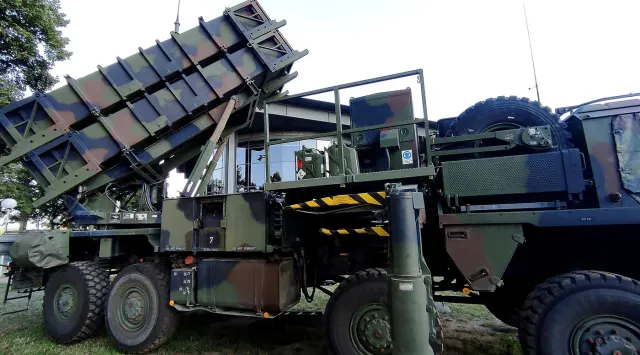
Air defense system
Patriot PAC-3Frequently asked questions
Has Ukraine actually been granted a license to build Patriot missiles? +
Not yet in any formal sense. President Trump stated on July 8, 2026 that the US will give Ukraine a license to manufacture Patriot interceptors, but he also said in the same remarks that Lockheed Martin and RTX Corporation, the two companies that build the Patriot system, have not been informed of the plan. A presidential pledge is a policy signal, not a signed licensing agreement, export authorization, or production contract.
Why would the US license Ukraine to build Patriots instead of just sending more missiles? +
Trump said the US does not currently have a large supply of Patriot interceptors available to transfer while it works to expand its own production. Domestic manufacturing in Ukraine, if it materializes, would reduce Kyiv's dependence on US stockpiles and supply chains for a weapon system it has relied on since 2023 to intercept Russian ballistic missiles, cruise missiles, and drones.
What is the Patriot PAC-3, and what has it been doing in Ukraine? +
The Patriot PAC-3 is a US-made, long-range surface-to-air system built around the hit-to-kill PAC-3 MSE interceptor, one of the few Western systems capable of intercepting ballistic missiles. Ukraine has operated Patriot batteries since 2023 to defend Kyiv and other cities against sustained Russian missile and drone bombardment, including large-scale barrages like the roughly 570 missiles and drones launched at Kyiv on July 6, 2026.
More news


