Israel Bombs Syrian Airbase to Block Turkish Deployment
Eight Israeli strikes hit Abu al-Duhur's runway hours after a Turkish delegation visit, reviving the Israel-Turkey rivalry Netanyahu has fought inside Washington over F-35 sales.

Israeli Air Force photo by Major Ofer, via Wikimedia Commons, CC BY 4.0. File photo from a December 2016 inaugural flight, not the Aug. 19 strike itself.
Israeli aircraft struck the runway and storage facilities at Abu al-Duhur airbase near Aleppo overnight, at least eight strikes carried out to stop Turkey from deploying forces there, the first time Israel has hit this specific base since the Assad government fell in December 2024.
What hit the base, and why Israel waited a day to admit it
Israeli warplanes carried out the strikes overnight between Aug. 18 and 19, targeting the runway and storage infrastructure at Abu al-Duhur, an airbase in Syria’s Idlib province roughly 40 kilometers southeast of Aleppo. Syrian state television reported the damage but no casualties, a detail Israel’s government did not dispute when it confirmed the operation roughly a day later. The delay itself is notable: Israel has struck targets across Syria on a near-continuous basis since Assad’s fall, usually confirming or at least not denying strikes within hours. Waiting a day to own this one suggests officials wanted the justification lined up before the confirmation went out (NPR, Aug. 19, 2026).
That justification, when it came from the prime minister’s office, was specific: Syria was “on the verge of breaching” an informal security understanding that has governed the country since Assad’s ouster, by allowing Turkish troops to deploy at Abu al-Duhur. The claim followed a Turkish military delegation’s visit to the same base one day earlier, a visit Israeli officials characterized as preparation to convert Abu al-Duhur into a joint Syrian-Turkish facility (Times of Israel, Aug. 18-19, 2026).

Turkey rejected the entire premise. Ankara said flatly that it has no troops at Abu al-Duhur and no plan to establish a base there, calling Israel’s version of events “untenable” and lacking seriousness (Al Jazeera, Aug. 18, 2026). Two governments, two flatly contradictory accounts of the same event: this is a dispute, not a confirmed fact set, and both sides have obvious reasons to shade their version.
Qatar, Egypt and Saudi Arabia condemn a strike that lands inside a live sanctions dispute
Qatar, Egypt and Saudi Arabia condemned the strikes, a response consistent with how Gulf and Arab states have generally reacted to Israeli operations inside post-Assad Syria, where the new government in Damascus has been trying to stabilize its own authority without becoming a battleground for other countries’ rivalries.
What makes this particular strike land harder than most is the timing against a separate, ongoing argument in Washington. Netanyahu has spent recent months actively lobbying against a Trump-backed push to lift the U.S. export ban on F-35 sales to Turkey, arguing publicly that Turkish F-35s would “destroy the power balance” in the region. That framing dates to at least early July, when Netanyahu made the case in comments picked up by CNN and the Times of Israel. The ban itself goes back to 2019, when Turkey’s purchase of Russia’s S-400 Triumf air defense system, a system WeaponSpecs’ own database notes drew direct U.S. sanctions, got Ankara expelled from the F-35 partner program entirely. Turkey has flown the U.S.-made F-16C Block 70 since, the most modern Viper variant in mass production, but not the stealth fighter it originally signed up to build and buy alongside NATO allies.
That is the subtext running underneath a strike on a Syrian runway. The F-35A Lightning II, a Mach 1.6 stealth fighter with roughly 2,200 kilometers of range, is the aircraft Netanyahu does not want in Turkish hands, and Abu al-Duhur is the latest place that argument is playing out on the ground rather than in a lobbying memo. An Israeli government trying to keep Turkey’s air force out of the F-35 club has every incentive to also keep Turkish forces, of any kind, out of a Syrian airbase within easy reach of Israeli territory.
Washington calls it an escalation, not a defensive strike
The U.S. reaction broke from Israel’s framing almost immediately. Tom Barrack, the U.S. ambassador to Turkey and special envoy to Syria, posted on X that the strikes represented an “unnecessary escalation” that “does not advance regional stability.”
“Unnecessary escalation… does not advance regional stability,” and carries “a real risk of rapid escalation into a direct military confrontation between Israel and Turkey as well as Syria,” said Tom Barrack, U.S. Ambassador to Turkey and Special Envoy to Syria (NBC News, Aug. 19, 2026).
Barrack’s statement is the most concrete signal yet that Washington sees this strike as destabilizing rather than defensive, a notable break given that the Trump administration has otherwise given Israel wide latitude for its operations across Syria since Assad’s fall. It also underlines how much is riding on the “status quo” Israel says it is protecting: an informal, unwritten security arrangement, not a signed treaty, that has kept Israeli and Turkish forces from directly colliding inside Syrian territory even as both countries expand their footprints there.
An unwritten arrangement now under real strain
None of this resolves cleanly. Syria’s post-Assad government has courted both Israel and Turkey as it tries to rebuild state authority, and it has little leverage to stop either country from striking or maneuvering on its own soil. Turkey has emerged as one of the most influential outside powers in post-Assad Syria, with deep ties to factions that helped topple the old government, while Israel has continued treating Syrian airspace as an open operating area for strikes it deems necessary. Abu al-Duhur sits at the collision point of both trends: a base Turkey visited once and Israel bombed within 48 hours.
The bigger question the strike raises is whether the informal “status quo” Israel invoked can survive repeated tests like this one. If Turkey did have plans for the base, as Israel claims, Ankara now knows Israel will act preemptively rather than negotiate. If Turkey’s denial is accurate, Israel just conducted an airstrike on unconfirmed intelligence against a NATO member’s alleged activity, a precedent that raises its own risks the next time the two countries’ interests cross in Syrian territory.
Sources
- Israel strikes an air base in Syria to prevent Turkish troops from deploying — NPR, Aug 19, 2026
- Israel confirms striking Syrian air base, saying Turkey was planning to deploy forces — The Times of Israel, Aug 19, 2026
- Israel attacks airbase in Syria's Idlib as US, Turkiye slam 'escalation' — Al Jazeera, Aug 18, 2026
- Israel admits strike on Syria's Idlib airbase — The Jerusalem Post, Aug 19, 2026
- U.S. says Israeli strikes on Syrian base are 'unnecessary escalation' — NBC News, Aug 19, 2026
Systems mentioned
Every system named in this story, with its photo and, where available, a video. Tap a card to open the full spec sheet.
Compare these side by side →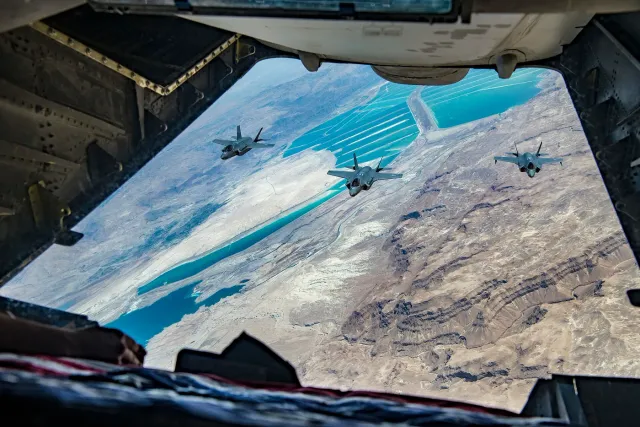
Fighter aircraft
F-35A Lightning II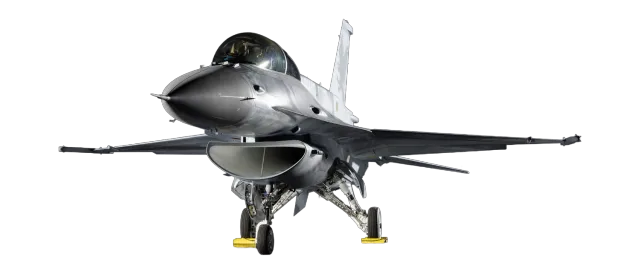
Fighter aircraft
F-16C Block 70/72 Fighting Falcon
Air defense system
S-400 TriumfFrequently asked questions
Is this the first strike on Abu al-Duhur since Assad fell? +
Yes. It is the first reported Israeli strike on this specific airbase since the fall of the Assad government in December 2024, even though Israel has struck other targets across Syria repeatedly since then.
Were there casualties? +
No casualties were reported despite at least eight strikes hitting the base's runway and storage facilities. Syrian state television confirmed damage to the infrastructure.
Why does this matter for US-Turkey-Israel relations? +
It surfaces an open rift between Israeli Prime Minister Benjamin Netanyahu, who has lobbied against lifting the U.S. export ban on F-35s to Turkey, and President Trump, who has signaled openness to lifting it, with Turkey's expanding footprint in post-Assad Syria now the flashpoint.
What does Turkey say happened? +
Turkey denies deploying any troops to Abu al-Duhur or planning to establish a base there, calling Israel's allegations "untenable" and lacking seriousness.
More news


