Navy Weighs Moving Carrier Islands to Match Trump's Taste
Engineers are studying an aesthetic redesign of the $13B Ford-class island that Navy officials warn could cost billions and delay the program.

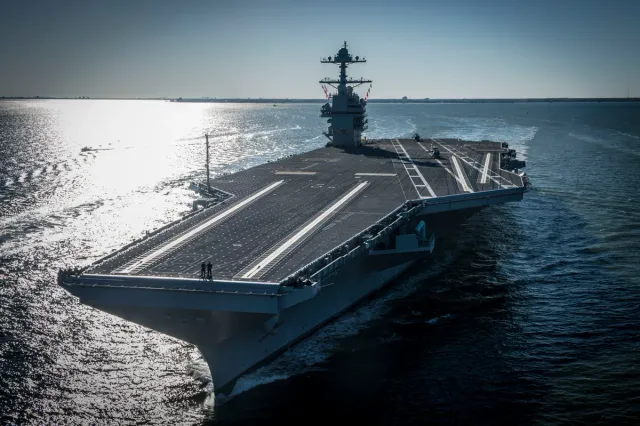
U.S. Navy photo by Seaman Apprentice Nathan Sears, DVIDS, public domain
The Navy has begun evaluating whether to move the island, the command tower that houses the bridge and flight-control stations, on future Gerald R. Ford-class carriers roughly 140 feet forward from its current position, after President Trump directed the change to bring the ship’s silhouette closer to the proportions of World War II-era carriers like USS Lexington and USS Yorktown. A Navy spokesperson told reporters engineers have begun moving out on options to meet the president’s intent, confirmation that a real technical study is underway, not yet a decision to build it that way.
An island position the Navy did not choose by accident
The Ford class’s island already sits more than 100 feet aft of where the island sat on the preceding Nimitz class, itself a deliberate repositioning the Navy made when it designed the Gerald R. Ford-class carrier. WeaponSpecs’ own systems database records that repositioned island as one of the class’s signature design changes relative to Nimitz. Officials cited in Newsweek’s reporting give four specific reasons the island sits where it does: more open flight-deck space forward of the island for parking aircraft near the catapults, better efficiency getting jets into launch position, less turbulence for aircraft on approach during landing, and improved overall flight-deck safety.
Moving the island roughly 140 feet forward, closer to the Yorktown or Essex-class proportions Trump has cited as his preference, would reverse the logic the Navy built the current design around. It is not a cosmetic swap of one box for an identical box in a different spot; the island is integrated with the flight deck’s launch and recovery choreography, the placement of catapults and arresting wires, and the sightlines air-traffic controllers need during flight operations.

The Navy has already run this study once
According to reporting from both Newsweek and The Maritime Executive, the Navy studied this same relocation during Trump’s first term and concluded then that it could cost billions of dollars and significantly delay the program, an internal finding being revisited now rather than a fresh engineering conclusion. That history matters for how seriously to take the current cost warnings: this is not the Navy improvising resistance to a new directive, it is officials pointing back to their own prior analysis of the identical question.
Outside cost estimates vary and should not be treated as a single number. Washington Post reporting, cited by both The Maritime Executive and Newsweek, puts the added cost at several billion dollars on top of the roughly $13 billion base price per hull, a figure that lines up with the $13.3 billion procurement cost WeaponSpecs’ own Gerald R. Ford-class carrier record lists for the lead ship. Army Recognition separately cites a $22 billion figure for future hulls. Those are two different outlets’ estimates rather than a reconciled total, and neither should be added to or averaged against the other.
Bryan Clark, a senior fellow at the Hudson Institute who studies naval force structure, put the scale of the change in blunt terms:
“A major redesign,” said Bryan Clark, senior fellow at the Hudson Institute (Newsweek, August 15, 2026).
Clark separately described the move as very disruptive to the program. Todd Harrison of the American Enterprise Institute called it highly unusual and disruptive in the same reporting, and Sen. Mark Kelly, D-Ariz., estimated it would probably cost billions. Retired Adm. Gary Roughead, a former chief of naval operations, warned it would detract from other shipbuilding design initiatives already in progress.
Where the real schedule risk sits
The most concrete warning in the reporting comes from General Atomics, which builds the Electromagnetic Aircraft Launch System and the advanced arresting gear used on Ford-class carriers under a $1.2 billion contract. The company says production of those systems is already nearly 50% complete for the relevant hull, and it has flagged significant risk to both cost and schedule if the island’s position changes mid-build. That timing is the crux of the story: a design change is far less disruptive on a carrier that exists only on paper than on one already under construction, where launch and arresting-gear systems are engineered around a fixed island location and flight-deck layout.
Ford-class carriers are rated for a higher sortie-generation rate than their Nimitz-class predecessors, 160 sorties over a sustained 12-hour day versus 120 for Nimitz, and 270 versus 240 during a surge period, according to figures reported by Army Recognition. Navy officials argue the current island position helps protect those gains. Whether a relocated island would erode that sortie advantage has not been publicly studied in this round of evaluation, and none of the current reporting quantifies it.
Sources
- Trump's Aircraft Carrier Changes Draw Warnings of Higher Costs, Delays — Newsweek, Aug 15, 2026
- Report: Trump Wants to Move Ford-Class Carrier's Island for Appearance — The Maritime Executive, Aug 18, 2026
- US Navy considers Ford-class aircraft carrier redesign to match Trump's WWII island style preference — Army Recognition, Aug 18, 2026
Systems mentioned
Every system named in this story, with its photo and, where available, a video. Tap a card to open the full spec sheet.
Frequently asked questions
Why is the Ford-class island positioned where it is now? +
Navy officials cite operational reasons: more forward flight-deck parking for aircraft near launch areas, better launch efficiency, less landing-approach turbulence and improved safety, a design change the Ford class already made relative to the Nimitz class.
How much would moving it cost? +
Estimates vary by outlet. Reporting cited by the Washington Post puts it at several billion dollars on top of the roughly $13 billion base cost per hull, while Army Recognition separately cites a $22 billion figure for future ships. A first-term Trump-era Navy study already concluded a move could cost billions of dollars and significantly delay the program.
Has the Navy actually decided to do this? +
No. A Navy spokesperson described the work as engineers moving out on options to meet the president's intent, language describing an evaluation, not a finalized design change.
Does this affect ships already built? +
The greatest schedule risk falls on hulls still under construction. General Atomics, which builds the catapult and arresting-gear systems under a $1.2 billion contract, says that production is already nearly 50% complete for the relevant ship, and warns of significant risk to cost and schedule if the island moves.
More news


