Navy Reveals Modular Missile Family for Ships, Subs
A single 10-inch interceptor stack, sized four ways, would let Aegis destroyers and Virginia-class submarines share one air-defense missile line.

U.S. Navy photo by Lt. James Cavila, DVIDS, public domain
The U.S. Navy has laid out a new family of air-defense interceptors built around one common terminal stage, a design meant to let Aegis destroyers, cruisers and, for the first time, Virginia-class attack submarines all draw missiles from the same production line instead of separate ones. The Naval Modular Missile, disclosed in program documents published July 31, 2026 and detailed further in follow-on reporting, mates a single 10-inch Terminal Stage Interceptor to four different booster-and-canister combinations, producing four missiles sized for four different jobs. The Navy is requesting $311 million in fiscal year 2027 to stand the effort up as a new budget line, with a draft prototype solicitation already released on July 14.
One seeker, four missiles
The core of the program is the Terminal Stage Interceptor, a 10-inch-diameter (25.4 cm) module that combines radio-frequency and infrared sensors with a highly maneuverable kill vehicle. It is built from five parts: a seeker assembly module, a lethality module, a command module, a terminal-stage rocket motor and a control actuation module. That stack does not change from missile to missile. What changes is the booster and canister wrapped around it, according to Army Recognition’s August 3 report on the Navy’s released program details.
Four variants follow from that single terminal stage. NMM Long Range is single-loaded in one Mk 41 Vertical Launch System cell, hypersonic-capable, and leverages an existing 21-inch rocket motor investment the Navy has already made elsewhere. NMM Dual-Pack Extended-Range fits two missiles into one Mk 41 cell. NMM Quad-Pack Medium-Range packs four into a cell, the shortest-range but highest-density option for close-in defense. And NMM Extended-Range Submarine is adapted to fit the Multiple All-Up-Round Canister already used in Virginia Payload Module tubes, seven missiles to a canister.
That last variant is the one that changes what a submarine can do. Virginia-class boats currently have no missile of their own for shooting down an aircraft or incoming missile; their defense is staying hidden. The War Zone’s Joseph Trevithick, who first reported the Navy’s submarine-launched anti-air ambitions on July 31, described the submarine variant as effectively new ground for the fleet, not an upgrade of anything that exists today. Giving a submarine even a limited terminal-defense missile would let it engage a maritime patrol aircraft or an inbound anti-submarine weapon without having to dive deeper or run, an option it does not have now.

Why one missile family instead of several
The logic behind consolidating four missiles around one terminal stage is largely an industrial and sustainment argument. Building and qualifying a seeker, a lethality package and a guidance system is the most expensive and time-consuming part of developing any interceptor. Today’s Navy runs several missile lines in parallel, each requiring its own production, testing and logistics tail. A shared terminal stage would mean one seeker design to certify, one production line for the hardest part of the missile, and only the booster and canister varying by platform. The effort runs under Project No. 26-10 through the S2MARTS Other Transaction Authority, managed by the National Security Technology Accelerator, a mechanism the Navy has increasingly used to move prototype efforts faster than a traditional acquisition program of record.
NMM has no confirmed per-unit price yet, and none should be assumed. What is known is what it would eventually compete against: the SM-6, currently priced around $4.3 million each, and the SM-3 Block IIA, a hit-to-kill interceptor priced around $28 million each. Those figures are useful only as a sense of the cost range NMM would need to land in to be worth building, not as a prediction of where it will land.
The Navy’s production ambition is large if the program clears its early hurdles: 1,000 interceptors a year within five years of a contract award. For scale, that is roughly the pace at which the Navy would need to replace an entire destroyer’s typical VLS magazine load several times over in a single year, a rate current single-purpose missile lines are not built to sustain. But that clock has not started. The July 14 draft solicitation is still a prototype call, not a production contract, and $311 million is a fraction of what full development and fielding would eventually cost.
This is not the Navy’s first attempt at shared submarine air defense in recent memory. WeaponSpecs covered the Navy’s roughly $58.6 billion in combined Virginia and Columbia-class submarine contract activity in late July, spending focused on hull production rather than new weapons. NMM is a different kind of investment: not more submarines, but a new capability for the ones already being built and already in the fleet, since the ER-S canister is sized to fit the Virginia Payload Module tubes that newer Virginia-class boats already carry.
Figures as published in the Navy's program details for the Naval Modular Missile. NMM has no confirmed per-unit price yet; none is shown here rather than estimated.
What is unproven
None of this is fielded, funded for production, or fully engineered. A draft solicitation and a $311 million budget request are early-stage signals of intent, not commitments, and Navy interceptor programs have a long history of schedule slip between a promising architecture and a fielded round. The submarine variant in particular has to solve problems ship-launched missiles do not: a submerged or near-surface launch sequence, a canister designed for torpedo-tube-adjacent stowage rather than a topside VLS cell, and integration with a submarine’s existing sensor suite for targeting. Neither Trevithick’s reporting nor Army Recognition’s account describes a submarine test having taken place yet.
Sources
- U.S. Navy Is Seeking A Submarine Launched Anti-Air Missile — The War Zone, Jul 31, 2026
- U.S. Navy Reveals Naval Modular Missile Architecture for Future Air Defense Interceptors — Army Recognition, Aug 3, 2026
Systems mentioned
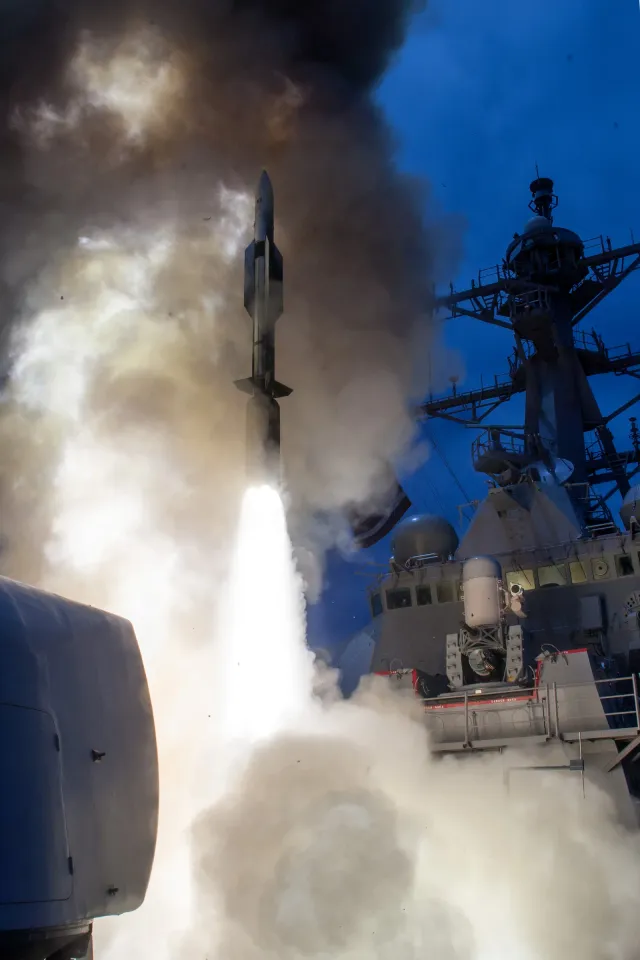
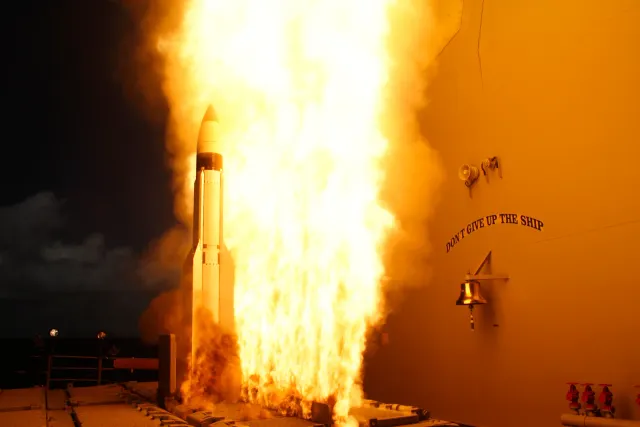
Every system named in this story, with its photo and, where available, a video. Tap a card to open the full spec sheet.
Compare these side by side →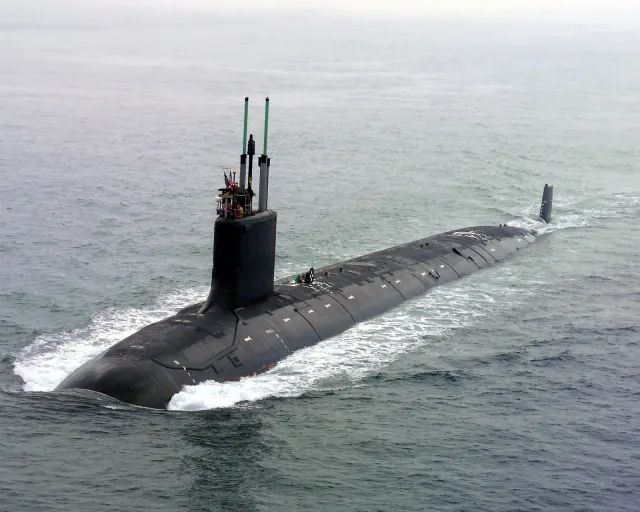
Frequently asked questions
Is NMM an actual weapon yet, or just a concept? +
Neither fully. The Navy released a draft Other Transaction Authority prototype solicitation on July 14, 2026, and is requesting $311 million in fiscal year 2027 to fund it as a new budget start. No production contract has been awarded.
Why would a submarine need an anti-air missile? +
Submarines currently rely on stealth and carry no organic air-defense weapon. The NMM Extended-Range Submarine variant, fired through existing Multiple All-Up-Round Canisters in Virginia Payload Module tubes, would be what The War Zone's reporting calls an all-new capability for the fleet.
How is this different from existing Standard Missiles like the SM-2 or SM-6? +
NMM does not replace them yet. It is a new architecture betting that one common terminal-stage seeker and kill vehicle, scaled with different boosters, will be cheaper to build and sustain over time than maintaining separate missile lines for every launch platform.
When could this reach the fleet? +
The Navy's stated goal is 1,000 interceptors a year within five years of a contract award, but no contract has been awarded, so that five-year clock has not started.
More news


