N. Korea Fires 10 Missiles as Trump Eyes 4th Kim Summit
Pyongyang test-fired over 10 short-range ballistic missiles hours after Trump said he'd meet Kim this year and cut Ulchi Freedom Shield short.

Lt. Cmdr. Brendan Trembath, United Nations Command, DVIDS, public domain. File photo of the DMZ/Joint Security Area, not imagery from the Aug. 20 missile launches, for which no public imagery exists.
North Korea fired more than 10 short-range ballistic missiles from the Pyongyang area on Aug. 20, roughly 24 hours after President Trump told reporters he expects to meet Kim Jong Un again this year. The barrage, the largest of three North Korean missile tests this month, flew about 300 kilometers into the East Sea and came a day after Kim’s sister Kim Yo Jong publicly played down any revived high-level contact with Washington.
What Trump actually said
Speaking to reporters on Aug. 19, Trump said he expects to meet Kim Jong Un “at some point” in 2026. “Yeah, I will be,” he said, adding: “I know Kim Jong Un very well, and he’s going to be fine as long as we have a smart president.” He framed the relationship as an asset, not a liability: “The fact that I get along with him, that’s a good thing, not a bad thing.” He also claimed North Korea has “57 very powerful nuclear weapons,” a figure that is Trump’s own stated assessment, not a confirmed US intelligence estimate or a North Korean disclosure, and should be treated as an unverified political claim rather than fact.
A fourth meeting between the two leaders, after Singapore in 2018, Hanoi in 2019 (which ended without an agreement) and an impromptu DMZ meeting later that year, would be unprecedented; no sitting US president has met the same North Korean leader more than three times. The comments came days after Trump separately ordered this year’s Ulchi Freedom Shield exercise shortened from 11 days to 5, calling the full drill “totally inappropriate and hostile,” a decision WeaponSpecs covered on Aug. 17 and treats here only as background for why this year’s drill ended early.
Pyongyang’s answer, less than a day later
South Korea’s Joint Chiefs of Staff confirmed the Aug. 20 launches in a statement to Korea Herald:
“Our military is closely monitoring various North Korean activities under a firm South Korea-US combined defense posture and maintaining the capabilities and readiness to respond overwhelmingly to any provocation,” a Joint Chiefs of Staff spokesperson said (Korea Herald, Aug. 20, 2026).
Kim Yo Jong, in her own public remarks, called US-Trump ties “excellent” but said she was “unaware” of any revived high-level contact, a claim from a North Korean government figure that is a state assertion, not independently verified, and one that sits awkwardly next to a missile barrage launched roughly a day later. The specific missile type was not disclosed. South Korea’s military and independent analysts have previously assessed North Korea’s KN-23 short-range system, believed derived from Russia’s 9K720 Iskander-M, as the design family most consistent with North Korea’s recent barrage tactics, background on the likely system family, not a confirmed identification of what flew on Aug. 20.

Three tests, one escalating curve
What separates Aug. 20 from an isolated provocation is that it’s the third North Korean missile test in under three weeks, and each one has grown sharply larger. WeaponSpecs covered the first, a single short-range launch from the Wonsan area on Aug. 6, paired at the time with a Kim Yo Jong warning over Japan’s Tomahawk acquisition. The second, also a single missile, came on Aug. 12, days ahead of Ulchi Freedom Shield’s original 11-day schedule. The Aug. 20 barrage broke that pattern outright: more than 10 missiles in one window, over ten times the scale of either prior test this month.
Figures are South Korean military-reported launch counts for North Korea's three missile tests this month, not North Korean state disclosures. The Aug. 20 figure is South Korea's Joint Chiefs of Staff count of "more than 10" missiles; the exact total has not been further specified.
That trajectory, one missile to one missile to more than ten inside a three-week window that also contains Trump’s summit remarks and a shortened joint exercise, is what makes this month read as a genuine escalation sequence rather than three disconnected headlines. None of North Korea’s own statements have explicitly tied the Aug. 20 launch to Trump’s comments. But the sequence speaks for itself: overture on Aug. 19, dismissal from Kim Yo Jong, the month’s largest test within roughly 24 to 48 hours of both.
The diplomacy-and-drills tension underneath it
There’s a real tension in Washington’s own posture that the past two weeks have made concrete. Trump wants a fourth summit and already scaled back a major joint exercise to avoid provoking Pyongyang, calling the full 11-day Ulchi Freedom Shield “totally inappropriate and hostile.” North Korea’s response to both moves has been a larger show of force, not a reciprocal gesture. That doesn’t mean the diplomatic track is dead: Kim Yo Jong’s own remarks stopped short of rejecting engagement outright, she said she was simply unaware of any revived contact, not that Pyongyang refuses it. But the near-term evidence points toward North Korea testing capability and resolve rather than answering an overture with restraint.
What to watch next
The open questions: what missile type flew, whether Seoul or Washington releases a more specific assessment, and whether North Korea tests again before any summit planning firms up.
Sources
- Trump says he expects to meet Kim Jong Un this year — ABC News Australia, Aug 20, 2026
- Trump on meeting Kim Jong Un again — CNN, Aug 19, 2026
- North Korea fires missiles — Korea Herald, Aug 20, 2026
- North Korea fires missiles after dismissing Trump — Jefferson City News-Tribune (AP), Aug 21, 2026
Systems mentioned
Every system named in this story, with its photo and, where available, a video. Tap a card to open the full spec sheet.
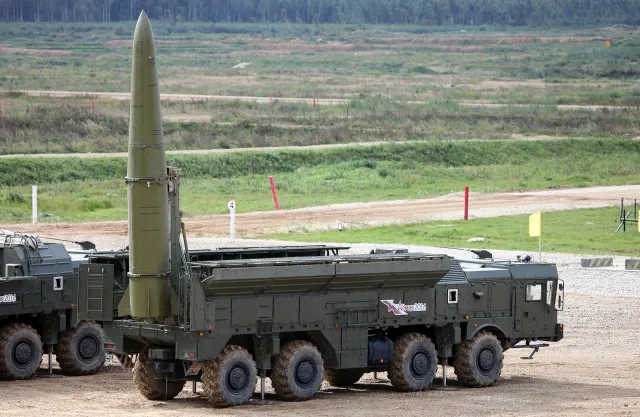
Missile
9K720 Iskander-MFrequently asked questions
Did North Korea say the missile test was linked to Trump's summit comments? +
Not explicitly in North Korean state statements reported so far. But South Korean and international press directly juxtaposed the timing: the barrage came about 24 hours after Trump's remarks and a day after Kim Yo Jong publicly downplayed any revived high-level contact.
Would a fourth Trump-Kim meeting be a record? +
Yes. A fourth meeting would be unprecedented; no US president has met the same North Korean leader more than three times. Trump and Kim previously met in Singapore in 2018, Hanoi in 2019 (which ended without an agreement), and at the DMZ later in 2019.
What missiles did North Korea actually fire? +
South Korea's Joint Chiefs of Staff said more than 10 short-range ballistic missiles flew about 300 kilometers into the East Sea. The specific missile type was not disclosed at the time of reporting.
Is Trump's '57 nuclear weapons' claim accurate? +
That's Trump's own stated assessment, not an official US intelligence estimate or a North Korean disclosure. It should be treated as an unverified political claim, not a confirmed fact about North Korea's arsenal.
More news


