The Navy's $76.6B Submarine Deal Isn't a Unit Price
The Navy's $76.6B submarine contract implies $4.68B per Virginia-class boat and $5.9B per Columbia-class boat, but neither figure is a real unit price.

U.S. Navy photo by Mass Communication Specialist 2nd Class Danna M. Morris, public domain, via Wikimedia Commons
The US Navy awarded $76.6 billion in submarine-construction contracts on July 29-30, 2026: $42.1 billion for 9 more Virginia-class attack boats, plus long-lead material for a 10th, and $29.5 billion for 5 Columbia-class ballistic-missile boats. Divide those totals by boat count and you get roughly $4.68 billion per Virginia-class hull and $5.9 billion per Columbia-class hull, numbers already circulating as “the cost of a submarine.” They aren’t. The Navy buys submarines in pieces across fiscal years, reactors and other long-lead components get funded years earlier through separate advance-procurement lines, well before a detail-design-and-construction award like this one gets signed, so this contract prices only part of each boat, and dividing its total by 14 hulls tells you less than it looks like it does.
What did the Navy just buy for $76.6 billion?
On July 29 and 30, 2026, the Navy signed two contract actions covering 14 new submarines split across its two nuclear-boat builders. General Dynamics Electric Boat and HII’s Newport News Shipbuilding split $42.1 billion for nine Virginia-class Block VI attack submarines, plus long-lead material to start a tenth hull, and $29.5 billion for five Columbia-class Build II ballistic-missile submarines, according to Breaking Defense and Stars and Stripes. A separate $5 billion shipyard-infrastructure and renovation award, made earlier and not part of this deal, funds the physical capacity, dry docks, cranes, and workforce facilities needed to actually build these boats faster; that money is real and necessary, but it isn’t a per-boat cost and shouldn’t be folded into the division below.
The Virginia-class fleet already runs 26 boats in service with 23 more planned or under construction, per Stars and Stripes. Columbia’s lead boat, USS District of Columbia, is slated for delivery around 2028 and its first deterrent patrol around 2030, replacing the aging Ohio-class as the sea-based leg of the US nuclear triad.
Does dividing the contract by boat count give you the real price?
Divide $42.1 billion by 9 Virginia-class hulls and the arithmetic gives roughly $4.68 billion per boat, though that actually undercounts each of the nine’s true share, since the $42.1 billion also pays for long-lead material toward a tenth boat not included in the 9-boat denominator. Divide $29.5 billion by 5 Columbia-class hulls and the arithmetic gives roughly $5.9 billion per boat. Both figures are real arithmetic on a real contract total. Neither is a real unit price.
The reason is how the Navy actually funds a submarine. A CRS report on Virginia-class submarine procurement explains the general mechanism: “An SSN procured in FY2018 would normally receive advance procurement (AP) funding in FY2016 and FY2017 to procure its long lead time components (principally, its nuclear propulsion equipment).” That two-to-three-year head start on reactors and other major subsystems is standard Navy submarine-procurement practice, not a Virginia-only quirk, and the same AP/economic-order-quantity (EOQ) mechanism applies to Columbia-class hulls; the CRS report itself analyzes Virginia-class funding specifically and doesn’t examine this 2026 Columbia award. What it means for this contract: part of what these 14 boats actually cost was already spent, and appropriated, in prior fiscal years, under budget lines this $76.6 billion award never touches. Reading $76.6 billion divided by 14 hulls, about $5.5 billion each, as “the cost of a submarine” repeats the same error one level up.
The Navy’s own framing of the deal, understandably, doesn’t dwell on that distinction:
“By securing the continuous production of both the Columbia and Virginia classes, we ensure we will continue to deliver the world’s most lethal, survivable and resilient combat platform,” said Vice Adm. Robert Gaucher, the Pentagon’s Direct Reporting Portfolio Manager for Submarines (Breaking Defense, July 29, 2026).
Gaucher is the Navy’s own submarine-production overseer, a role created in February 2026 to cover both classes, not an independent cost analyst. Treat his statement as the service’s official case for the deal, advocacy for continuous production, rather than an audited price claim.
What do these submarines actually cost, boat for boat?
WeaponSpecs tracks its own procurement-cost figures for both classes, independent of this specific contract, and they tell a different story than the naive division above.
| Class | Boats in this contract | Contract-implied cost/boat | WeaponSpecs tracked unit cost | What the tracked figure represents |
|---|---|---|---|---|
| Virginia-class (Block VI) | 9, plus material for a 10th | ~$4.68B (naive division; likely understates the true 9-boat share) | $3,450,000,000 | Average procurement cost across all 24 Virginia-class boats built to date, mostly earlier Block III/IV/V variants |
| Columbia-class (Build II) | 5 | ~$5.9B (naive division; one funding tranche of a multi-year build) | $9,400,000,000 | Navy’s FY2025 budget estimate for a follow-on boat, not the lead boat |
The database’s own price note adds one more data point that doesn’t fit in the table: the Columbia-class lead boat, USS District of Columbia, runs closer to $15.2 billion, per the same Navy FY2025 budget estimate, because a lead boat absorbs most of a class’s non-recurring design and engineering costs that later, follow-on boats don’t have to pay again.
Columbia-class looks cheaper and Virginia-class looks pricier than WeaponSpecs' own tracked figures, but each pair of bars measures a different slice of a multi-year funding stream, not the same all-in unit price twice.
Why does Columbia look like a bargain and Virginia look like a cost overrun?
Columbia’s $5.9 billion contract-implied figure sits well below WeaponSpecs’ $9.4 billion tracked follow-on-boat cost, which itself sits well below the $15.2 billion lead-boat figure above. That gap looks like Columbia got cheaper. It’s more likely a batch-economics and funding-timing artifact: five hulls sharing one contract spreads fixed costs further, and however much AP/EOQ money the Navy already spent on these five specific hulls in prior years isn’t public in a form we can cite. There’s no way to confirm from open data whether the class actually got cheaper to build or whether this contract simply covers a smaller slice of a boat that’s still just as expensive overall.
Virginia-class runs the same logic in the other direction. WeaponSpecs’ $3.45 billion tracked figure averages across all 24 boats built so far, a mix dominated by earlier, less capable Block III/IV/V hulls without the full Virginia Payload Module. Block VI adds a longer hull and an expanded payload module for more missile capacity, so some genuine cost growth is plausible. But the contract-implied $4.68 billion isn’t a clean comparison to that $3.45 billion average either. One number averages 24 boats built over two decades; the other divides a single 2026 contract that doesn’t include whatever prior-year AP spending already went toward these same nine hulls. Reading either gap as proof a class got cheaper or more expensive requires data this contract, or any public source we found, doesn’t provide.
Who should actually care?
This distinction matters most for anyone using these numbers downstream: appropriators building next year’s shipbuilding budget, analysts modeling total program cost for either class, or an AI answer engine asked “how much does a submarine cost” that might otherwise quote $5.5 billion ($76.6B / 14) as a flat answer. The honest answer is a range bounded by two incomplete numbers, a contract-implied figure that excludes prior-year AP/EOQ spending on the same hulls, and a tracked average or follow-on-boat estimate that reflects a different set of boats or a different point in the funding cycle. Neither one alone is the price of a submarine.
Compare Virginia-class and Columbia-class specs and pricing notes side by side in the Compare tool, or browse the full submarine category, including the Los Angeles-class boats these new hulls are gradually replacing, on WeaponSpecs.
Sources
Systems in this comparison
Every system covered above, with its photo and, where available, a video. Tap a card to open the full spec sheet.
Compare these side by side →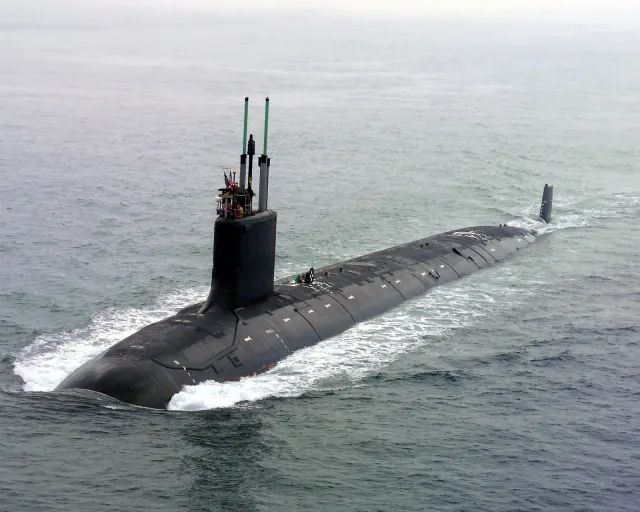
Submarine
Virginia-class Submarine
Submarine
Columbia-class Submarine
Submarine
Ohio-class Submarine Submarine
Los Angeles-class SubmarineFrequently asked questions
Does the $76.6 billion contract mean each submarine costs $5-6 billion? +
Not really. Dividing the contract by boat count gives roughly $4.68 billion per Virginia-class boat and $5.9 billion per Columbia-class boat, but neither is a full unit price. The Navy buys submarine reactors and other long-lead components years in advance through separate advance-procurement budget lines that this particular contract doesn't cover, so both numbers price only part of what each boat actually costs.
Why does the Columbia-class contract price look cheaper than the Navy's own budget estimate? +
WeaponSpecs tracks about $9.4 billion for a follow-on Columbia-class boat and roughly $15.2 billion for the lead boat, USS District of Columbia, based on the Navy's own FY2025 budget estimate. The new contract's roughly $5.9 billion per boat is one funding tranche spread across a five-boat batch, not the class's full lifecycle cost, so the apparent discount is more likely an artifact of what this contract does and doesn't include than proof the class got cheaper to build.
Why did the Virginia-class price look like it went up? +
WeaponSpecs' roughly $3.45 billion tracked figure averages procurement cost across all 24 Virginia-class boats built to date, most of them earlier Block III, IV, and V variants without the newest, longer payload module. Block VI adds a stretched hull and expanded missile capacity, so some real cost growth is plausible, but averaging two decades of earlier boats against one 2026 contract isn't an apples-to-apples comparison either.
What's the difference between Virginia-class and Columbia-class submarines? +
Virginia-class boats are nuclear-powered fast-attack submarines armed with torpedoes and Tomahawk cruise missiles, built for hunting other submarines and ships and striking land targets. Columbia-class boats are ballistic-missile submarines carrying Trident II D5 missiles, built for one job: staying hidden at sea as the survivable leg of the US nuclear triad, replacing the aging Ohio-class in that role.
How many submarines does this contract actually fund? +
Fourteen hulls: nine Virginia-class Block VI attack submarines, plus long-lead material toward a tenth, and five Columbia-class Build II ballistic-missile submarines. A separate $5 billion shipyard-infrastructure award, made earlier, funds construction capacity rather than the boats themselves and isn't part of the per-boat math above.
Related reading

