Marines Add AI-Aimed M240 Gun to Counter-Drone Truck
A $6.2M prototype deal puts Allen Control Systems' Bullfrog turret on L-MADIS, promising drone kills at about $10 a shot.

U.S. Marine Corps photo by Sgt. Servante R. Coba, DVIDS, public domain
The U.S. Marine Corps has selected Allen Control Systems’ Bullfrog, a robotic turret built around the standard M240 machine gun, for integration onto its L-MADIS counter-drone trucks, under an initial $6.2 million prototype contract disclosed the week of July 20, 2026. The system uses AI to detect and track drones and aim the gun automatically, but a human operator still has to authorize every shot.
A machine gun that aims itself
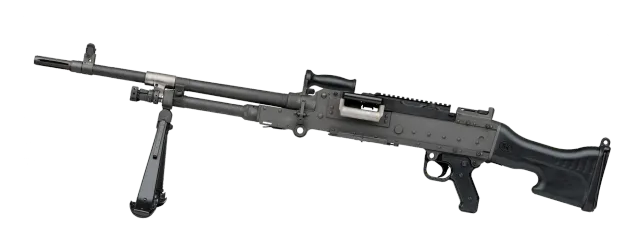
L-MADIS, the Light Marine Air Defense Integrated System, is a two-vehicle expeditionary counter-drone package built on Polaris MRZR all-terrain vehicles: one carries command and control, the other an electronic warfare suite that jams and disrupts hostile drones’ navigation and communications links. It has been in Marine Corps service for years as a purely electronic defense. The Bullfrog M240, made by Texas-based Allen Control Systems (ACS), adds a kinetic option to that pairing. It is not a new weapon in the conventional sense: the gun itself is an unmodified, standard-issue M240 7.62mm machine gun, the same one fielded by more than 80 countries and already in WeaponSpecs’ database. What Bullfrog adds sits around the gun, not inside it: a robotic mount, sensors and AI-assisted fire control that detect an approaching drone, track it and slew the weapon onto target, cutting out most of the manual aiming a Marine would otherwise do by hand.
The turret weighs about 300 pounds without ammunition, fires up to 850 rounds per minute, and per Allen Control Systems is rated against drones through DoD Group 1 to 3, a classification that tops out around 1,320 pounds maximum takeoff weight. The company says its effective engagement range against medium and large drones runs to nearly half a mile. The integration will move forward through a prototype Other Transaction Agreement (OTA), a Pentagon contracting vehicle designed for fast, lower-commitment testing rather than a locked-in production buy, with an initial value of roughly $6.2 million.

Why the Marine Corps is buying a cheaper way to shoot down drones
The appeal is arithmetic as much as engineering. Air-defense planners have spent the past several years confronting what’s often called the cost-curve problem: a quadcopter or FPV drone that costs a few hundred to a few thousand dollars can force a defender to expend an interceptor missile costing tens of thousands of dollars or more, a trade that favors whoever is attacking, especially at scale when dozens of cheap drones are launched at once. Ukraine’s battlefield and the Houthi campaign against shipping in the Red Sea have both made that math impossible to ignore. A Raytheon Patriot interceptor, built to stop ballistic missiles and advanced aircraft, can run several million dollars each; using one against a cheap drone is the air-defense equivalent of using a sledgehammer to swat a fly, and doing it often enough eventually empties the magazine.
Allen Control Systems advertises Bullfrog’s engagement cost as “a cost-per-kill as low as $10,” the price of the standard 7.62mm rounds the M240 already fires, versus a missile-based intercept that can cost thousands of times more per engagement. That’s the same logic behind AeroVironment’s counter-drone contract with the Army and Anduril’s reusable Roadrunner-M interceptor: all three represent a broader shift toward cheaper, faster-to-produce counter-drone tools that sit below a Patriot battery in the defensive stack, absorbing the high-volume, low-value threats so the expensive interceptors stay reserved for harder targets.
“The Marine Corps requires the most sophisticated and accurate possible capabilities to carry out its critical missions,” said Mike Wior, co-founder and CEO of Allen Control Systems. “We are honored to support Marines with fast, scalable, and cost-effective counter-drone solutions that integrate seamlessly into existing platforms” (statement to Breaking Defense, July 20, 2026).
Human on the loop, not out of it
Bullfrog’s automation stops short of letting software decide who or what gets shot. Allen Control Systems describes the system as “human in the loop”: the AI detects, identifies and tracks a target and calculates the firing solution, then presents it to a human operator, who has to authorize the engagement before the gun fires. Reporting on the system’s rollout has noted that once a Marine gives that authorization, the actual firing sequence, roughly 14 rounds a second at Bullfrog’s rated rate of fire, happens automatically, which is exactly why the human step is treated as non-negotiable rather than a formality: it is the last point at which a person, not the AI, confirms the target is a drone and not something else in the frame.
That distinction matters because the $6.2 million Marine Corps deal is not Bullfrog’s only contract. The U.S. Army Applications Lab awarded Allen Control Systems a contract in December to evaluate Bullfrog on five Army combat vehicles, and U.S. Special Operations Command has a separate contract to integrate it onto maritime platforms, signed in September. The Marine Corps selection folds L-MADIS into a Bullfrog customer base that already spans multiple services, each testing the same automated-aiming, human-authorized-fire model against the same cheap-drone problem from a different platform.
The Marine Corps’ own budget documents put the scale of the underlying problem in context: the service is requesting approximately $1.27 billion in its fiscal 2027 budget for the broader Ground-Based Air Defense (GBAD) program that L-MADIS and Bullfrog both fall under, a figure that dwarfs this initial prototype deal and signals GBAD is being treated as a long-term program of record, not a one-off experiment. Whether Bullfrog graduates from a $6.2 million prototype into a program funded out of that larger pool is the next milestone to watch, not the current contract value itself.
Sources
- Marine Corps selects new robotic weapon system for L-MADIS integration — Breaking Defense, Jul 20, 2026
- US Marine Corps Pairs ACS Bullfrog Anti-Drone System With L-MADIS — The Defense Post, Jul 21, 2026
- US Marine Corps turns to AI-powered Bullfrog as drone threats expand — Military Times, Jul 21, 2026
- The Marines' New AI Gun Tracks Drones. It Can Also Track & Target People. — Gadget Review, Jul 23, 2026
Systems mentioned
Every system named in this story, with its photo and, where available, a video. Tap a card to open the full spec sheet.
Frequently asked questions
Is Bullfrog a new gun? +
No. Bullfrog is a robotic turret and fire-control system built around an unmodified, standard-issue M240 7.62mm machine gun. The gun itself is unchanged; what Allen Control Systems adds is AI-assisted detection, tracking and aiming, with a human operator still authorizing the shot.
Does the AI decide when to shoot? +
No. Allen Control Systems describes Bullfrog as operating with a human in the loop: the system detects, tracks and cues a target, then presents it to a human operator, who must authorize the engagement before the weapon fires. It is not granted autonomous kill authority.
Is $6.2 million a large contract? +
Not by Pentagon standards. It's a small prototype Other Transaction Agreement, a fast, low-commitment vehicle the Marine Corps and other services use to test new tech before a full acquisition program. The more telling number is the Marine Corps' $1.27 billion fiscal 2027 budget request for its broader Ground-Based Air Defense program, which is what Bullfrog is being evaluated to support.
L-MADIS already jams drones with Modi II. Why add a gun? +
Modi II jamming is electronic and non-kinetic: it disrupts a drone's navigation, communications or control link, which does nothing against a drone that is already flying on a jam-resistant autopilot or has already released a munition. Bullfrog gives L-MADIS crews a kinetic backup that still works once jamming has failed or was never going to.
More news


