Japan's F-2 Spotted Carrying New 1,000km Stealth Cruise Missile
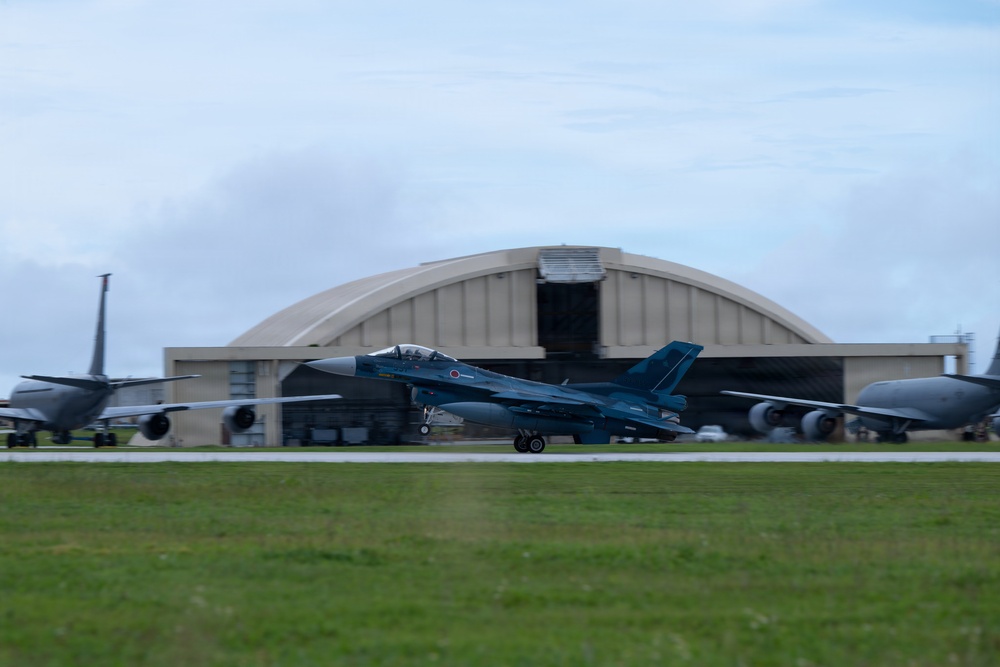
A JASDF F-2B was photographed with an unidentified missile believed to be the air-launched Type 25, 5x the range of its predecessor.

SrA Austin Salazar, Regional Media Center-Japan (U.S. Air Force), DVIDS, public domain
A Japan Air Self-Defense Force F-2B fighter was photographed on July 30 carrying a large, previously unseen missile that independent defense outlets identify, though the Japanese government has not confirmed, as the air-launched version of the Type 25, a stand-off weapon whose ground-launched variant already reaches more than 1,000 km, roughly five times the range of the missile it replaces.
What was actually photographed
The sighting involved F-2B tail number 68-8101, assigned to the JASDF’s Air Development and Test Wing, seen flying out of Gifu Air Base on what appears to have been an early test flight carrying the new weapon. The missile itself is notably large, described by The War Zone as bigger than the F-2’s existing ASM-2 anti-ship missile or even the newer, ramjet-powered ASM-3, with a long, slender fuselage, wings that fold flush against the upper body, and four cruciform tailfins. Its shape carries low-observable design cues, including chines similar to those seen on other stealth-shaped missiles and an underslung engine intake fitted with a protective cap for ground handling. Japan’s Ministry of Defense has not officially named the weapon. The inference that it is Type 25’s air-launched variant rests entirely on its size, configuration and the timing of the test, which lines up closely with the ground-launched system’s own development track, not on any government statement, and this piece treats it accordingly, as a strong, source-attributed inference rather than a confirmed fact.
From a 200 km coastal-defense missile to a 1,000 km strike weapon
The ground-launched program that this new missile is believed to descend from is not itself brand new. Type 25, also referred to as 25SSM, is a heavily redesigned evolution of Japan’s Type 12 Surface-to-Ship Missile, the truck-mounted coastal-defense weapon that has anchored Japan Ground Self-Defense Force anti-ship batteries since the 2010s with a published range around 200 km. Type 25 extends that reach past 1,000 km, a roughly fivefold jump, through a new low-observable airframe with folding wings and cruciform tailfins, a subsonic radar-evading cruise profile, and GPS/inertial guidance backed by a terminal radar seeker for the final approach to target. Alongside a companion supersonic boost-glide weapon, the Type 25 Hyper Velocity Gliding Projectile, the ground-launched Type 25 SSM was formally inducted into JGSDF operational units on March 31, 2026, at Camp Kengun in Kumamoto Prefecture and Camp Fuji in Shizuoka Prefecture, giving Japan its first fielded stand-off weapon in this range class. The Ground Self-Defense Force has framed the program, in remarks reported by Army Recognition, as a response to Japan’s evolving security environment rather than as an offensive escalation, language consistent with how Tokyo has publicly described its broader stand-off weapons push.
What the July 30 sighting adds, if the identification holds up, is a second launch platform for a missile that until now only fired from a ground vehicle. An air-launched variant carried by the F-2, a fighter that already operates from bases across Japan and can be forward-deployed, would put the same roughly 1,000 km strike reach behind the mobility and reach of the fighter fleet rather than the fixed geography of a battery position. That distinction matters strategically: a ground battery’s range footprint is set the moment it’s emplaced, while a fighter-launched missile’s effective reach shifts with wherever the aircraft flies from, a materially different, harder-to-fix targeting problem for any potential adversary.
The policy backdrop: counterstrike, not coastal defense alone
This test flight sits inside a broader, deliberate shift in Japanese defense policy. Japan’s 2022 National Security Strategy formally authorized a “counterstrike capability,” permitting strikes on enemy bases or launch assets under strict constitutional conditions, a genuine break from the country’s postwar defensive-only military posture. Defense officials have publicly framed that shift as a response to intensifying Chinese military activity around Taiwan and the East China Sea alongside North Korea’s continuing missile and nuclear programs, rather than as a policy reversal for its own sake. A fighter-launched, roughly 1,000-km missile would put coastal and inland targets across a meaningfully wider swath of China within theoretical range of JASDF strike aircraft operating from Japanese territory, extending the practical reach of that counterstrike authority beyond what ground batteries alone can cover. No comparable chart accompanies this piece: independent sourcing on the intermediate, upgraded-Type-12 range figure conflicts across outlets closely enough that this desk judged a clean before/after comparison couldn’t be built without overstating precision the underlying numbers don’t support.
Sources
- Japanese F-2 Fighter Appears With New Large Stealth Cruise Missile Under Its Wings — The War Zone, Jul 30, 2026
- Japan Deploys New Type 25 Long-Range Anti-Ship Missiles Extending Strike Reach Beyond 1,000 km — Army Recognition, Mar 31, 2026
Systems mentioned
Every system named in this story, with its photo and, where available, a video. Tap a card to open the full spec sheet.
Compare these side by side →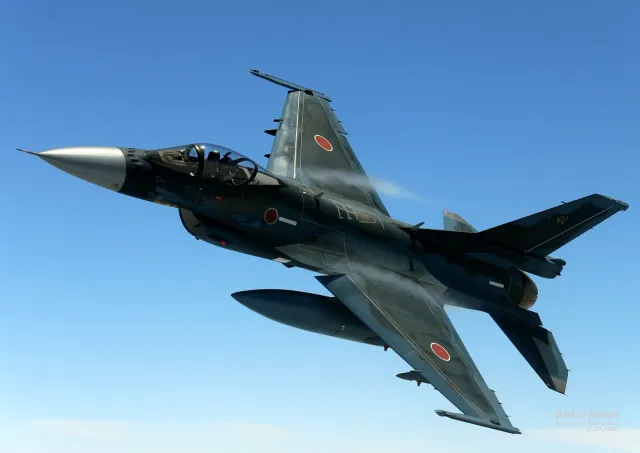
Fighter aircraft
Mitsubishi F-2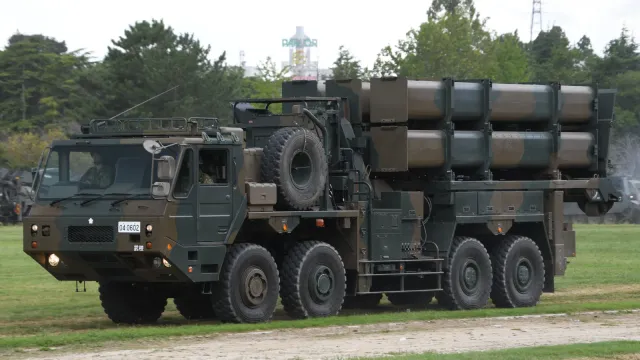
Missile
Type 12 SSMFrequently asked questions
What is the Type 25 missile? +
Type 25 is a heavily redesigned evolution of Japan's Type 12 coastal-defense anti-ship missile, extending range from roughly 200 km to more than 1,000 km with a low-observable airframe, folding wings and cruciform tailfins. The ground-launched version was formally inducted into Japan Ground Self-Defense Force units on March 31, 2026.
Is this confirmed to be Type 25 on the F-2? +
No. The Japanese Ministry of Defense has not officially identified the missile photographed under the F-2B's wing on July 30. Outlets including The War Zone infer it is the air-launched Type 25 variant based on its size, shape and the timing of the test flight, but this remains an informed inference, not an official confirmation.
Why does an air-launched version matter? +
Japan's existing 1,000-km-class Type 25 missiles are ground-launched from truck batteries. Putting a missile of similar reach on a fighter would let Japan strike the same kinds of distant targets from the air, extending stand-off reach beyond fixed coastal batteries to wherever the JASDF's F-2 fleet can fly.
How does this fit Japan's "counterstrike" policy? +
Japan's 2022 National Security Strategy authorized a counterstrike capability allowing strikes on enemy bases or launch assets under strict constitutional conditions, a break from its postwar defensive-only posture. A longer-range, fighter-launched missile would materially extend which targets fall within that policy's practical reach.
More news


