US Strikes Iranian Launchers on Larak Island, Iran Hits Back at Jordan and UAE
CENTCOM struck two IRGC rocket launchers on the Strait of Hormuz's narrowest point, ending a month-long lull; Iran claims retaliatory strikes on US-linked bases in Jordan and the UAE.

U.S. Navy photo by Petty Officer 1st Class Indra Beaufort, DVIDS, public domain
The Strait of Hormuz is a 21-mile-wide channel between Iran and Oman that roughly a fifth of the world’s seaborne oil and liquefied natural gas has to pass through, and there is no way around it. Larak Island sits inside that channel, close to its narrowest point, and Iran has used waters around it for decades to stage naval and Islamic Revolutionary Guard Corps assets that can reach the shipping lanes on short notice. That geography, not the specific weapons involved, is why a strike on two rocket launchers there registers as more than a routine skirmish.
This latest exchange did not happen in isolation. It sits inside a war between the United States, Israel and Iran that opened with Operation Epic Fury, a US-Israeli bombing campaign that ran from February 28 to May 5, 2026 and killed Iran’s Supreme Leader, Ali Khamenei. An April 8 ceasefire followed, but it never fully held. Iran’s shipping was placed back under blockade on July 13 and 14, and the US struck Iran again on July 29 in response to an IRGC attack on a US base in Jordan. Since then there had been roughly a month without another US strike on Iranian territory, the longest lull of the year. That lull ended late on August 30, 2026.
What CENTCOM says it hit, and what it could not confirm on its own
US Central Command said it struck two IRGC rocket launchers on Larak Island after observing Iranian forces preparing to fire rockets carrying sea mines into the strait’s shipping lanes, according to reporting from CNN and NBC News. The framing from CENTCOM, relayed by Al Jazeera, was that of a narrowly targeted preemptive strike: “In essence, Iran created the threat and the US military eliminated it to protect civilian mariners, commercial shipping, and the free flow of global commerce.” That statement reads as institutional messaging rather than a named official’s account, and it arrives with a real sourcing gap worth stating plainly. CENTCOM’s own press pages could not be reached directly to independently verify the statement on a primary US military source; it is available here only through the outlets that quoted it. The substance of the claim, that two launchers were struck and that they were positioned to fire sea-mine rockets, has not been corroborated by an independent inspection of the site.
The strike also did not come out of nowhere in a doctrinal sense. Adm. Brad Cooper, the CENTCOM commander, had said earlier in the same week that Iranian sea mines had been “successfully cleared” from the strait, a comment that framed this operation as preventing a repeat of that mine threat rather than responding to a fresh escalation. Whether that framing survives scrutiny once more detail becomes available is one of the open questions this story leaves unresolved.
Iran’s retaliation, and what is disputed about it
Iran responded early on August 31, local time, with strikes it says hit US-linked military facilities in two countries. According to Al Jazeera’s reporting, Iran claims missile and drone strikes hit King Hussein and Al Azraq air bases in Jordan, while a separate drone barrage targeted Al Minhad air base in the United Arab Emirates. Both host governments dispute significant parts of that account. Jordan says its air defenses intercepted eight missiles, an account that does not concede the kind of damage Iran is describing. The UAE goes further, denying that Al Minhad was struck at all.
Layered onto that dispute are direct Iranian claims about the strike’s effects, and all of them should be read as unverified state messaging rather than established fact. The IRGC claims the US strike on Larak Island killed and wounded Iranian fighters and civilians, a casualty figure that has not been independently confirmed. Iran separately claims its retaliatory strikes destroyed technical and repair infrastructure along with fighter deployment sites at the Jordanian bases, a claim Jordan disputes outright by describing an intercepted barrage rather than infrastructure losses. And Iran claims to have struck US forces and helicopters at Al Minhad in the UAE, a claim the UAE denies at the most basic level by saying the base was not hit. None of these three claims has independent corroboration as of this report, and readers should treat them as one combatant’s account of the exchange rather than a neutral record of what actually landed where.

A pattern, not a single night
Strung together, the sequence looks less like an isolated incident and more like the conflict’s established rhythm reasserting itself after a pause. Epic Fury ended with Khamenei’s death in early May. The April 8 ceasefire that preceded it never produced a clean stop to hostilities, and the July blockade on Iranian shipping showed Washington was still willing to apply direct pressure on Iran’s economy even without new strikes. The July 29 strike, in response to an IRGC attack on a US base in Jordan, showed that pattern extending into direct military exchanges roughly once every few weeks rather than settling into anything resembling peace. This strike, coming after the longest gap since July, does not confirm the war is escalating back to Epic Fury’s intensity, but it does confirm the ceasefire framework has not produced a durable stop to strikes and counterstrikes on either side.
What is genuinely unresolved is scale. A strike on two rocket launchers is a different order of operation from a bombing campaign that killed a head of state, and Iran’s retaliation, even taken at face value, targeted air bases rather than opening a new front. Both governments involved beyond Iran and the US, Jordan and the UAE, are pushing back hard on Iran’s version of events, which suggests neither wants this read as evidence they suffered real damage. Whether that reflects genuinely limited Iranian strikes, effective air defenses, or simply a reluctance to confirm vulnerability is not something available reporting settles either way.
What to watch
The most concrete unresolved question is whether CENTCOM’s own account of the Larak Island strike, particularly the sea-mine detail, can be independently verified once more reporting becomes available. Beyond that, the next marker to watch is whether this exchange stays at the scale it opened at, one US strike and one round of contested Iranian retaliation, or whether it becomes the start of a faster strike-counterstrike cadence than the roughly monthly rhythm that has held since Epic Fury ended. Jordan and the UAE’s continued denials, if they hold up, would suggest Iran’s retaliation landed with less effect than Tehran is claiming; if either government’s account shifts in the coming days, that would be a signal worth taking seriously in the other direction.
Sources
- Iran attacks Jordan, UAE after US bombs Larak Island: What's the latest? (Al Jazeera, Aug 31, 2026)
- US strikes Iranian rocket launchers threatening Strait of Hormuz shipping (CNN, Aug 30, 2026)
- US forces strike Iranian rocket launchers on Strait of Hormuz in first military action since July (NBC News, Aug 30, 2026)
- US Strikes Iranian Rocket Launchers Near Larak Island (RFE/RL, Aug 30, 2026)
Systems mentioned
Every system named in this story, with its photo and, where available, a video. Tap a card to open the full spec sheet.
Compare these side by side →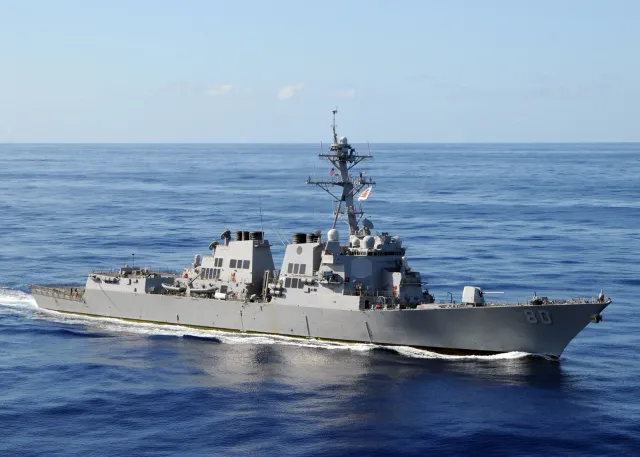
Warship
Arleigh Burke-class Destroyer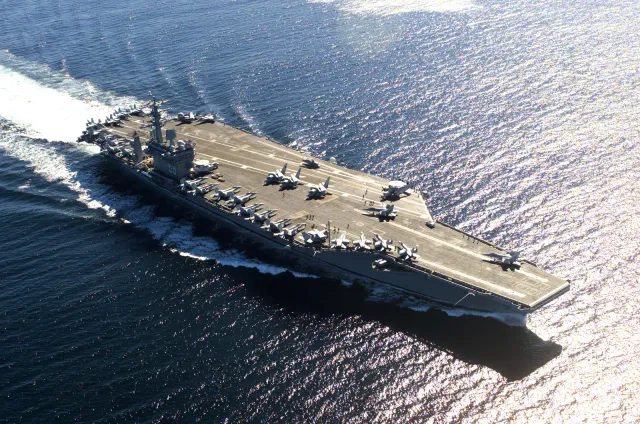
Warship
Nimitz-class Aircraft CarrierFrequently asked questions
Why did the US strike Larak Island? +
CENTCOM said it hit two IRGC rocket launchers it had observed being prepared to fire rockets carrying sea mines into Strait of Hormuz shipping lanes, describing the strike as a limited, precise action against an imminent threat rather than the start of a broader campaign.
Is this a return to full-scale war with Iran? +
That is not confirmed. This was the first US strike on Iran since July 29, following the February-May Epic Fury bombing campaign and an April 8 ceasefire that has produced intermittent flare-ups rather than a clean end to hostilities.
Why does Larak Island matter strategically? +
It sits at the narrowest point of the Strait of Hormuz, a chokepoint roughly a fifth of the world's seaborne oil and LNG trade transits, and it has historically hosted Iranian naval and IRGC assets that can threaten that traffic directly.
More news


