Boeing's F-15 Eagle Crest Deal Tops Out at $131 Billion
A sole-source Air Force contract folds F-15 production, upgrades, retrofits and depot work into one $131.23 billion vehicle that can run through 2037.

U.S. Air Force photo by Senior Airman Amy Kelley, DVIDS, public domain (VIRIN 260708-F-LD348-1037)
Boeing has been awarded a sole-source contract with a $131.23 billion ceiling to produce, modernize and sustain F-15 fighters for the U.S. Air Force and seven foreign buyers through 2037. The contract, called F-15 Eagle Crest, was signed Aug. 24 by the Air Force Life Cycle Management Center at Wright-Patterson Air Force Base, Ohio, but only $343,740 was actually obligated at signing, a gap between the ceiling figure and real spending that shapes almost everything else worth knowing about this deal.
By the numbers: what Eagle Crest actually locks in
Eagle Crest is an indefinite-delivery, indefinite-quantity contract, a vehicle that sets a spending cap and a list of eligible work rather than ordering a fixed number of jets. Three known dollar figures inside or adjacent to its scope show how that structure plays out in practice, from the headline ceiling down to the one foreign sub-deal with a disclosed price tag.
| Contract / sub-deal | What it covers | Known value |
|---|---|---|
| F-15 Eagle Crest (full ceiling) | USAF and Air National Guard F-15EX production, F-15E/C modernization and retrofits, sustainment, new organic depot maintenance, plus FMS work, through Aug. 2037 | $131.23 billion ceiling; only $343,740 in FY26 R&D funds obligated at signing |
| Israel F-15IA | 25 aircraft ordered under a Dec. 29, 2025 agreement, with an option for 25 more | $8.58 billion |
| South Korea F-15K Slam Eagle | Fleet modernization, a separate sole-source award through the same contracting office, January 2026 | $2.8 billion |
| Japan F-15J Super Interceptor | Radar, self-protection electronic warfare kit and mission computers, a separate sole-source award, December 2024 | $450.5 million |
Saudi Arabia, Singapore, Indonesia and Poland are also named as foreign military sales customers under Eagle Crest’s scope, but current public reporting does not break out individual dollar figures for their portions, and this piece does not estimate ones that have not been disclosed. Indonesia and Poland do not currently fly the F-15 at all, so their inclusion signals a future sale rather than support for an existing fleet.
A ceiling, not a checkbook
The clearest way to see what an IDIQ ceiling does and does not commit the government to is a direct comparison. When the same Air Force office awarded Lockheed Martin a 10-year, $62 billion IDIQ for new F-16 exports in August 2020, it issued a $4.94 billion order for 90 jets the same day, an immediate, countable commitment sitting inside the ceiling. Eagle Crest’s Aug. 24 notice includes no order for a single jet. What it obligated instead was $343,740 in research and development funds, a figure closer to a rounding error than a down payment on a $131 billion program.
An Air Force spokesperson made the same point directly in a statement to Air & Space Forces Magazine.
“As an indefinite-delivery, indefinite-quantity contract, it provides flexibility to support future efforts up to the contract ceiling, while each award remains subject to independent decision making. The ceiling represents capacity for future needs, not a commitment to spend the full amount. By consolidating these efforts under a single contract vehicle, Eagle Crest will help the Air Force move faster and reduce administrative burden,” an Air Force spokesperson said (Air & Space Forces Magazine, Aug. 27, 2026).

Heather Penney, a former F-16 pilot who is now director of studies and research at the Air & Space Forces Association’s Mitchell Institute, argued the structure itself, not any single dollar figure, is the real story.
“It is because we have not had large production runs, both in annual rate and total quantity, that we’re seeing a lot of the strains across the defense industrial base today. So this IDIQ contract could be one way that the service begins to solve that problem,” said Heather Penney, director of studies and research at the Mitchell Institute for Aerospace Studies (Air & Space Forces Magazine, Aug. 27, 2026).
Landing on a program already behind schedule
Eagle Crest arrives while the F-15EX program it anchors is already running late. Military Times reports the program will miss its planned July 2027 full operational capability date, a delay the Air Force’s own fiscal 2027 budget documents tie to a 15-week strike at Boeing’s St. Louis plant from Aug. 4 to Nov. 17, 2025, “compounded by the prime contractor’s subsequent failure to meet production recovery goals.” The Air Force’s response has been to lean further into the program rather than pull back: the same budget documents raise the planned U.S. F-15EX buy to 268 aircraft through fiscal 2031, nearly triple the original 98-aircraft baseline, a decision that will force a refresh of the jet’s radar, mission computer, electronic warfare suite and engines to keep pace with the larger production run.
That combination, a bigger planned buy landing on top of a schedule slip, is the practical reason a single consolidated contract vehicle appealed to the Air Force now. Folding new production, existing-fleet retrofits, sustainment and a brand-new organic depot capability into one IDIQ removes the administrative overhead of separately competing or re-negotiating each of those efforts as the F-15EX line tries to recover its footing, at the cost of locking in Boeing, and only Boeing, as the sole source for all of it through 2037.
The number that will actually matter over the life of Eagle Crest is not $131.23 billion. It is how many task orders the Air Force places against that ceiling in the next few years, and how much of that spending goes to new F-15EX airframes for the expanded 268-jet U.S. buy versus retrofits, sustainment and the foreign sales listed above. The ceiling only describes what Boeing is now eligible to be paid for; the task orders that follow will show what the Air Force actually decided to buy.
Sources
- Air Force awards Boeing $131 billion ceiling contract for F-15 production, modernization (Military Times, Aug 28, 2026)
- Boeing Lands Potential $131.2B Air Force F-15 Eagle Crest Contract (GovConWire, Aug 25, 2026)
- What the $131 Billion F-15 Contract May Mean For the Air Force (Air & Space Forces Magazine, Aug 27, 2026)
Systems mentioned
Every system named in this story, with its photo and, where available, a video. Tap a card to open the full spec sheet.
Compare these side by side →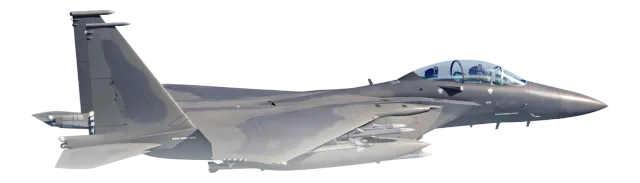
Fighter aircraft
F-15EX Eagle II Fighter aircraft
F-15E Strike Eagle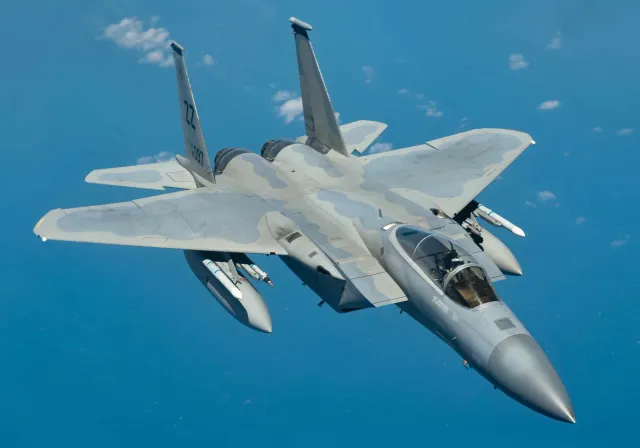
Fighter aircraft
F-15C EagleFrequently asked questions
Does this mean the Air Force is spending $131 billion on F-15s? +
No. The $131.23 billion is an IDIQ ceiling, the maximum the Air Force could order over the contract's life, not a guaranteed spend. Only $343,740 in fiscal 2026 research and development funds was obligated when the contract was signed; actual spending happens task order by task order.
What does Eagle Crest actually cover? +
New-build F-15EX production, modernization and retrofits of existing F-15E and F-15C/D fleets, sustainment, a new organic Air Force depot-maintenance capability, and foreign military sales work, all folded into one contract vehicle running through 2037.
Which countries benefit from this contract? +
The Aug. 24 notice names Japan, Israel, Saudi Arabia, South Korea, Singapore, Indonesia and Poland as foreign military sales customers covered by Eagle Crest's scope, alongside the U.S. Air Force and Air National Guard.
Is the F-15EX program on schedule? +
No. Military Times reports the program will miss its planned July 2027 full operational capability date, a delay tied to a 15-week Boeing labor strike from August to November 2025 and the company's subsequent failure to meet production-recovery goals.
More news


