Saab Unveils A3-001, a Stealth Wingman Drone for the Gripen
Sweden's Saab unveiled a full-scale A3-001 concept, a stealth drone meant to fly with crewed Gripen E fighters, with demonstrators targeted before 2030.

Saab AB, official press image
Saab unveiled a full-scale mock-up of the A3-001, a low-observable, supersonic-capable uncrewed combat aircraft, at the Swedish Armed Forces Jubilee Air Show at Malmen Air Base in Linkoping on August 22. It is Sweden’s own concept for a “loyal wingman” drone built to fly ahead of a crewed JAS 39 Gripen E, the country’s answer to the Collaborative Combat Aircraft race already underway in the United States. Saab is explicit that what stood on the show floor was a ground model, not a flying prototype, and that any operational aircraft depends on Sweden choosing to fund the next phase of the work.
A mock-up, not a prototype
What Saab showed at Malmen was a full-scale physical model built to convey the aircraft’s shape and role, not a functioning airframe. The design is tailless with a blended-wing, compound-delta planform, a chined forward fuselage, and a serrated exhaust with no protruding nozzle, shaping choices aircraft designers use to scatter radar returns rather than reflect them back at a hostile sensor. Saab paired that low-observable shaping with a supersonic-capable airframe, aiming for a wingman that can keep pace with a Gripen E rather than trail behind it.
Saab named three missions for the aircraft: electronic warfare, suppression of enemy air defenses, and precision strike in contested airspace, the high-risk tasking a “loyal wingman” is meant to take on so a crewed fighter and its pilot do not have to. New Atlas reported the airframe will end up roughly the size of a Gripen E, but that comparison did not come from Saab itself, no other outlet repeated it, and Saab has published no dimensions, weight, unit cost, or top speed for the A3-001.
“We are currently in an intensive development phase where, together with Sweden, we are exploring technologies that will lay the foundation for the next generation of combat air systems… we intend to fly uncrewed demonstrators with fighter-like characteristics before 2030… This separate Saab A3 system is our own concept for what could follow in the mid-2030s should Sweden decide to build on the work we are currently doing,” said Peter Nilsson, head of business unit Advanced Programs at Saab, Aug. 22, 2026.

Nilsson’s wording is careful about what is and is not committed. Saab says it intends to fly uncrewed demonstrators with fighter-like characteristics before 2030, work already underway with Sweden’s involvement. The A3-001 as a fielded aircraft is a separate step further out, something Saab describes as possible in the mid-2030s only if Sweden decides to build on the demonstrator work. Nothing about that second step is funded today.
Where the A3-001 sits against the US programs it’s answering
Saab is not the first company chasing this concept. The US Air Force’s Collaborative Combat Aircraft program already selected two designs, General Atomics’ YFQ-42A and Anduril’s YFQ-44A, and both are further along than a ground mock-up. Comparing the three on what is actually confirmed, rather than on unreleased performance numbers, shows how much distance separates Sweden’s concept from the US effort it is explicitly positioned against.
| Program | Country / service | Prime contractor | Status | Target timeframe | Primary missions |
|---|---|---|---|---|---|
| Saab A3-001 | Sweden (Swedish Armed Forces) | Saab | Full-scale ground mock-up unveiled Aug. 22, 2026; no flying prototype | Demonstrators before 2030; possible operational A3 in the mid-2030s, contingent on Swedish funding | Electronic warfare, SEAD, precision strike |
| General Atomics YFQ-42A (Dark Merlin) | United States (US Air Force) | General Atomics Aeronautical Systems | Flying; first flight Aug. 27, 2025; selected for CCA Increment 1 initial production, June 2026 | Part of a combined 150-aircraft production run with the YFQ-44A, planned by 2030 | Air superiority, ISR, strike |
| Anduril YFQ-44A (Fury) | United States (US Air Force) | Anduril Industries | Flying and weapons-tested; fired a live AIM-120 AMRAAM missile July 15, 2026, the first CCA live-fire test | Part of the same combined 150-aircraft production run, planned by 2030 | Air superiority, ISR, strike |

The gap in the status column is the real story: the US Air Force has already flown both Increment 1 candidates and put a live weapon on one of them, while Sweden is still at the mock-up stage with no funded follow-on. That does not make the A3-001 a paper exercise. It means Saab is a step or two behind a race it is deliberately entering anyway, using the same industrial argument every air force chasing this category makes: crewed fighters are too expensive and too precious to fly first into contested, heavily defended airspace when an uncrewed aircraft can absorb that risk instead.
What’s confirmed and what isn’t
One secondary source adds detail Saab itself has not confirmed, and the gap is worth stating plainly. New Atlas reported the program is on “an accelerated development cycle of 15 to 18 months from August 2026,” with a first-flying A1 prototype targeted for 2027, an armed A2 demonstrator by 2030, and a production-representative A3 prototype flying “early in the next decade,” powered by a General Electric F414 turbofan, the same engine family that powers the Gripen E. None of it, not the letter-coded prototype sequence, not the 2027 first-flight date, not the named engine, appears in Saab’s own release, which commits only to demonstrators “before 2030” and a possible A3-derived aircraft “in the mid-2030s.” Other outlets covering the unveiling did not repeat New Atlas’s dates or engine claim either, so readers should treat that reporting as one outlet’s sourcing, not Saab’s confirmed plan.
Sweden joined NATO in 2024, and the A3-001 reads as Sweden’s own hedge inside an alliance now watching the United States build a production line of uncrewed wingmen. Saab already sells the Gripen E and the GlobalEye early-warning aircraft into that alliance market, and Nilsson’s quote leans on both as the base the company says it can build a next-generation combat air system from, a genuinely Swedish answer to the CCA concept rather than a copy of the US approach, but one still a funding decision away.
The A3-001 is not a competitor to the US CCA program yet: it is Sweden’s opening move in the same contest. What happens next depends on a decision Saab does not control: whether the Swedish government funds the demonstrator work Nilsson described, and later, whether it funds an operational aircraft built on top of that. Until that funding materializes, the mock-up shown at Malmen is a statement of intent, not a program.
Sources
- Saab showcases full-scale uncrewed aircraft concept (Saab AB, Aug 22, 2026)
- Saab Unveils A3-001 Collaborative Combat Aircraft Concept (The Aviationist, Aug 22, 2026)
- Saab Unveils Full-Scale A3-001 Supersonic Fighter Drone Concept at Linkoping (New Atlas, Aug 22, 2026)
- SAAB Unveils A3-001 Autonomous Fighter as European Counterpart to U.S. Collaborative Combat Aircraft (Army Recognition, Aug 24, 2026)
Systems mentioned
Every system named in this story, with its photo and, where available, a video. Tap a card to open the full spec sheet.
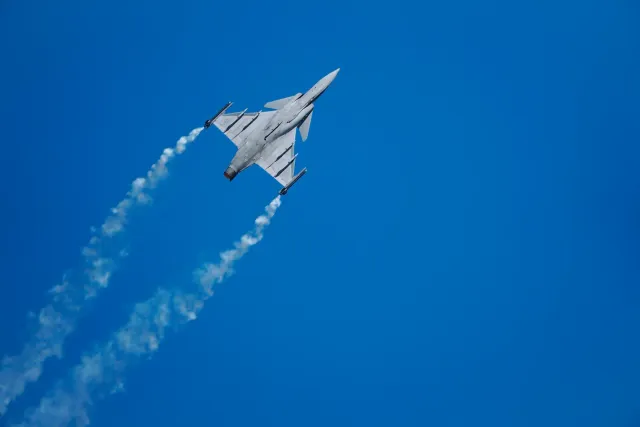
Fighter aircraft
JAS 39E GripenFrequently asked questions
Is the A3-001 actually flying yet? +
No. Saab showed a full-scale ground mock-up on August 22, 2026. Flight demonstrators with fighter-like characteristics are targeted before 2030, and that work is contingent on the Swedish government funding the next phase.
How does the A3-001 compare to the US 'loyal wingman' drones? +
It plays the same role as General Atomics' YFQ-42A and Anduril's YFQ-44A, an autonomous, low-observable aircraft flying ahead of a crewed fighter to absorb risk, but it has no equivalent program-of-record status yet. Both US designs are already flying and have entered production planning; the A3-001 is a mock-up Saab says depends on Swedish funding to go further.
What engine will the A3-001 use? +
Saab has not named one. New Atlas reported the aircraft will use a General Electric F414 turbofan, the same engine family that powers the Gripen E, but that claim did not appear in Saab's own press release or in the other outlets that covered the unveiling, so it should be treated as one outlet's reporting rather than a confirmed spec.
More news


