UK Clears MBDA to Let Ukraine Build Storm Shadow
Britain authorized MBDA to give Ukraine the data to build Storm Shadow missiles at home, trading it for access to Kyiv's AI targeting network.

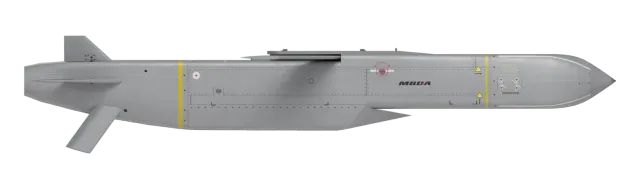
UK Ministry of Defence, Wikimedia Commons, Open Government Licence v1.0
The United Kingdom has authorized missile maker MBDA to declassify and hand over technical data on the British-made components of the Storm Shadow cruise missile, clearing the way for Ukraine to build the weapon on its own soil rather than depend on donated stockpiles. UK Prime Minister Andy Burnham and Defence Secretary Luke Pollard announced the decision August 24 in Kyiv, during Burnham’s first overseas trip since taking office and on the day Ukraine marked its Independence Day.
Burnham became prime minister July 20, succeeding Keir Starmer, and his choice of Kyiv for a first foreign visit was itself a signal. The Storm Shadow decision goes further than symbolism: it is a genuine export-control threshold, the UK declassifying intellectual property so a third country can manufacture a frontline NATO stand-off weapon indigenously, not another shipment from existing stocks. Per reporting from The War Zone and The Aviationist, it is also the first time Kyiv has been cleared to build a Western deep-strike cruise missile at home, rather than assembling drones or short-range systems, which Ukraine’s defense industry already does at considerable scale.
Under the arrangement, MBDA will release the UK-origin technical data behind Storm Shadow’s components, while France leads setting up the actual assembly line inside Ukraine. That two-country split reflects how the missile has always been built: Storm Shadow is the UK-developed baseline, and SCALP-EG is the French variant, with the two governments and MBDA jointly holding the underlying design. Standing up production domestically, rather than simply integrating an existing missile onto a new aircraft, means building precision manufacturing capacity for a turbojet-powered cruise missile inside a country under sustained Russian missile and drone attack, a materially harder undertaking than anything Ukraine’s Western partners have cleared it to build before.
Pollard framed the move plainly at the announcement.
“We’re sharing technology with Ukraine that will enable them build Storm Shadow missiles on their own soil,” said Luke Pollard, UK Defence Secretary (The War Zone, August 24, 2026).
In exchange, the UK gains access to and collaboration on Ukraine’s Avenger AI Labs, a battlefield-sensor platform that pulls feeds from thousands of daylight and infrared cameras to let drones operate autonomously in electronic-warfare-contested environments, the kind of jamming-heavy airspace that has made simple remote-piloted drones increasingly unreliable on both sides of the front. The exchange sits inside a bilateral “100-Year Partnership” the two countries have signed, a framework meant to outlast any single conflict or contract. For London, autonomous-targeting data drawn from more than two years of continuous combat use is not something it can generate at home at anything like the same pace or realism.

Storm Shadow, built by MBDA, is a turbojet-powered, air-launched cruise missile that flies at roughly Mach 0.8 and carries a 450-kilogram BROACH tandem-charge warhead designed to punch through hardened targets before detonating inside them. It navigates on inertial and GPS guidance corrected against terrain data, then switches to imaging-infrared terminal guidance for a final precision approach. Around 3,000 have been built, in service with eight operators at an estimated export cost near $3 million per unit, and it has flown combat missions over Iraq, Libya and Syria before Ukraine began receiving it in 2022. More background on the missile’s full specification set is available on WeaponSpecs’ Storm Shadow system page.
WeaponSpecs’ own database lists Storm Shadow’s range at 560 kilometers, the classified full-performance figure. Some secondary reporting instead cites a lower range of 250 to 400 kilometers, which reflects the publicly releasable export specification rather than the missile’s actual capability. Readers comparing figures across outlets should treat the lower number as the export-cleared version, not a different or newer missile.
Ukraine has fielded Storm Shadow and SCALP-EG since 2022, launched from modified Soviet-era Su-24M “Fencer” bombers first photographed carrying the missile in May 2023. Integration reportedly took only weeks rather than the years a Western weapon-and-aircraft pairing normally requires, because Storm Shadow carries pre-loaded target coordinates and needs minimal aircraft-side electronic integration to fire, a design feature that let Ukraine fit a NATO cruise missile onto a Soviet-designed bomber built for an entirely different weapons suite. NATO members field the same missile family from more modern platforms, including Tornado GR4, Typhoon and Mirage 2000-5, with integration onto France’s Rafale still in progress.
None of this means locally built missiles are imminent. The War Zone’s reporting on the announcement is explicit that it remains unclear when Ukrainian-built Storm Shadow or SCALP missiles will actually join the country’s strike arsenal. Standing up a cruise-missile production line, sourcing precision components, training a workforce, and hardening facilities against the same kind of strikes Russia has aimed at Ukraine’s defense industry throughout the war, is a multi-year industrial undertaking under the best of circumstances, and Ukraine is attempting it while still fighting. The declassification clears a legal and technical path; it does not by itself produce a single missile.
What happens next is worth watching closely. No production timeline has been announced, and the pace at which France’s assembly-line support translates into actual manufacturing capacity on Ukrainian soil will say more about how quickly this changes Ukraine’s strike options than the declassification announcement itself did. If Kyiv can eventually produce Storm Shadow domestically at meaningful volume, it would mark a shift from a donor-dependent strike capability to a sovereign one, a change with implications well beyond this single missile for how the UK and France structure future arms transfers to Ukraine.
Sources
- Storm Shadow Cruise Missile Production Is Coming To Ukraine (The War Zone, Aug 24, 2026)
- Ukraine Receives Storm Shadow Production License from UK in Exchange for Avenger AI Data (The Aviationist, Aug 24, 2026)
- Ukraine to Produce French-British Storm Shadow Cruise Missiles Domestically (United24 Media, Aug 24, 2026)
Systems mentioned
Every system named in this story, with its photo and, where available, a video. Tap a card to open the full spec sheet.
Missile
Storm ShadowMore news


